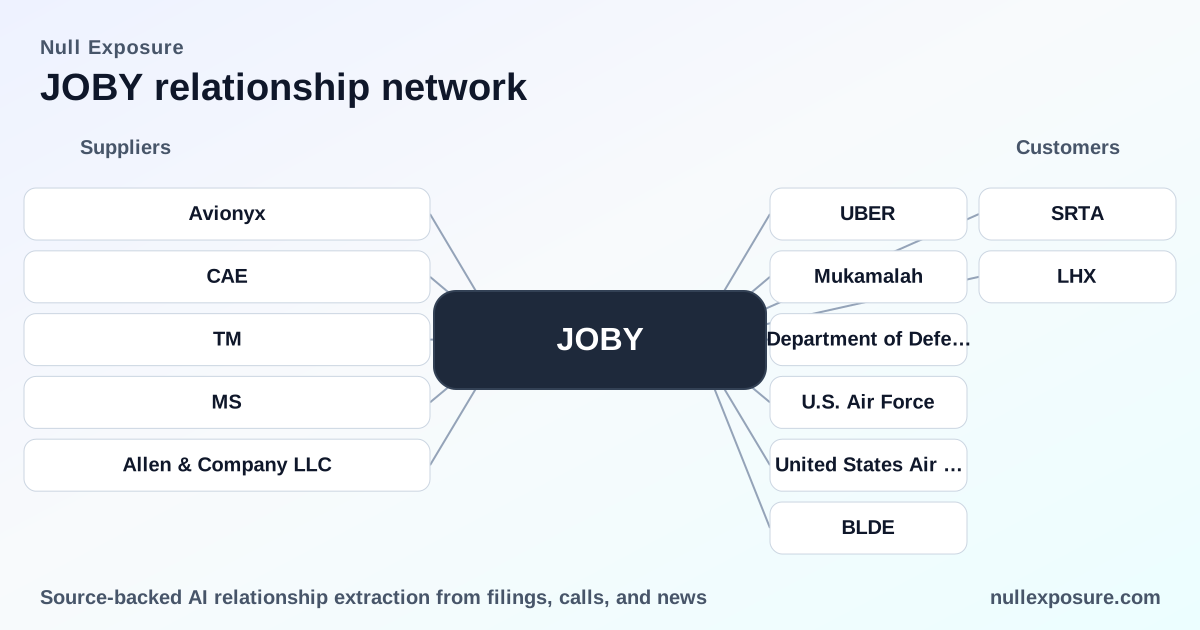
Joby Aviation: customer map and commercial posture for investors
Joby Aviation builds, manufactures and intends to operate all‑electric vertical takeoff and landing (eVTOL) aircraft and monetizes through two channels: flight services and platform partnerships (direct sales or operated services, plus app integrations that drive bookings). The company’s near‑term revenues are service‑led — including government contracts and third‑party operations — while long‑term upside rests on scaling consumer rides via partner platforms and owned operations. For a compact, investor‑grade view of Joby’s counterparties and what each relationship means for revenue, operations and risk, read on. For more corporate relationship intelligence, visit https://nullexposure.com/.
How Joby makes money and what that implies for investors
Joby is building a vertically integrated transportation business: it manufactures aircraft, operates flights and sells booking access through partners. That structure creates a blend of capital intensity (manufacturing and vertiports), operational complexity (fleet operations and software like ElevateOS), and revenue concentration risk while giving high optionality if commercial scale is achieved. The company’s current revenue mix and public commentary show a services-first commercial posture with meaningful government contracting exposure and growing strategic alliances that lower customer acquisition costs.
Key operating signals:
- Government concentration: Joby reports meaningful revenue from DoD/USAF flight services and holds active government contracts, signaling near-term revenue stability but single‑counterparty concentration risk. (Company filings and press coverage, 2024–2026.)
- Services and operator role: Joby recognizes flight services revenue as performance‑based and operates aircraft for customers, reflecting a seller/operator posture rather than pure OEM sales. (Company earnings reports, FY2025–FY2026.)
- Geographic footprint: Fixed assets and early revenue are U.S.‑centric; international rollouts are through partnerships and MOUs. (Company filings, FY2024–FY2026.)
- Stage and maturity: Relationships are active and transactional today while strategic partnerships target scale later; this is an operational transition from R&D to commercial launch. (Company press releases, 2024–2026.)
If you want a deeper dive on counterparty risk and exposure modelling, check https://nullexposure.com/ for structured research and screeners.
Customer and partner map — short, source‑backed summaries
Below are the primary counterparties referenced in public reports and Joby materials; each entry is a concise, source‑linked takeaway.
Blade / Blade Air Mobility (BLDE)
Joby agreed to acquire Blade’s passenger business and become the preferred VTOL partner for Blade’s organ transport operations, integrating Joby’s ElevateOS into Blade to support high‑tempo operations and medical logistics. Source: Joby SEC 8‑K and multiple press reports (Blade acquisition announcement, Aug 2025; industry coverage, 2026).
Strata Critical Medical (SRTA)
Strata — the renamed critical‑medical unit spun from Blade — has a long‑term commercial relationship to use Joby eVTOLs for medical missions, positioning Joby in high‑value, mission‑critical logistics beyond passenger flights. Source: Media coverage and market commentary on the Blade/Strata deal (2025–2026).
Mukamalah (Saudi Aramco subsidiary)
Joby signed a memorandum of understanding with Mukamalah to introduce Joby aircraft into the Kingdom of Saudi Arabia via direct sales, supporting Joby’s international commercialization plan and certification efforts in Australia and the Middle East. Source: Joby corporate news (production and sales update, Q2 2024 filing referenced in 2026 press).
Uber (UBER) — “Uber Air powered by Joby”
Joby and Uber launched Uber Air powered by Joby, enabling customers to book Joby air taxis directly in the Uber app and materially lowering customer acquisition costs ahead of commercial operations, with a visible consumer debut planned in Dubai and other international markets. Source: Joby press releases and coverage of the Uber Air launch (Joby press release; Flying Magazine; March 2026).
Department of Defense (DoD)
Joby currently generates significant service revenue from DoD flight services, delivering customer‑directed flights and on‑base operations under government contracts, which provides near‑term revenue but concentrates exposure to public‑sector demand. Source: Financial coverage summarizing company statements and filings (Benzinga; company filings, FY2024–FY2026).
United States Air Force (USAF) / U.S. Air Force
Under the Agility Prime program, Joby delivered an aircraft to Edwards AFB and is a contracted operator/supplier to the USAF, with the Agility Prime contract noted as worth up to $131 million and marking the first eVTOL delivery to a government customer. Source: Joby investor releases and coverage on Agility Prime (company press release; 2024–2026 reporting).
Delta Air Lines (DAL)
Joby has a strategic alliance with Delta for airport transfers and facility access in major hubs, permitting use of Delta’s New York and Los Angeles facilities in exchange for offering differentiated services to Delta clients. This gives Joby ground‑integration credibility in key U.S. markets. Source: Trading‑platform commentary and Joby press materials referencing partner facility agreements (2026).
Reuben Brothers
Reuben Brothers will integrate Joby’s air taxi service as an amenity at its Park Elm development (Century Plaza), signaling demand from real‑estate partners to embed vertiport/ride offerings in premium residential projects. Source: Joby investor relations press release (May 2026).
L3Harris Technologies (LHX)
Joby has partnered with L3Harris to explore defense applications for its autonomous aircraft platform, widening potential defense use‑cases beyond commercial air mobility and supporting systems integration capabilities. Source: News summaries and market reports referencing the L3Harris collaboration (March 2026).
What these relationships collectively tell investors
- Revenue today is service‑driven and skewed toward government contractors and strategic partners, creating short‑term earnings visibility but concentration risk. Evidence in filings and press shows flight services and DoD/USAF contracts drive meaningful revenue.
- Partnerships (Uber, Delta, real‑estate operators) are tactical channels to scale demand and lower customer acquisition costs; software integration (ElevateOS) increases Joby’s operational leverage when rolling out high‑tempo city services.
- Medical logistics (Strata/Blade) are a deliberate route to higher‑margin, mission‑critical use cases that de‑risk passenger adoption cycles by proving utility in medical transport.
- International expansion uses MOUs and local partners (Mukamalah) rather than organic rollouts, reflecting a capital‑efficient approach to global market entry while certification and operational readiness mature.
Constraints and operational posture — company‑level signals
The public evidence yields firm company‑level signals: government counterparty concentration, U.S. asset concentration, an active seller/operator relationship model, and a services segment focus. These constraints imply Joby must manage:
- contracting and compliance demands from government customers;
- capital allocation between manufacturing, operating fleets and building vertiport partnerships;
- concentrated revenue risk while transitioning to a consumer platform business.
Bottom line for investors
Joby’s counterparty set balances stable, contract revenue from government and B2B medical partners with optionality from rideshare integration and real‑estate vertiport deals. The core investment question is whether Joby can convert partner access and initial service revenue into scalable consumer flights while maintaining operational discipline and avoiding excessive concentration risk. For a structured review of counterparties and exposure, explore our platform at https://nullexposure.com/.
Bold takeaways: services first, partnerships to scale, government revenue concentrated, and international expansion via local partners.