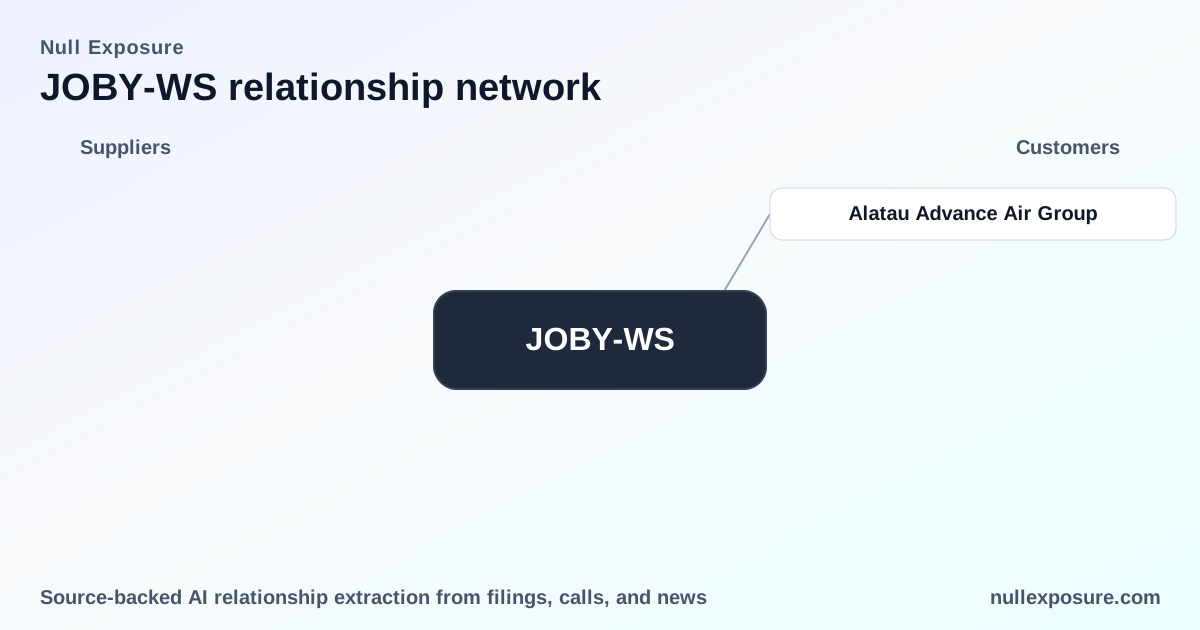
JOBY-WS: Customer signals and the Kazakhstan LOI that moves the needle
Joby Aviation develops and will monetize all-electric vertical takeoff and landing (eVTOL) aircraft through aircraft sales, long-term service contracts, and operational partnerships that enable urban air mobility networks. The company’s commercial model blends hardware sales with recurring service revenue and strategic customer commitments—early letters of intent (LOIs) and partnerships are the primary observable instruments that convert technology and certification progress into commercial value.
For more customer intelligence on emerging commercial aerospace plays, visit https://nullexposure.com/.
What the Alatau Advance Air Group LOI means for Joby’s commercial trajectory
A March 10, 2026 news report on ts2.tech documents that Joby signed a letter of intent to sell aircraft and services worth up to $250 million to Alatau Advance Air Group to underpin future air taxi operations in Kazakhstan. This LOI represents a concrete, regionally targeted commercial promise that links Joby’s product offering—aircraft plus lifecycle services—to an operator intent on launching air taxi services in Central Asia. (Source: ts2.tech, March 10, 2026.)
This transaction, expressed as an LOI, signals a near-term pathway to revenue by packaging aircraft with accompanying services—the commercial construct Joby has emphasized as critical to unlocking unit economics for eVTOL operators.
Why this relationship is strategically significant
- Geographic expansion: The Alatau LOI places Joby in a non-U.S. market where first-mover positioning for eVTOL operations can create structural advantages for landing sites, regulatory relationships, and operator partnerships.
- Commercial packaging: The contract value explicitly includes both aircraft and services, reinforcing Joby’s go-to-market posture of selling integrated aviation solutions rather than standalone airframes.
- Scale potential: At up to $250 million, this single LOI is material relative to the typical early-stage commercial bookings of urban air mobility manufacturers and demonstrates commercial appetite beyond headline markets.
Full list of customer relationships we identified
This section enumerates every customer relationship in the available customer-scope results.
- Alatau Advance Air Group — Joby signed a letter of intent to sell aircraft and services worth up to $250 million to support planned air taxi operations in Kazakhstan. This LOI is a regionally focused commercial commitment that packages hardware and services and indicates Joby’s effort to secure international operator partners. (Source: ts2.tech, reported March 10, 2026.)
Contracting posture, concentration and maturity: what the evidence implies
The observed customer evidence is currently sparse but strategically targeted. Joby’s disclosed customer activity centers on early-stage commercial commitments such as LOIs rather than firm, large-scale production contracts. That pattern yields several operating-model characteristics:
- Contracting posture: The use of LOIs indicates Joby is executing a staged commercial strategy—first secure operator commitments, then convert to firm orders as certification and operational planning progress.
- Concentration risk: With few named customers publicly disclosed, revenue concentration is a present signal; each relationship has outsized importance to near-term bookings and perception of market traction.
- Criticality of relationships: Early operator partnerships are critical not only for revenue but for validation of route economics, operating procedures, and regulatory navigation in new jurisdictions.
- Maturity: The commercial pipeline remains in a formative phase; LOIs demonstrate demand intent but do not yet reflect large-scale serial production or fully converted long-term contracts.
No contract-level constraints were disclosed in the customer-scope data. That absence is itself a company-level signal: publicly available customer agreements do not currently include detailed constraint disclosures such as exclusivity, milestone penalties, or delivery guarantees in this record.
Upside, risk vectors, and what investors should watch
- Upside: Successful conversion of LOIs like the Alatau agreement into firm orders and recurring service revenue would materially increase revenue visibility and validate Joby’s commercial packaging strategy. International operator wins accelerate route network effects and broaden addressable markets.
- Execution risk: Conversion risk is the primary short-term concern—letters of intent do not equal binding revenue, and certification timelines, local regulatory approvals, and infrastructure deployment will determine realization.
- Concentration and partner dependency: With a small set of disclosed customers, adverse developments with a single operator partnership could have outsized impact on near-term commercial momentum.
- Regulatory and operational risk: Entry into novel regulatory environments, such as Kazakhstan, requires successful coordination with local aviation authorities and ground infrastructure development—elements that determine the timeline for revenue recognition.
Practical read for investors and operators
- Monitor LOI conversions and service-contract signings as the clearest signal that Joby is moving from development into repeatable commercial deliveries.
- Track country-level regulatory milestones in Kazakhstan and comparable jurisdictions because local approvals are gating factors for when the Alatau engagement transitions into revenue.
- Assess concentration: Any future disclosures that diversify the customer base will materially reduce single-counterparty exposure and improve revenue visibility.
For continued updates on how customer commitments translate into commercial progress for aerospace innovators, visit https://nullexposure.com/.
Bottom line
The Alatau Advance Air Group LOI is Joby’s most visible customer signal in the public record: a regionally significant, up-to-$250 million commercial package combining aircraft and services that aligns with Joby’s integrated sales model. The current public customer footprint is limited, making each disclosed relationship strategically important; the market-moving event to watch is conversion of LOIs into firm orders and signed service agreements, accompanied by regulatory clearances in the relevant jurisdictions.