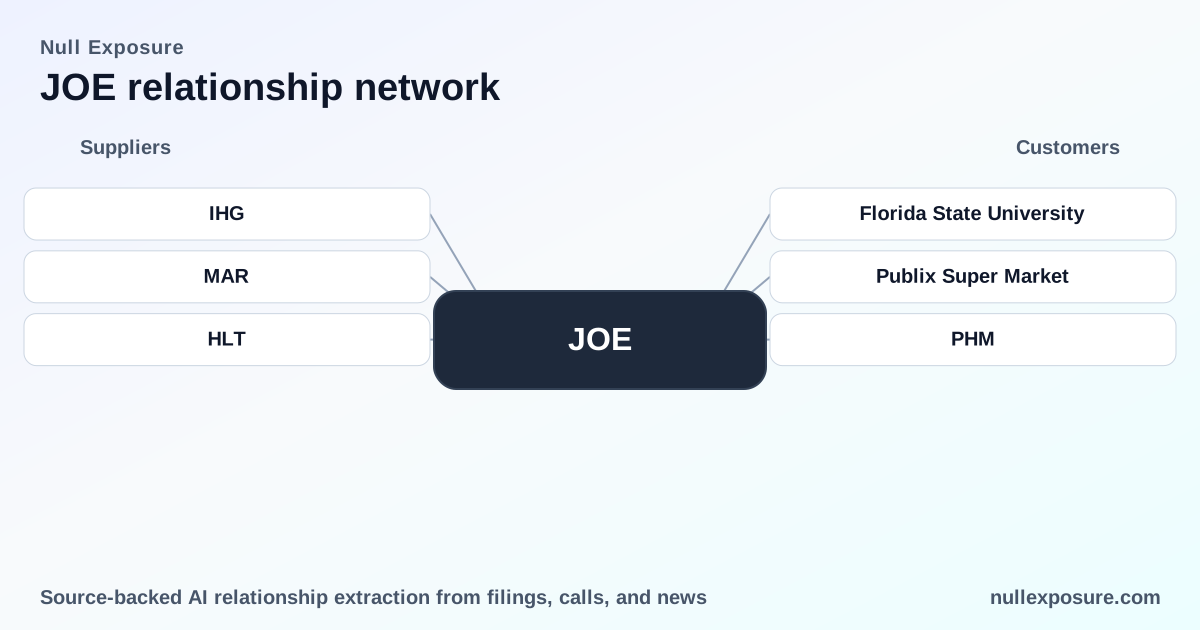
St. Joe Company (JOE) — Customer Map and What It Means for Revenue and Risk
St. Joe is a land‑centric real estate developer that monetizes through phased land sales, homesite sales to national and regional homebuilders, commercial leasing and joint‑venture asset management across Northwest Florida. The company’s cash flow is driven by large, often multi‑year contracts with homebuilders and by monetizing amenity and retail development through leases and JV partnerships—an operating model that concentrates revenue on a small number of large counterparties and on a single geography. For investors evaluating customer relationships, the most important facts are who buys homesites, who anchors retail projects, and which counterparties are payment‑ or contract‑critical to near‑term cash collection. Learn more at https://nullexposure.com/.
How St. Joe’s commercial logic translates to cash
St. Joe develops competing product streams: residential land sold largely to builders, and commercial/retail assets developed and leased (often in JVs) to national operators. The company books revenue when homesites are sold or when land/lease consideration is recognized; it also recognizes installment receivables and partner‑payable arrangements that stretch cash timing. The business monetizes both one‑time land sale proceeds and recurring cashflows from leases and shared JV operations, which creates a mix of lumpy and steady revenue that is highly dependent on buyer appetite in its footprint.
The customer roster every investor should track
Below are every customer relationship identified in the recent coverage of JOE, with a concise plain‑English read and the source cited.
PulteGroup (PHM)
PulteGroup signed a contract for up to 2,653 homesites across two planned gated communities near Watersound West Bay Center, marking a material new builder relationship that expands Joe’s roster of national homebuilders. This development relationship was announced in Q1 2026 and disclosed in earnings remarks and filings (Q1 2026 earnings call and company disclosures reported March–May 2026). (Source: company Q1 2026 disclosures and earnings transcript, March–May 2026)
D.R. Horton (DHI)
D.R. Horton is an existing national homebuilder operating in St. Joe’s markets and is cited as one of the company’s core builder partners alongside Toll Brothers and the new PulteGroup relationship. This is a longstanding builder relationship referenced in St. Joe’s 2026 press coverage. (Source: company press releases and Q1 2026 reporting, May 2026)
Toll Brothers (TOL)
Toll Brothers is identified as another national builder active in JOE’s communities, reinforcing the company’s strategy of placing national builders across its planned phases. The relationship has been noted in St. Joe’s public communications in 2025–2026. (Source: company press release and investor materials, 2025–2026)
Latitude Margaritaville Watersound JV
In December 2025 St. Joe sold an additional 34 acres to the Latitude Margaritaville Watersound joint venture in a transaction structured for contingent payments — roughly $1.2 million contractual value to be paid as homes are sold by the JV. This is a sale‑for‑future‑home closings arrangement documented in the 10‑Q. (Source: Q1 2026 10‑Q filing, disclosed May 2026)
Florida State University
St. Joe donated approximately 16.5 acres to Florida State University to facilitate a new hospital build in Panama City Beach, demonstrating the company’s role in institutional land contributions that can support broader community‑scale development. (Source: The News Herald report, March 31, 2025)
Publix Super Market
St. Joe has begun development of a Publix-anchored retail center at Watersound West Bay Center comprising a ~50,000 sq ft store and adjacent leasable retail—an anchor that materially increases retail foot traffic and lease appeal for the site. (Source: SimplyWallSt coverage of Watersound West Bay Center development, Dec 2025–Mar 2026)
GKN plc
St. Joe built and leased a 137,000 sq ft industrial facility to GKN plc, illustrating the company’s capacity to develop purpose‑built industrial assets and sign long‑term leases with international manufacturers. (Source: StockInvestor coverage referencing the lease, May 2026)
Topgolf
Topgolf is cited as an anchor tenant for the Pier Park East project, reflecting St. Joe’s active pursuit of branded entertainment anchors to drive center traffic and value capture for adjacent retail. (Source: Q4 2025 earnings call transcript, reported in Q1 2026 coverage)
Florida Department of Transportation
A legacy land sale agreement with the Florida Department of Transportation contributes deferred revenue on St. Joe’s balance sheet (noted as ~ $10.9 million), indicating multi‑period cash recognition tied to a governmental counterparty contract originating from 2006. (Source: Q1 2026 10‑Q filing, May 2026)
Panama City Timber Finance Company, LLC
As part of a 2014 real estate sale, St. Joe holds a $200 million fifteen‑year installment note issued by Panama City Timber Finance Company, LLC — a structured receivable that factors into the company’s long‑dated cash conversion profile. (Source: Q1 2026 10‑Q filing, May 2026)
Starbucks
A Starbucks operates inside a Busy Bee convenience concept on St. Joe‑developed property managed through unconsolidated JVs, illustrating how F&B national tenants contribute to commercial mixed‑use revenue without direct consolidation. (Source: Q1 2026 10‑Q filing, May 2026)
TownePlace Suites by Marriott / Residence Inn (Marriott)
Through unconsolidated JVs, St. Joe’s commercial portfolio includes a 124‑room TownePlace Suites and a 121‑room Residence Inn, representing hospitality partners that deliver recurring operating cashflows via JV structures rather than consolidated hotel operations. (Source: Q1 2026 10‑Q filing, May 2026)
Busy Bee (fuel station and convenience)
Busy Bee is part of a commercial footprint operated by JV partners that includes fuel, convenience retail and branded F&B (including Starbucks), highlighting how St. Joe leverages third‑party operators to run small‑format retail assets. (Source: Q1 2026 10‑Q filing, May 2026)
Operating constraints and company‑level signals investors must price
- Geographic concentration: Seller‑financed properties and the bulk of operations are located in Northwest Florida, which concentrates development risk around local demand, weather events and regional infrastructure. Evidence for this geographic posture is in company financing language referencing Northwest Florida seller‑financed properties. (Company signal from public filings)
- Customer concentration / materiality: As of year‑end 2023–2024, one homebuilder customer accounted for roughly 16–17% of the company’s receivables, signaling material counterparty concentration in cash collections and credit exposure. This is a company‑level disclosure in its financial statements. (Company signal from public filings)
- Relationship role — buyer: St. Joe sells homesites primarily to homebuilders (and on a limited basis to retail customers); that contracting posture makes builder credit, pipeline timing and presales cadence central to revenue recognition and short‑term cash flow. (Company signal from operational disclosures)
Investment implications and risks
- Upside: The PulteGroup contract for up to 2,653 homesites and continued relationships with national builders are clear revenue drivers, providing a multi‑year backlog pathway and potential earnings visibility as phases commence in 2027 and beyond.
- Risk: Single‑geography exposure and customer concentration elevate downside if local demand softens or a large builder delays purchases; installment notes and deferred revenue further extend cash‑collection timing.
- Advisory: Monitor builder presales, JV lease commencements and the timing of installment note receipts to assess near‑term liquidity and revenue harvesting.
For an analyst or operator building a model, the crucial next steps are to map builder delivery schedules (PulteGroup, D.R. Horton, Toll Brothers), triangulate JV occupancy/leasing cadence (Publix, Topgolf, GKN, Marriott brands) and stress‑test receivable recoverability tied to the Panama City Timber note and DOT deferred payments.
If you want a consolidated view of JOE’s counterparty exposures and a feed of newly disclosed deals as they post, visit https://nullexposure.com/ for tailored monitoring and alerting.