Johnson Outdoors (JOUT) — customer relationships that drive durable margins in outdoor leisure
Johnson Outdoors designs, manufactures and sells branded outdoor hardware — fishing, diving, camping and watercraft electronics — and monetizes through product sales to a mix of large retailers, distributors and direct consumers. The business is inventory- and channel-driven: product margins come from branded hardware sold at point of sale, with working-capital dynamics governed by short-term trade terms and a concentrated retail footprint. Investors should evaluate customer concentration, retail relationships and geographic mix as primary drivers of near‑term revenue cadence and margin volatility. For a quick corporate reference, Johnson Outdoors reports roughly $625.7M in trailing revenue and a market capitalization near $525M (latest public data).
Interested in a deeper look at counterparty exposures and channel risk? Visit the Null Exposure homepage for more relationship intelligence: https://nullexposure.com/
How Johnson Outdoors actually sells — the operating model in plain terms
Johnson Outdoors operates as a hardware-first manufacturer and reseller partner. The company produces branded seasonal outdoor products and distributes them through a combination of:
- Large outdoor specialty retailers and big-box chains (the majority of retail footprint),
- Distributors and resellers that serve independent marine and sporting-goods dealers, and
- Direct-to-consumer channels via brand websites (Minn Kota, Humminbird, Cannon, SCUBAPRO).
Johnson Outdoors recognizes revenue at the point of delivery and predominantly uses short-term receivable terms. Financials show that sales heavily favor North America but the product portfolio is sold globally. These elements create a predictable inventory-to-cash conversion rhythm but expose operating performance to retail ordering cycles and seasonal demand.
Customer relationships on record: who matters to JOUT
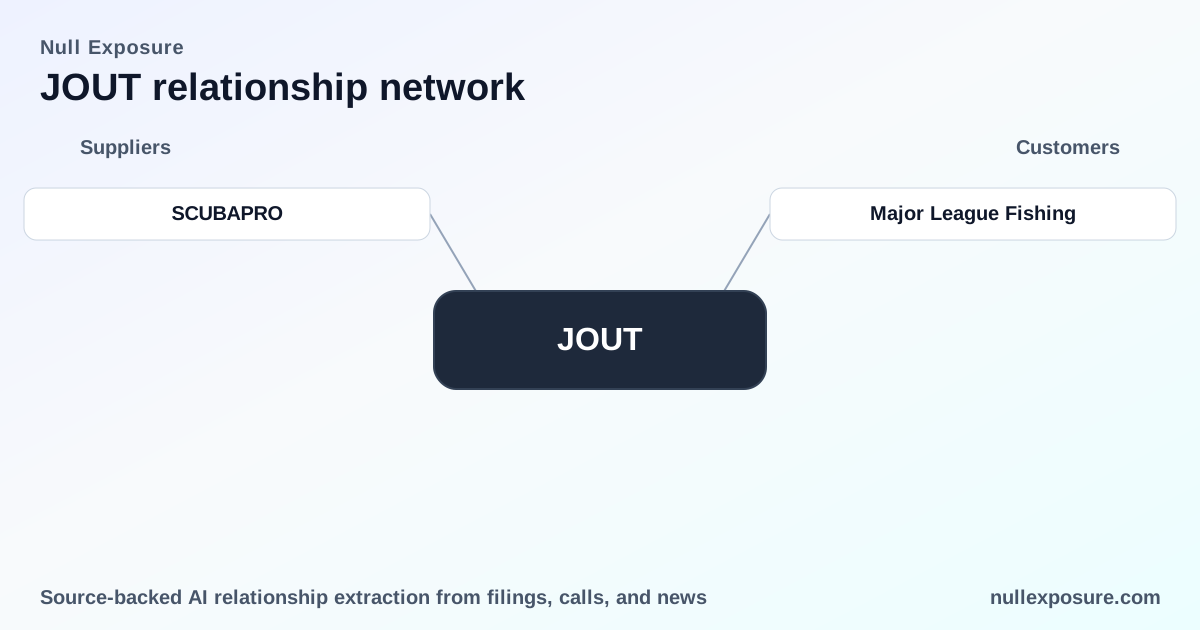
The available relationship data identifies a clear third-party partnership: Major League Fishing. This is the sole named customer relationship in the sample, and it is worth parsing for both marketing value and channel exposure.
Major League Fishing — Johnson Outdoors renewed its sponsorship partnership for the 2025 season, consolidating the company's visibility in competitive angling and aligning brand exposure with core product lines such as Humminbird. According to a Major League Fishing press release dated March 10, 2026, the agreement extends the companies’ sponsorship relationship into the 2025 season and reinforces Johnson Outdoors’ commitment to the competitive-fishing audience (majorleaguefishing.com, March 10, 2026).
What the constraints tell investors about counterparty and contract risk
Several company-level signals drawn from filings and public disclosures illuminate how customer relationships convert into revenue and risk:
- Contracting posture: short-term trade terms. Johnson Outdoors sells on customary short-term credit — generally 30 to 90 days — and does not generally carry long-duration contracts satisfied over time. This implies receivables and working capital dynamics are the central credit risk vector rather than contract performance risk.
- Counterparty mix: both individuals and large enterprises. The company sells direct to consumers through brand websites and sells in volume through large specialty retailers and chains such as Bass Pro Shops and Scheels. That dual channeling reduces single-channel dependence but concentrates revenue into a set of large retail partners.
- Geographic concentration: North America first, global reach second. Net sales disclosures show the United States dominates revenue, supported by sales in Europe and Canada; global distribution exists but North America carries the revenue weight.
- Materiality: customer concentration exists. Filings indicate that combined sales to one customer for the Fishing, Camping and Watercraft segments represented approximately $119,540, $113,509, and $101,392 in consolidated revenues for the years ended October 3, 2025; September 27, 2024; and September 29, 2023 respectively — a signal that one or more large accounts materially influence topline results.
- Role and product type: manufacturer and hardware vendor. Johnson Outdoors is primarily a hardware manufacturer and reseller of seasonal recreational products, with related services provided by specialty dive stores and training centers in the diving segment.
- Revenue recognition and timing: point-in-time transfer. The company records revenue when goods transfer control, consistent with product sales rather than time-based services.
These constraints collectively define a capital-light contract profile (no long-term revenue-recognition over time), concentration sensitivity (material customers), and seasonal channel dependence (retail ordering cycles drive quarterly swings).
What this means for investors and operators
- Channel concentration matters. Material sales to a small number of large retailers accelerate revenue when inventory turns are high, and amplify downside during wholesale destocking. The disclosed single-customer figures require monitoring of major retail partners’ inventory strategies and promotional calendars.
- Working capital is the lever to watch. With 30–90 day trade terms and point-in-time revenue recognition, inventory and receivables are the primary operational levers. Margin expansion is tied to product mix and sell-through at retail, not extended contract pricing.
- Brand activation partnerships have strategic payoff but limited revenue visibility. The Major League Fishing sponsorship enhances Humminbird’s brand exposure to competitive anglers, supporting product demand, but sponsorships are a marketing and positioning tool rather than a guaranteed revenue stream (Major League Fishing press release, March 10, 2026).
- Geographic concentration is a defensive and offensive trade-off. North American dominance provides predictable retail channels but leaves the business exposed to regional retail cost pressures and consumer spending shifts; incremental growth will rely on either deeper penetration in existing channels or faster international expansion.
Practical monitoring checklist for the next 12 months
- Track inventory and days-sales-outstanding versus historical bands; large swings will presage margin pressure.
- Watch ordering patterns and promo activity from major retail partners (Bass Pro Shops, Scheels) during spring and summer seasons.
- Monitor renewal and sponsorship disclosures like the Major League Fishing announcement for shifts in marketing spend that could influence near-term demand.
- Review quarterly revenue breakdowns by geography to detect any acceleration in international sales that could diversify concentration.
If you want ongoing, relationship-level visibility for JOUT and peer names, Null Exposure aggregates customer and partner signals into investor-ready profiles — see the homepage for subscription details: https://nullexposure.com/
Bottom line
Johnson Outdoors is a branded hardware manufacturer whose revenue profile is shaped by short-term trade terms, major retail partners, and channel-driven demand cycles. The Major League Fishing renewal underscores the company's focus on brand alignment within its core angling market, while company-level disclosures highlight concentration and working-capital risks that investors must actively monitor. For investors allocating to seasonal leisure hardware, the interplay between retail buying patterns and inventory management will determine near-term returns more than long-duration contractual protections.