JPMorgan Chase: Customer Relationships that Drive Fees, Credit and Depositary Momentum
JPMorgan Chase (JPM) operates as a universal bank: it earns advisory and underwriting fees from capital markets, collects net interest margin from syndicated and bilateral lending and revolving facilities, and takes recurring fees as depositary, custodian and asset-manager across ETFs and ADR programs. Its customer relationships span M&A advisory, underwriting, lending and depositary services—each relationship translating into fee, interest or float income that supports the bank’s diversified revenue base. For investors, the mix of advisory mandates, syndicate leadership and depositary roles shows how JPM captures both episodic advisory fees and durable balance-sheet earnings. Learn more at https://nullexposure.com/.
Why customers matter to JPM: concentrated strengths, operational posture, and delivery vectors
JPMorgan’s operating model is transaction-driven but balance-sheet enabled. Underwriting and advisory work generate high-margin fees that are highly cyclical and sensitive to capital markets activity; lending and repo/repo-like facilities produce interest income that is sticky and rate-sensitive; depositary and custody roles create low-volatility fee streams and optional float. The firm's counterparty mix includes governments, large corporates and consumer franchises—so concentration risk is limited by breadth, but criticality is high where the firm serves as administrative agent, depositary or sole structuring agent. The constraints in public filings and disclosures show JPMorgan’s exposures across geographies (North America, EMEA, APAC, LATAM) and counterparty types (large enterprise, government, small business), which is consistent with a global, multi-product bank that monetizes client reach and balance-sheet capacity.
- Contracting posture: frequently acts as lead arranger, sole bookrunner or exclusive financial advisor—roles that require underwriting risk or balance-sheet commitment.
- Concentration & criticality: depositary and administrative agent roles create operational dependencies (custody, ADR programs, trust accounts).
- Maturity & durability: lending and depositary engagements are generally multi-year; underwriting/advisory spikes with deal flow.
If you want a tailored exposure analysis or continuous monitoring of JP Morgan’s customer relationships, visit https://nullexposure.com/ for enterprise-grade coverage.
Comprehensive relationship catalogue — plain-English summaries and sources
Below are the customer relationships cited in public reports and filings; each entry is a concise 1–2 sentence summary with the original source noted.
- ALKS — J.P. Morgan provided fully committed financing and acted as exclusive financial advisor to Alkermes in its FY2025 acquisition support; source: PR Newswire (FY2025).
- GTY — Getty Realty executed a forward equity sale (4.0M shares) sold through forward sale agreements with J.P. Morgan and Wells Fargo; source: TradingView / company release (FY2026).
- WTTR — Select/Waterbridge priced a public offering led by J.P. Morgan and BofA with JPMS allocations listed in the prospectus supplement; source: SEC prospectus supplement / StreetInsider (FY2026).
- TPGXL — J.P. Morgan acted as a financial advisor to TPG in the Angelo Gordon transaction; source: MarketsMedia (FY2023).
- PUK — Prudential purchased ordinary shares executed via JP Morgan Securities plc as part of its buyback program; source: Sharecast / company announcement (FY2026).
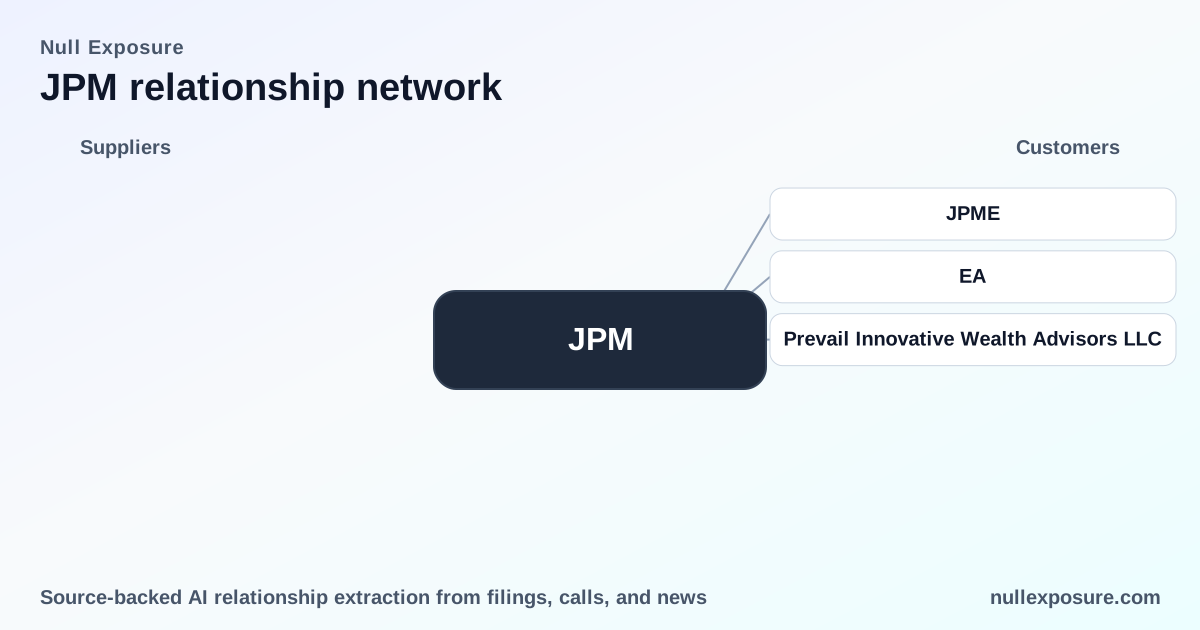
- EA — JPMorgan led syndication and placement of large-scale LBO debt for Electronic Arts, highlighting sensitivity in demand and structure; source: TradingView / Reuters summaries (FY2026).
- NXRT — NexPoint entered a $200 million revolving credit facility with JPMorgan, improving liquidity; source: The Globe and Mail / company press release (FY2025).
- OS (OneStream) — J.P. Morgan served as financial advisor and provided a fairness opinion to OneStream in its sale process; source: Ad-hoc News / PR Newswire (FY2026).
- INLX — Intellinetics secured a $1 million secured credit line with JPMorgan Chase Bank as counterparty; source: TradingView (FY2026).
- RHLD — Resolute Holdings signed a $30 million senior secured revolving credit facility with JPMorgan Chase Bank, N.A., replacing a prior smaller facility; source: company filing / Investing.com (FY2026).
- WBI — Waterbridge Infrastructure’s offering listed J.P. Morgan and Barclays as joint book-running managers and related lock-up and underwriting arrangements; source: SEC filing / StreetInsider (FY2025).
- JPME — The JPMorgan-managed ETF (JPME) has assets managed by J.P. Morgan and generates asset-management fees; source: Bitget / ETF announcements (FY2026).
- AQN — J.P. Morgan served as exclusive financial advisor to Algonquin Power for a sale of its renewable business; source: Newswire (FY2024).
- NOTE — J.P. Morgan acted as financial advisor to FiscalNote in the Duddell Street combination; source: FiscalNote press release (FY2022).
- VNO-P-M — Vornado obtained a $1.2 billion loan originating from JPMorgan refinanced for a San Francisco property; source: Bloomberg coverage cited by Mother Jones (FY2021).
- AS (Amer Sports) — J.P. Morgan acted as administrative agent and co-lead arranger on term loan and revolving facilities; source: prospectus supplement / StockTitan (FY2026).
- CPTK — Proceeds from a registered offering were deposited into a U.S. trust account at J.P. Morgan Chase Bank, N.A., per prospectus; source: SEC filing (FY2021).
- LFT — Lument Finance Trust entered repo facilities and an uncommitted repurchase agreement with JPMorgan providing up to $450 million; source: earnings call and press releases (FY2025).
- APO-P-A — Apollo purchased debt including paper issued by JPMorgan Chase, noted in market coverage of opportunistic trades; source: PE-Insights (FY2024).
- DLO — dLocal’s secondary offering was led by J.P. Morgan, Goldman Sachs and Morgan Stanley as global coordinators; source: StockTitan / company filings (FY2025).
- BLSH (Bullish) — Underwriters led by JPMorgan received an option on additional shares in the Bullish IPO process; source: CNBC reporting (FY2025).
- ARRY — Array Technologies upsized a credit facility with J.P. Morgan among joint lead arrangers; source: Marketscreener / company release (FY2026).
- AAT — UTC office towers were sold by JP Morgan Asset Management as seller/developer in a real estate transaction; source: ConnectCRE (FY2019).
- VINP — Vinci Compass Investments’ IPO listed J.P. Morgan as an underwriter among others; source: MarketBeat alert (FY2026).
- JIDE — J.P. Morgan Asset Management launched the JPMorgan International Dynamic ETF (JIDE) and collects management fees; source: ETFTrends / Yahoo Finance (FY2026).
- COLM — Columbia Sportswear entered a $500 million unsecured revolving credit facility with JPMorgan Chase to support operations and liquidity; source: SahmCapital / company announcement (FY2026).
- BDRX — The ADR ratio change for Biodexa references JP Morgan Chase Bank, N.A. as depositary facilitating ADR exchange; source: SahmCapital / company press release (FY2026).
(Selected catalogue above reflects the public filings and press releases in the provided results; each relationship is documented in the cited company disclosure or news report.)
Operational signals and investor takeaways
- Fee diversification is JPM’s competitive moat. Advisory and underwriting wins (EA, DLO, XENE, many IPOs) deliver high-margin episodic revenue while lending and repo lines (COLM, NXRT, LFT, RHLD) generate durable interest income and sticky balance-sheet utilization.
- Deposit and custody roles are strategic infrastructure. Acting as depositary for ADRs and trust accounts (CPTK, various ADR programs) creates low-volatility fees and operational lock-in.
- Syndicate leadership shows capacity but also risk concentration. When JPM is sole or lead arranger, the firm carries underwriting or commitment exposure that can be sensitive in stressed markets (observed in large LBO debt placements for EA).
For a continuous feed of client relationship signals, exposure snapshots and enterprise watchlists linking flagged mandates to filings, visit https://nullexposure.com/ — or contact our team for a tailored institutional briefing.
Bold conclusion: JPMorgan’s customer footprint is the bank’s core operating engine—it turns advisory mandates into high-margin fees, lending commitments into spread income, and custody/depositary roles into recurring revenue, producing a resilient, multi-vector monetization profile.