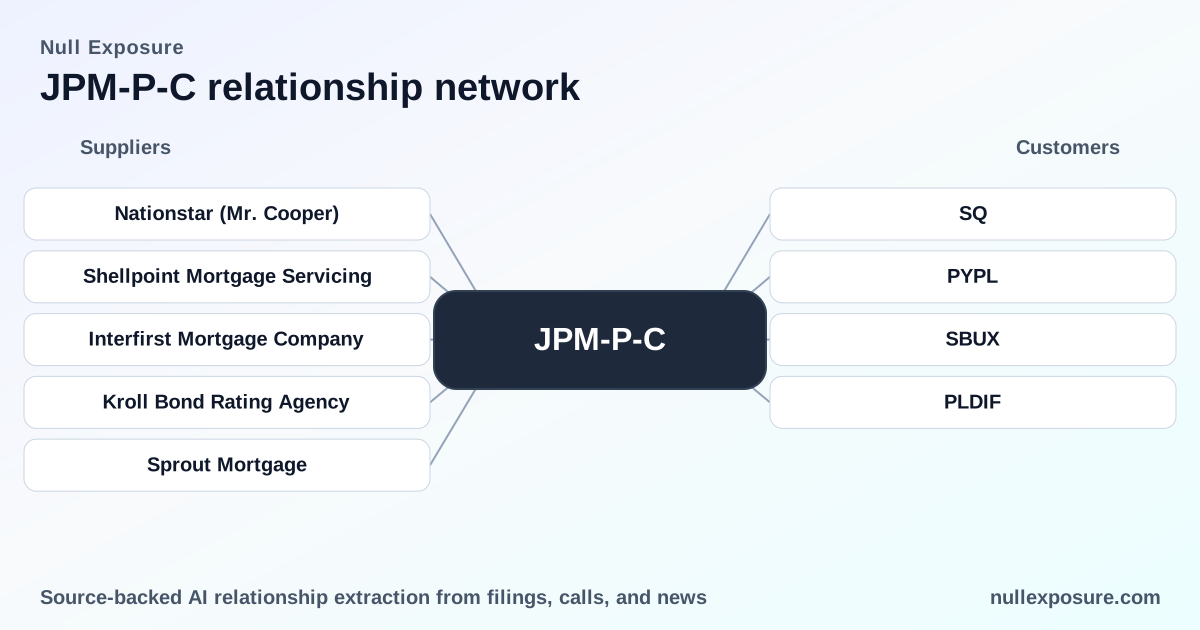
JPM-P-C: What the Bank’s Customer Footprint Tells Preferred-stock Investors
JPMorgan Chase operates as a global universal bank that monetizes through interest spread, transaction and advisory fees, custody and treasury services, and corporate lending; the customer relationships summarized below show the breadth of its payments, custody, and institutional-lending flows that support those revenue lines. For preferred-stock investors in JPM-P-C, the client fabric is a direct lens on funding diversity, fee negotiation dynamics, and counterparty concentration—factors that influence credit stability and dividend coverage.
For a more systematic view of counterparty exposures and relationships, visit https://nullexposure.com/.
How customer relationships translate into economic levers for holders of JPM-P-C
JPMorgan’s customer list is not a roster of retail accounts; it is a mosaic of corporate, fintech, institutional and sovereign counterparts that drive fee income, payment volumes, and secured funding channels. The relationships below illustrate four operating-model signals investors should treat as company-level characteristics:
- Contracting posture: multi-faceted commercial agreements. Large fintechs negotiate bundled deals across cards, processing and treasury, which drives durable fee streams rather than one-off transactional revenue.
- Concentration: broad but strategically concentrated. JPM’s clients span global institutions and high-volume fintech partners — diversification in sectors but concentration among high-value counterparties.
- Criticality: core provider to systemic and corporate clients. Relationships with multilateral institutions and large corporates reflect critical infrastructure status, supporting stable deposit and fee bases.
- Maturity and negotiation power: incumbent advantage. Long-standing integrations with fintechs and corporates create switching costs that protect margins, even as regulators and competitors pressure fees.
If you want ongoing updates and deeper relationship mappings for institutional counterparties, check https://nullexposure.com/ for subscription options.
A compact catalog of every customer relationship surfaced
Below I walk through each reported relationship in the results. Each entry contains a succinct, plain-English statement and the original source referenced in context.
Starbucks — large retail payments partner
Starbucks leverages JPMorgan-linked payment products (QR code initiatives) at scale, with Starbucks stores included in early partner rollouts targeting hundreds of thousands of participants. According to a Darden business-school writeup (FY2016), the product targeted 7,500 Starbucks locations at launch.
PayPal — negotiated multi-faceted commercial arrangements
PayPal has negotiated comprehensive, multi-channel commercial agreements with large banks including JPMorgan, insulating it from marginal fee shocks. A Fortune report (July 16, 2025) described analysts’ view that mature fintechs such as PayPal have pre-existing, multi-faceted agreements with major banks.
Block (Cash App owner) — mature fintech counterpart
Block is treated similarly to other mature payments platforms, with legacy commercial arrangements that limit immediate fee impact. Fortune (July 16, 2025) grouped Block alongside PayPal as having negotiated terms with major banks, including JPMorgan.
Granite Point Mortgage Trust Inc. — repurchase agreement counterparty
Granite Point’s subsidiary amended a master repurchase and securities contract with JPMorgan, showing JPM’s role as a secured funding counterparty to mortgage REITs. Investing.com reported the amendment to the Master Repurchase and Securities Contract Agreement (reported May 2026).
PYPL (duplicate entry for PayPal) — reiterated fintech relationship
The record reiterates PayPal’s negotiated status with large banks, including JPMorgan, across cards and processing. Fortune’s reporting (July 16, 2025) is the source for this duplicate mention.
SBUX (duplicate Starbucks entry) — repeated confirmation of payments linkage
A second entry repeats Starbucks’ inclusion in the payments rollout, reinforcing the retail breadth of JPM-backed payment products. The same Darden piece (FY2016) is the underlying reference.
World Bank — sovereign and multilateral banking client
JPMorgan acts as a banking partner to multilateral institutions, including the World Bank, highlighting institutional custody and settlement functions. Politico’s coverage of executive comments (May 1, 2023) quoted JPMorgan leadership noting the bank’s role in banking large institutions and the World Bank.
GP Commercial JPM LLC — Granite Point’s wholly owned subsidiary in the repo amendment
GP Commercial JPM LLC, Granite Point’s unit, executed the repurchase agreement amendment with JPMorgan, underscoring JPM’s use as a counterparty for structured credit funding. Investing.com (May 2026) covered the subsidiary-level amendment.
Unum — payments and insurance payment flows
Unum uses J.P. Morgan to streamline and secure healthcare insurance payments, evidence of JPM’s role in insurer payment rails and treasury services. JPMorgan’s own insights page (FY2025 commentary) described the collaboration between Unum and J.P. Morgan on payment processing.
Opay — bank-led IPO syndicate participation
Opay tapped JPMorgan among other banks for US IPO advisory or underwriting services, illustrating JPM’s role in cross-border capital markets work for fintechs. MarketScreener reported that Opay engaged Citi, Deutsche and JPMorgan for an upcoming US IPO (May 2025 coverage reflected in FY2025 reporting).
International Monetary Fund — sovereign and supranational banking
JPMorgan banks the IMF as part of its sovereign and multilateral client roster, reinforcing the bank’s global settlement and custody footprint. Politico (May 1, 2023) quoted JPMorgan remarks listing the IMF among institutions the bank serves.
AES — lead financial advisory in a major take-private transaction
J.P. Morgan acted as lead financial advisor on AES’s announced take-private transaction valued over $45 billion, highlighting advisory fee generation in large M&A. JPMorgan’s markets commentary (FY2025) noted the firm’s advisory role on the GIP/EQT-led consortium transaction.
GoodLife — private-credit underwriting and syndication teammate
JPMorgan participated in a private-credit package for GoodLife alongside Ares, demonstrating the bank’s placement and distribution role in private credit. MarketScreener/Bloomberg reported an $800 million private credit arrangement where Ares and JPMorgan were involved (April 30 reporting in FY2025).
PLDIF (Plaid recorded under alternate code) — long-term fintech data access agreement
Plaid executed an agreement in 2018 for secure connectivity to Chase customer information, illustrating early platform-level integrations between fintech aggregators and the bank. Fortune’s reporting (July 16, 2025) recalled Plaid’s 2018 agreement with JPMorgan for secure data access.
Plaid — direct access partnership with Chase
Plaid’s 2018 agreement with Chase established a formal conduit for fintech-to-bank data access, driving third-party payment and fintech integrations. Fortune (July 16, 2025) is the cited source for the historical agreement.
What these relationships mean for JPM‑P‑C investors
Collectively, these relationships show high-value, sticky revenue streams coming from payments integrations (Starbucks, Plaid), fintech settlement and fee arrangements (PayPal, Block, Opay), large institutional and sovereign banking (World Bank, IMF, AES), and secured funding via repo-style contracts (Granite Point). That mix supports predictable fee income and diversified counterparty funding, both favorable for preferred-stock credit resilience.
Risk vectors are visible and concrete:
- Negotiated fintech fees can compress revenue if competitors or regulation force lower pricing, though incumbent agreements provide insulation. (See Fortune, 2025.)
- Secured funding exposures (repo amendments) introduce counterparty and liquidity risk during stress periods. (See Investing.com, May 2026.)
- Concentration among large counterparties means reputational or regulatory shocks to a handful of clients could ripple through revenue.
Bottom line: what to watch next
For holders of JPM‑P‑C, focus on trends in payment-fee negotiation (fintech relationships), repo and secured-funding contract terms, and the bank’s continued role as a custodian for sovereign and multilateral clients. These dynamics drive the stability of fee and funding lines that support preferred dividends.
For ongoing monitoring and granular counterparty maps tailored to institutional investors, visit https://nullexposure.com/ — the platform tracks relationship-level signals that inform credit and operational risk assessments.