JPM‑P‑D: What three customer signals tell investors about J.P. Morgan’s client reach
J.P. Morgan Chase operates as a universal bank and financial markets franchise that monetizes through diversified fee and interest income: commercial and investment banking fees, custody and treasury services, asset management fees, card and merchant services, and trading and securities underwriting. The preferred depositary shares represented by ticker JPM‑P‑D are a capital instrument sitting inside that broader franchise; investor focus should be on how client relationships drive stable fee pools, cross‑sell density, and custody/treasury scale across business lines.
For a concise, structured view of customer relationships and what they imply about franchise durability, see https://nullexposure.com/.
Why client examples matter for preferred‑share holders
Preferred instruments price and trade on perceptions of issuer stability and capital adequacy, which are ultimately shaped by recurring revenue streams and client stickiness. The three customer references pulled from recent J.P. Morgan communications illustrate two consistent themes: enterprise treasury and tax‑credit financing at scale, and an internal market‑making/pricing role within the securities arm. Collectively these relationships underscore a bank that captures payments and capital‑flow economics at both the public‑sector and community‑finance level while also supporting secondary liquidity for structured products.
Customer relationships in plain English
Salt River Project — automated receivables and payables
Salt River Project uses J.P. Morgan to automate receivables and payables, a classic treasury services engagement that embeds the bank into daily cash operations and payment rails. According to a J.P. Morgan insights piece published on jpmorgan.com (reported May 2026), this relationship reflects the bank’s role as a payment processor and treasury partner for large municipal and quasi‑governmental utilities.
Dupaco — tax‑credit equity for community redevelopment
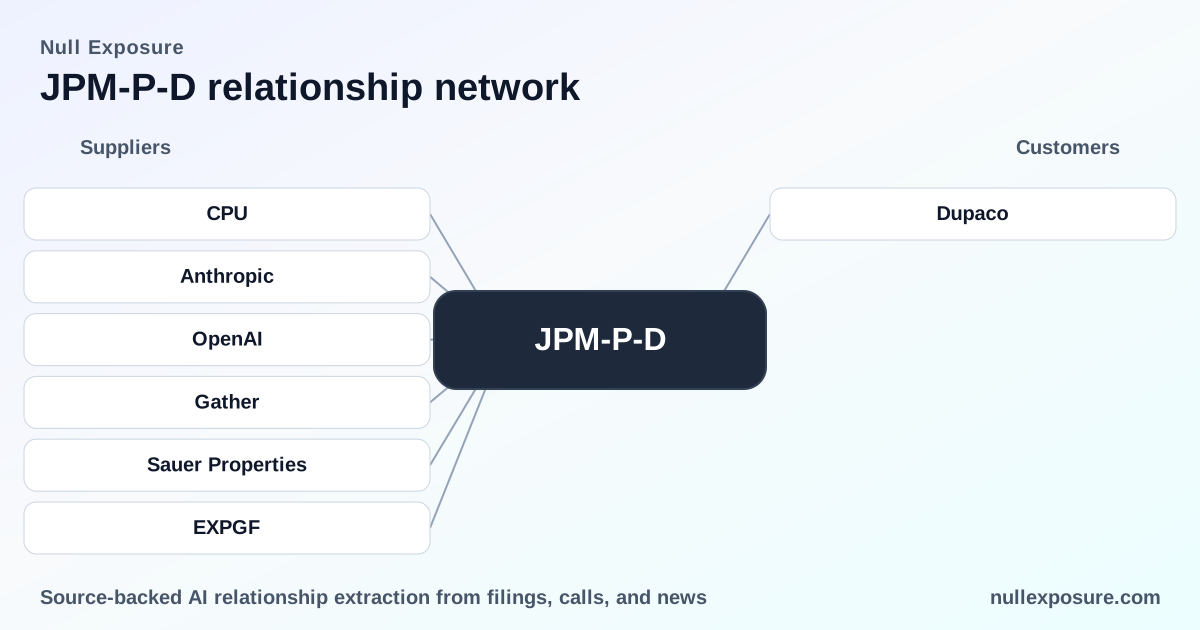
J.P. Morgan deployed Historic and New Markets Tax Credit financing to help Dupaco repurpose a vacant manufacturing facility and catalyze community development in Dubuque, Iowa, demonstrating the bank’s structured‑finance capability in support of community credit unions and regional economic projects. J.P. Morgan’s description of this transaction is detailed in a J.P. Morgan real‑estate insights article dated January 30, 2026 (posted on jpmorgan.com).
J.P. Morgan Securities LLC — internal market‑making and secondary pricing
J.P. Morgan Securities LLC functions as the internal dealer/market‑maker for certain notes and structured products, with secondary pricing dependent on JPMS’s willingness to buy and provide liquidity. This role is documented in a Form 424B2 filing and accompanying press posting in May 2026 (see the StreetInsider posting of the 424B2), which explicitly notes that trading liquidity for the issuer’s notes is linked to JPMS’s purchase behavior.
What these relationships reveal about operating posture and risk
The customer references collectively illuminate the bank’s operating model characteristics:
- Contracting posture: J.P. Morgan captures multi‑year, service‑level treasury relationships (Salt River Project) and structured tax‑credit investments (Dupaco) that are negotiated and executed at enterprise level, indicating an emphasis on bespoke commercial contracting rather than transactional retail deals.
- Concentration: The examples span public utilities, community finance, and internal securities operations, signaling low client concentration risk in these samples — revenue is earned across diverse counterparty types and sectors.
- Criticality: Treasury services and payment automation are mission‑critical to large clients; when a utility outsources receivables/payables, the bank becomes a systemically important provider for that client’s cash operations. That criticality supports stable, fee‑based revenue.
- Maturity and stickiness: Tax‑credit financing and institutional treasury implementations are long‑dated engagements that embed J.P. Morgan into client workflows, increasing cross‑sell potential and retention.
- Internal liquidity function: The bank’s securities arm acting as buyer/market‑maker (JPMS) means J.P. Morgan internalizes part of the note market‑making function, which both supports secondary liquidity and concentrates execution risk within the trading desk.
No explicit operational constraints were flagged in the review of these customer relationships, which at the company level signals that publicly disclosed customer interactions in this sample are operationally standard and contractually normal for a bulge‑bracket bank.
Investment implications — what investors should price in
- Fee stability and cross‑sell upside: Treasury automation and tax‑credit financing are fee‑accretive and persist over multiple years, supporting preferred‑class investors who prize predictable income streams.
- Liquidity support from the securities arm: JPMS’s market‑making role improves issuance economics for the parent but introduces trading‑desk concentration for secondary liquidity; investors should monitor disclosures around trading positions and liquidity provisioning.
- Reputational and operational leverage: Large public‑sector clients and community projects strengthen J.P. Morgan’s position as a platform provider across client segments, reinforcing the bank’s competitive moat in payments and treasury services.
Short checklist for active evaluation
- Review ongoing filings and disclosures for changes in JPMS market‑making commitments (Form 424B2/8‑K notices).
- Monitor J.P. Morgan’s insights and client case studies for expansion of treasury services in regulated utilities and municipal clients.
- Track structured‑finance pipelines (historic/new markets tax credits) as a barometer for community and regional investment activity.
Final read and action
The three relationships examined are small in number but strategically illustrative: J.P. Morgan is simultaneously a payments platform, structured‑finance originator, and internal liquidity provider — a combination that underwrites persistent fee income and franchise resilience. For a structured presentation of client relationships and how they drive issuer economics, visit https://nullexposure.com/.
Key takeaway: J.P. Morgan converts client cash flows and capital needs into durable fee pools and internalized liquidity functions; preferred shareholders should value that predictable cash‑flow capture while monitoring trading‑desk exposure disclosed in securities filings.