JPM-P-J: Strategic customer finance signals from JP Morgan’s corporate lending playbook
JPM-P-J represents preferred equity of JPMorgan Chase & Co., a universal bank that monetizes through diversified financial intermediation: net interest income from lending and market-making, fee income from investment banking, asset and wealth management, and treasury and custody services. For investors and operators evaluating JPM’s customer relationships, the bank’s recent headlines reinforce an active direct-financing posture into industrial supply chains, driven by strategic, fee-generating mandates and credit deployments. For a concise view of additional relationship signals and analytical services, visit https://nullexposure.com/.
A single customer story with two labels: what the sources show
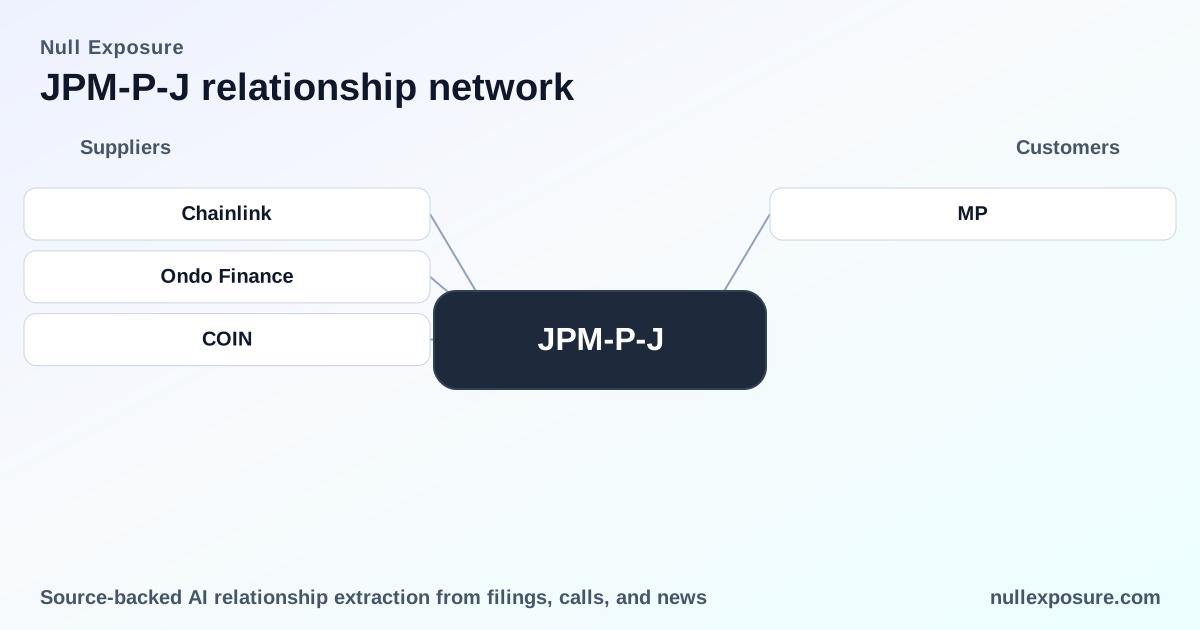
The public relationship hits in the customer scope show a focused transaction: JPMorgan is financing MP/MP Materials for capacity expansion in a nationally critical manufacturing segment. Below are the individual relationship entries captured and how they read for a credit- and operations-oriented audience.
MP
JPMorgan is providing financing that will support MP Materials’ second U.S. magnet-producing factory, a targeted capital deployment into domestic critical minerals manufacturing. A Breitbart report on March 10, 2026 described the bank’s financing commitment as part of a broader initiative to invest in U.S. companies with national-security ties.
Source: Breitbart, March 10, 2026.
MP Materials
The same financing relationship is documented under the full corporate name, MP Materials; JPMorgan’s financing is explicitly linked to the company’s second magnet plant in the United States, indicating a structured capital facility aimed at industrial scale-up. The reporting frames this as part of an up-to-$10 billion investment posture into companies tied to national security.
Source: Breitbart, March 10, 2026.
Why this relationship matters to investors: strategic finance, fee capture, and optionality
This financing illustrates several clear business-model drivers for JPMorgan:
- Direct credit and structured finance: JPM is deploying capital into industrial infrastructure, which generates interest income, commitment/arrangement fees, and cross-sell opportunities (cash management, FX, hedging).
- Strategic underwriting and advisory fees: Projects with government and national-security relevance attract advisory mandates, bond or equity underwriting, and syndication roles that bolster non‑interest fee income.
- Franchise and reputational capital: Active participation in critical-supply chain financing enhances JPM’s standing with sovereign and institutional counterparties, creating future mandate pipelines.
From an investor perspective, these deals are revenue-accretive and strategically defensive — they support fee diversification while embedding JPM deeper into supply chains where scale and balance-sheet capability provide a competitive edge.
Contracting posture, concentration, criticality, and maturity—how JPM operates here
JPMorgan’s approach to such relationships demonstrates a consistent operating model:
- Contracting posture: proactive and institution-scale — the bank structures bespoke financing facilities (term loans, project finance, or credit lines) rather than transactional, one-off exposures, enabling long-dated yield capture and syndicated distribution.
- Concentration: portfolio-level diversification with targeted concentrations — the firm’s overall book is highly diversified across sectors, but individual strategic investments (like MP Materials) create concentrated exposures that are balanced by syndication and risk distribution.
- Criticality: high strategic importance — financing domestic magnet production ties JPM to national-security critical infrastructure, increasing the political and regulatory sensitivity of the exposure and elevating the potential for government-facilitated risk sharing or guarantees.
- Maturity: institutional and long-term — these customer relationships are structured to support multi-year capex and operational ramps, aligning with JPM’s capacity to hold or distribute long-duration credit risk.
These characteristics are not unique to this single counterparty but reflect company-level posture: JPM leverages its balance sheet and advisory capabilities to originate and distribute strategic corporate finance opportunities.
Constraints and company-level signals
No contractual or operational constraints were present in the available customer-scope data for JPM-P-J. This absence should be read as a company-level signal: the public relationship capture does not show flagged restrictions, special covenants disclosed at the relationship level, or data-driven constraints in this collection. For investors, that means:
- There are no recorded public limits on JPM’s ability to deploy capital in this context within the dataset.
- Expect standard banking covenants and regulatory oversight typical for project and corporate finance transactions, even if they are not captured here.
- The lack of constraint flags does not eliminate execution or regulatory risk, particularly given the national-security framing of the counterparty’s industry.
Risk profile and operational considerations for stakeholders
Operators and credit analysts should weigh the following practical risks and mitigants:
- Regulatory and geopolitical exposure: Financing national-security-linked industries invites heightened oversight and potential political volatility; however, government support mechanisms can reduce downside for lenders.
- Concentration execution risk: Large-capex projects in nascent domestic manufacturing carry construction and offtake risk; JPM will likely mitigate via syndication, escrow controls, and completion guarantees.
- Reputational and compliance costs: High-profile strategic financing increases scrutiny on AML/KYC, export-control compliance, and ESG disclosures—areas where JP Morgan has scale to absorb incremental costs but which can compress margins.
- Cross-sell upside: Successful project delivery unlocks cross-sell across custody, treasury services, derivatives hedging, and asset management for investors and operators to monitor as revenue levers.
Key takeaways for investment and operational strategy
- JPMorgan is using its balance sheet to secure strategic industrial relationships that generate both interest income and high-margin advisory fees.
- The MP/MP Materials financing is emblematic of a broader strategy: targeted, policy-aligned investments that deepen client engagement and create syndication opportunities.
- No public constraints were captured in this data set, which should be interpreted as an absence of flagged contractual restrictions rather than a lack of regulatory exposure.
- Risk is political and executional, not primarily a deposit or liquidity concern for JPM given its market position; however, individual project fundamentals will determine credit outcomes.
For an organized, continuously updated view of JPM’s counterparty relationships and exposure mapping, consider reviewing extended analysis and tooling at https://nullexposure.com/.
JPM-P-J’s preferred position reflects ownership in a bank that executes large-scale, strategically important financing while harvesting diversified fee streams and interest margins; monitoring how these customer relationships evolve will be essential for forecasting franchise earnings and risk-adjusted returns.