JPM-P-K (JPMorgan Chase & Co.): Customer Relationships and What They Reveal for Investors
JPMorgan Chase is a universal bank that generates recurring revenue from interest margin, transaction fees, underwriting and advisory fees, custody and treasury services, and asset-management fees across a diversified global client base. For investors evaluating JPM-P-K customer relationships, the most relevant signal is how corporate and institutional engagements translate into stable fee income and high-frequency treasury flows rather than one-off transactional gains. For a concise view of relationship-level intelligence and enterprise exposure, see https://nullexposure.com/.
Why customer-level signals matter for a bank of this scale
JPMorgan operates a multi-line financial franchise where client stickiness, treasury product penetration, and advisory mandates drive the quality of revenue. Large corporate relationships rarely move the needle on consolidated earnings by themselves; instead, they function as durable revenue anchors—deposit balances, payment volume, custody mandates, and periodic underwriting/advisory assignments produce predictable margins and cross-sell opportunities. The bank’s preferred stock (JPM‑P‑K) is supported by the broader balance-sheet strength that these customer flows underpin.
Operating posture, concentration and maturity — company-level signals
No external constraint excerpts were provided for this analysis, so the following are company-level operating signals derived from JPMorgan’s business model and the relationships observed:
- Contracting posture: relationship-driven and long-term. Treasury services and custody contracts are negotiated with a view to multi-year operational integration and lock-in, which supports recurring fee streams.
- Concentration: broadly diversified across sectors and geographies. Single-client revenue concentration is low relative to total revenue; JPMorgan’s scale reduces single-relationship earnings volatility.
- Criticality: transactional and strategic. For corporate clients, JPMorgan provides critical day-to-day payment, liquidity, and risk-management infrastructure as well as episodic strategic services (capital markets, M&A).
- Maturity: established and institutional. Many corporate engagements are longstanding and upgrade over time from core banking to complex capital markets products, increasing lifetime value.
These signals indicate a stable contracting profile with high client lock-in for treasury and custody services, and episodic upside from capital markets mandates—a profile favorable for preferred-security holders who value predictable income support from a healthy asset-liability engine.
Customer relationships we tracked and what they imply
Below are the discrete customer relationships surfaced in public reporting. Each relationship is summarized plainly and paired with its source.
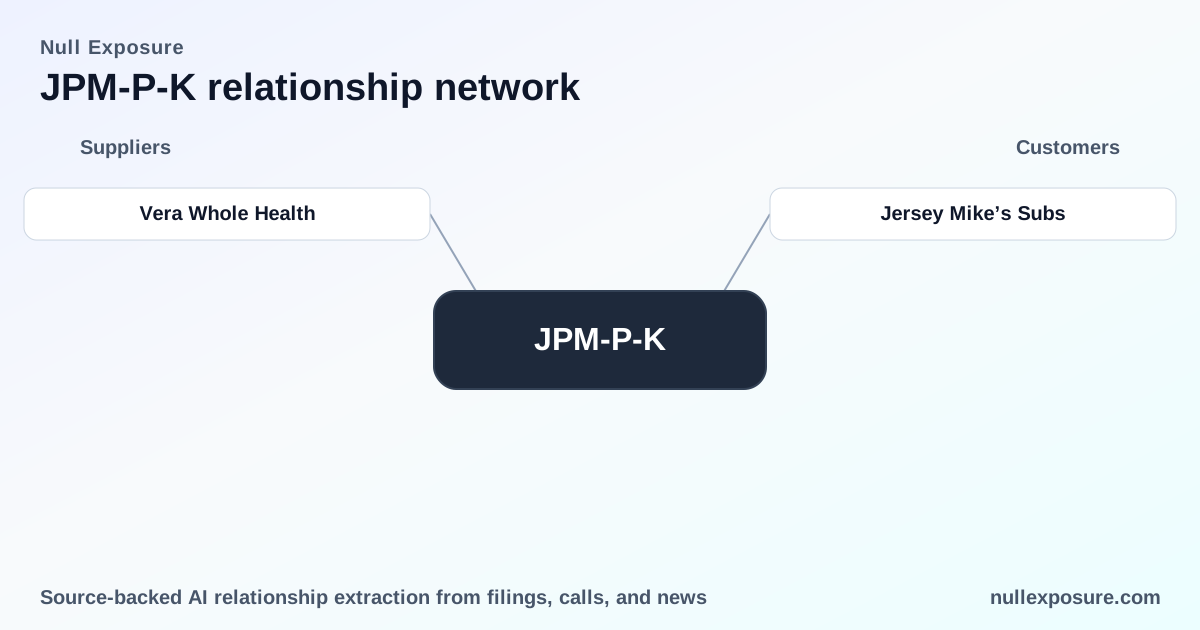
Jersey Mike’s Subs — advisory mandate for potential IPO
Jersey Mike’s tapped JPMorgan Chase and Morgan Stanley to work on a potential public listing, positioning JPMorgan as a lead advisor in a consumer-restaurant equity transaction that would generate advisory and underwriting fees if executed. According to Bloomberg reporting summarized by Yahoo Finance on January 29, 2026, the engagement put JPMorgan in a competitive role on a near-term capital markets mandate. (Source: Yahoo Finance summarizing Bloomberg, Jan 29, 2026.)
Takeaway: This is a classic capital-markets advisory assignment that produces episodic fee income and enhances the bank’s deal pipeline exposure in consumer retail.
Salt River Project — treasury automation and payables/receivables
Salt River Project uses J.P. Morgan technology to automate receivables and payables, reflecting an operational treasury and payments relationship that drives recurring fee and deposit flows. J.P. Morgan’s corporate insights on trade and working capital (noted in the firm’s treasury content in 2026 referencing FY2025 activity) describes the implementation as an automation of receivables and payables with J.P. Morgan. (Source: J.P. Morgan insights on treasury and trade working capital, 2026.)
Takeaway: This is a high-utility treasury engagement that locks in transactional revenue and increases balance-sheet utility through payment processing and potential deposit balances.
(For a broader set of customer-level intelligence and workflow, visit https://nullexposure.com/.)
What these relationships tell investors about near-term revenue drivers
The two relationships represent the two revenue axes that define JPMorgan’s corporate franchise:
- Capital markets and advisory (Jersey Mike’s): delivers high-margin, episodic fees that spike around IPOs and M&A; useful for monitoring deal flow and underwriting pipeline health.
- Treasury, payments and custody (Salt River Project): delivers consistent, lower-margin but recurring revenue tied to transaction volumes and deposit balances; critical for deposit base stability and liquidity.
Collectively, these engagements illustrate JPMorgan’s hybrid revenue model: stability from payments/treasury and upside from capital-markets mandates. For preferred-stock investors, the stable treasury flows are the more relevant underpinning of balance-sheet strength.
Risk and concentration considerations for portfolio managers
Investor evaluation should focus on several practical risk dimensions tied to customer relationships:
- Revenue volatility: Advisory fees (IPO work) are lumpy; a string of successful mandates lifts near-term earnings, while a slow issuance market suppresses fees.
- Operational concentration: Large-scale treasury integrations create operational dependency; failures or service disruptions can be reputationally and contractually consequential.
- Regulatory and credit exposure: As a universal bank, JPMorgan faces regulatory scrutiny across business lines; customer composition influences deposit stability and credit risk absorption.
- Competition for mandates: Tier-1 peers compete aggressively for high-profile mandates, which influences fee leverage and market share in capital markets.
All are manageable within JPMorgan’s diversified franchise, but they remain the vectors that influence earnings variability and long-term franchise value.
Actionable investor signals
- Monitor deal pipelines and capital markets calendars to anticipate advisory fee inflection points from mandates like Jersey Mike’s.
- Track transaction volumes and deposit trends in the treasury and payments business to gauge the durability of recurring revenue, as illustrated by Salt River Project’s automation engagement.
- Assess operational integration wins—each treasury automation deal increases stickiness and cross-sell capacity across liquidity and corporate banking products.
Final assessment
JPMorgan’s customer footprint captures both the stability of transaction-driven treasury relationships and the upside of advisory and underwriting mandates. Customer-level engagements like Salt River Project and Jersey Mike’s are emblematic of JPMorgan’s revenue mix: steady fee-bearing transactional relationships plus episodic capital markets opportunities. For conservative income investors focused on preferred securities, the treasury-derived cashflows are the most durable support for balance-sheet health; for equity-like return seekers, the cadence of advisory deals matters more.
For ongoing relationship-level monitoring and to explore how these signals map to counterparty exposure and revenue sensitivity, visit https://nullexposure.com/.