JPM-P-L Customer Relationships: What Avis Budget Group Integration Signals for Investors
Thesis: J.P. Morgan operates as a universal bank and payments platform, monetizing through a mix of interest income, transaction and custody fees, and embedded finance partnerships that convert treasury and payments capabilities into recurring fee streams. Partnerships that automate enterprise payments consolidate fee-bearing treasury flows and reduce churn, directly supporting the preferred equity stability underpinning JPM-P-L.
A concise deal snapshot investors care about
J.P. Morgan announced an integrated banking solution with Oracle that automated Avis Budget Group’s payment processes, eliminating manual work and reducing operational costs. That automation converts previously fragmented payables and receivables into centrally managed, fee-bearing flows for the bank and tightens the client’s operational dependence on J.P. Morgan’s payments and treasury stack. According to a J.P. Morgan insight published March 10, 2026, the solution with Oracle helped Avis Budget Group modernize and streamline payments processes (J.P. Morgan, March 2026).
Every relationship found in the search results
Avis Budget Group — Avis Budget Group worked with J.P. Morgan and Oracle to automate payment processes, cutting manual processing and lowering operational costs while centralizing treasury functions with the bank. According to a J.P. Morgan insight published March 10, 2026, the integrated banking solution directly targeted payables automation and operational efficiency gains (J.P. Morgan, March 2026).
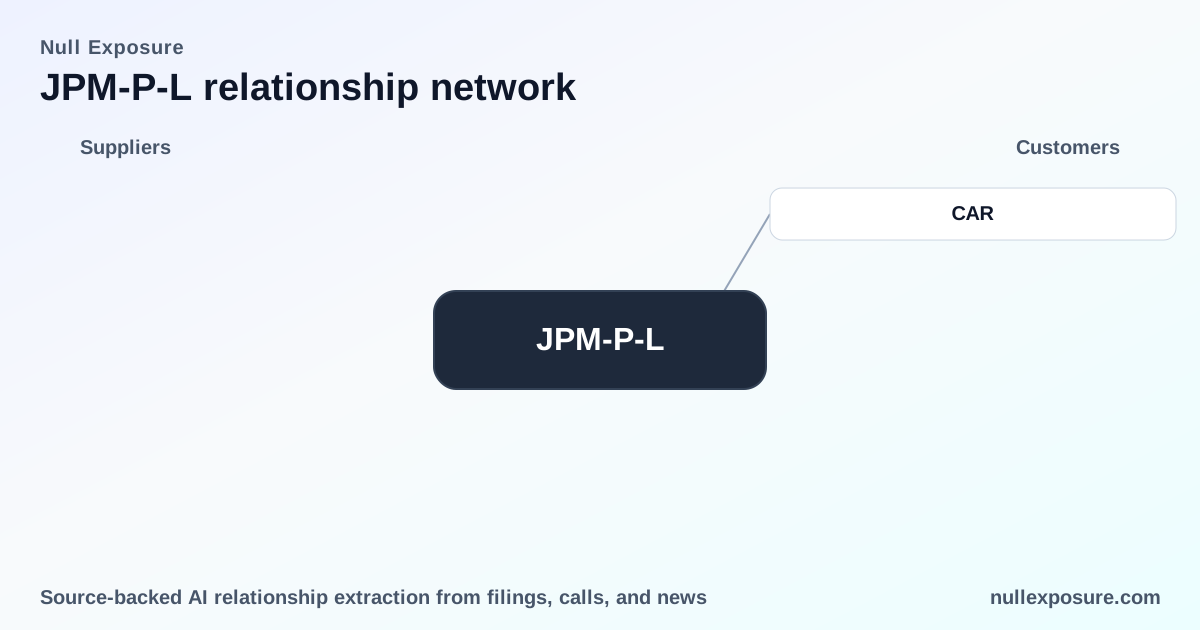
CAR — CAR is the trading symbol for Avis Budget Group; the same J.P. Morgan–Oracle integration that automated payments for Avis Budget Group is documented under the CAR identifier in the firm’s reporting. J.P. Morgan’s client-facing write-up dated March 10, 2026 references this implementation and the operational benefits realized (J.P. Morgan, March 2026).
Why this relationship matters for JPM-P-L holders
- Revenue stickiness: Automating a large corporate client’s payment flows creates predictable, recurring fee opportunities in payments, cash management, and treasury services—categories that support stable income for the bank’s capital structure, including preferred stock.
- Cross-sell and scale: Embedded finance arrangements with Oracle increase JPMorgan’s addressable market inside large ERP ecosystems; each successful enterprise integration is a commercial reference that accelerates follow-on business.
- Operational lock-in: Centralizing a client’s treasury operations reduces churn risk because switching costs are high for payments and cash management customers once systems and reconciliations are integrated.
These dynamics are fundamental to how J.P. Morgan turns enterprise payments relationships into durable balance-sheet economics that support preferred instruments like JPM-P-L. If you want a concise source of relationship intelligence, visit https://nullexposure.com/ for structured coverage and deal context.
How to think about contracting posture, concentration, criticality, and maturity
J.P. Morgan’s client engagements for payments and embedded finance exhibit enterprise contracting posture: they are negotiated at scale, often multi-year, and include SLAs and operational transition plans. The bank’s customer base is broad and diversified, which reduces single-client concentration risk at the firm level, even while individual large-enterprise contracts—like Avis Budget Group’s—are materially important for revenue in a given business line.
The services sold are highly critical to client operations because treasury and payments touch daily liquidity and vendor relationships; that criticality drives high retention once integration completes. From a maturity standpoint, these offerings are established lines for J.P. Morgan—payments, treasury, and custodial services are core competencies for the firm, not experimental products—which supports predictable cash generation and lowers execution risk relative to early-stage fintech partnerships.
Operational and counterparty risks that matter to investors
- Integration and execution risk: Large ERP and treasury integrations often have complex cutover windows; failed or delayed rollouts can compress near-term fee realization and create onboarding expense overruns.
- Competition and fee pressure: Global banks and specialist fintechs both compete for embedded finance mandates; sustained fee compression in payments is a persistent industry force.
- Regulatory oversight: Payments and treasury services are subject to evolving regulatory regimes across jurisdictions, which can impose compliance costs and operational constraints on cross-border flows.
Key risk monitoring metrics for holders of JPM-P-L are contract lengths and renewal cadence, realized fees from implemented integrations, and any public disclosures about onboarding challenges or regulatory findings related to payments operations.
What operators should watch in future partnership announcements
Operators assessing commercial exposure or counterparty value should prioritize three items in announced deals:
- Contractual tenure and termination rights: long-term contracts with limited termination windows increase revenue predictability.
- Scope of services and exclusivity: broader scopes and embedded exclusivity inside ERPs create higher switching costs.
- Measured operational KPIs: adoption rates, transaction volumes after go-live, and realized cost savings for the client indicate the quality of the revenue stream.
If you evaluate treasury relationships for portfolio companies, these dimensions define whether a bank partnership is strategic (sticky) or tactical (replaceable).
Bottom line: what this means for JPM-P-L investors
The J.P. Morgan–Oracle–Avis Budget Group implementation is a clear example of how enterprise payments automation converts operational dependence into recurring fee streams and cross-sell opportunities. For preferred shareholders, that translates into incremental stability for the bank’s non-credit income, supporting the predictable distributions characteristic of preferred instruments.
For deeper relationship mapping and ongoing tracking of customer integrations that influence capital stability, explore our coverage at https://nullexposure.com/ — it’s tailored for investors and operators who need actionable counterparty intelligence.
Bold takeaway: Enterprise payments integrations are a durable, fee-bearing channel for J.P. Morgan that directly supports income stability for preferred holders like JPM-P-L.