JPM-P-M: What the bank’s customer ties say about franchise strength and risk
JPMorgan Chase operates as a universal bank and market franchises operator: it underwrites and distributes capital markets products, provides custody and treasury services, manages assets and private wealth, and lends into corporate and project finance. The company monetizes through net interest income, fee-based services (investment banking, markets, asset management), and transactional banking — a diversified set of revenue streams that supports preferred-holders’ claims on the company’s earnings profile. For investors evaluating JPM-P-M, customer relationships are a direct window into underwriting depth, regional expansion, and the bank’s role as syndicate leader and arranger. If you want a fuller map of strategic client ties, visit https://nullexposure.com/ for more relationship intelligence.
How these customer interactions reveal JPMorgan’s commercial posture
JPMorgan’s entries in the sampled coverage show a consistent pattern: the bank leads syndicates and revises deal economics when investor sentiment shifts; it also serves as a cross-border distribution partner for emerging market issuers and co-finances development-focused credit in frontier markets. Collectively, these interactions signal a contracting posture that is proactive and market-facing — JPMorgan sets terms, manages investor pushback, and leverages global capabilities to win and execute mandates.
- Concentration: The relationships cited are dispersed across sectors and regions (industrial borrower, Nigerian banking, African development finance), indicating low short-sample concentration and reinforcing JPMorgan’s broad corporate client footprint.
- Criticality: For clients, JPMorgan is often critical as lead underwriter or co-lender; for investors, that role translates to fee capture and market franchise protection.
- Maturity: Historical ties (for example, Depositary Receipts issued in 2007 and co-financing from 2014) point to long-duration client relationships rather than transactional one-offs.
Detailed relationship snapshots investors should note
Sealed Air Corp. (SEE)
JPMorgan served as lead in a group of banks that revised the terms of a $7.2 billion debt offering after investor pushback, demonstrating active syndicate management and willingness to reprice or reshape large corporate financings to secure placement. According to an Investing.com SEC-filings report in May 2026, JPMorgan led the adjustment process on the Sealed Air deal.
GTCO / Guaranty Trust Bank (GTCO)
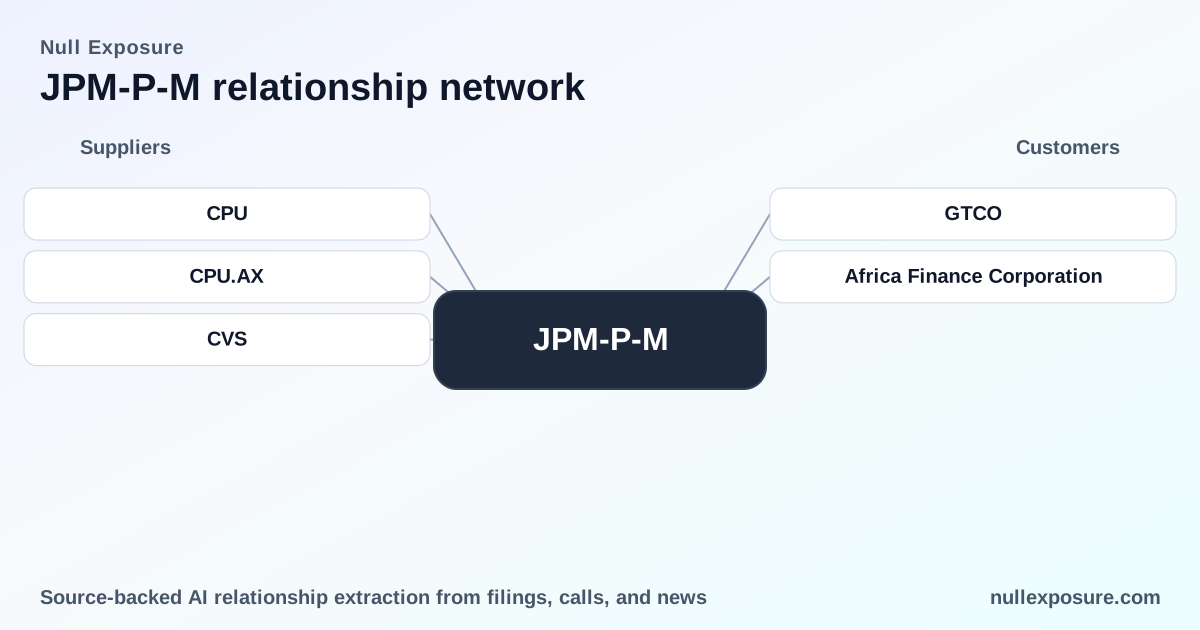
JPMorgan has acted as a distribution partner for Nigerian issuers: it issued Depositary Receipts for Guaranty Trust Bank in 2007, establishing a longstanding securities-distribution relationship that underscores JPMorgan’s role in connecting African issuers with global capital. A Finance in Africa article (March 2026) recounts JPMorgan’s earlier issuance of Depositary Receipts for Guaranty Trust Bank dating back to 2007.
Africa Finance Corporation
JPMorgan has engaged in development and project finance activity in Africa: it co‑financed a $100 million loan to the Africa Finance Corporation by 2014, alongside the U.S. Overseas Private Investment Corporation, evidencing its participation in multi-lateral, development-style credit facilities. The Finance in Africa piece (March 2026) references this co-financing activity as part of JPMorgan’s regional footprint.
What the relationships collectively imply for JPM-P-M holders
- Franchise durability: Leading and reshaping a $7.2 billion corporate debt deal shows JPMorgan’s market-making capacity — a positive sign for the stability of fee income that supports equity and preferred claims.
- Global reach with emerging-market execution: The bank’s role in DR issuance for a Nigerian bank and in project finance for African institutions confirms a dual strategy of cross-border distribution and local financing capabilities.
- Operating leverage: Syndicate leadership and cross-product execution (capital markets + lending + treasury) extract higher per-client economics than pure transactional relationships, supporting the bank’s margin profile on a normalized basis.
Constraints and operating-model signals (company-level)
There are no explicit constraint excerpts reported in the sampled coverage. That absence is itself an informative company-level signal: the limited constraints disclosure in these items suggests the relationships described are operational and commercial rather than contractually constrained or uniquely dependent on narrow third-party inputs. From an operating-model perspective, this sample points to:
- Negotiating leverage: JPMorgan’s ability to alter deal terms (Sealed Air) signals strong negotiating posture with investors and clients.
- Low customer concentration signal in this sample: The variety of counterparties (industrial, commercial bank, development-finance institution) indicates diversified client exposure across sectors and regions.
- Maturity of relationships: Long-running engagements (DR issuance in 2007; co-financing in 2014) are consistent with client-retention and recurring fee potential.
Risks, catalysts, and what to watch next
- Investor pushback on deal structures is a real-time risk for underwriting revenue; the Sealed Air example demonstrates both JPMorgan’s responsiveness and the market’s capacity to force concessions that can compress fees or reshape risk allocation.
- Emerging-market expansion introduces political, FX, and sovereign-credit considerations; growth in Africa is a strategic catalyst but also a volatility channel.
- Regulatory and macro shifts that affect capital markets activity will directly influence JPMorgan’s fee base and trading revenue — the primary support for preferred claims during periods of stressed net interest income.
Key takeaway: JPMorgan’s client interactions in this sample reinforce its role as a market leader that captures distributed fee pools, executes across borders, and sustains long-term client ties — attributes that support a resilient income mix for holders of JPM-P-M. For institutional teams that want a more exhaustive relationship map and continual updates, additional intelligence is available at https://nullexposure.com/.
Final read for investors
JPMorgan’s active syndicate leadership, distribution of cross-border securities, and participation in development finance are consistent with a diversified, mature customer base and a high-franchise operating model. Preferred holders should value the bank’s ability to translate complex mandates into fee-bearing outcomes and to adapt deal economics under investor pressure — both structural advantages that support preferred-equity claims under normal market conditions.