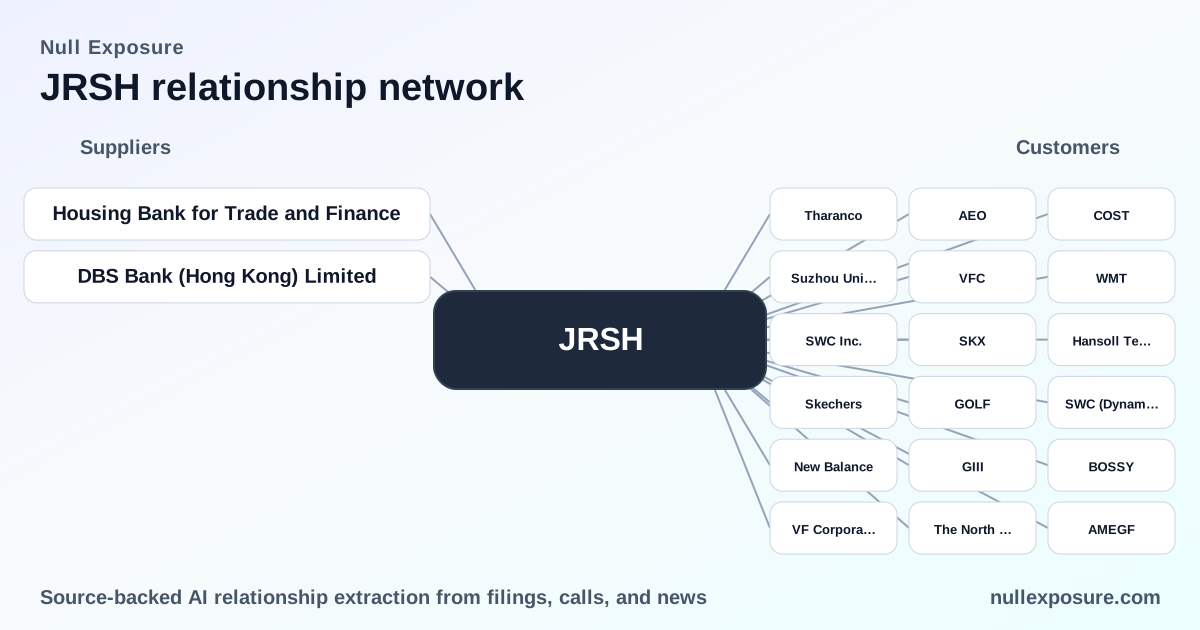
Jerash Holdings (JRSH): Customer Map and What It Means for Investors
Thesis: Jerash Holdings is a Jordan-based contract apparel manufacturer that monetizes by producing custom, ready-made sportswear and outerwear for large retail and brand customers; revenue comes from short-term manufacturing contracts and bulk order fulfillment for global apparel and retail enterprises.
For investors evaluating JRSH, the financial case is straightforward: high operating leverage tied to production throughput, heavy revenue concentration around a very small number of customers, and growth driven by capacity expansion and strategic partnerships. Read on for a concise investor-oriented read on the operating model, constraint signals from filings, and a line-by-line review of every customer relationship cited in public reporting and press coverage.
H2: How Jerash makes money and why customer mix matters Jerash manufactures knitted outerwear and sports garments in Jordan and sells finished product to large global brands and retailers. The company recognizes revenue on short-term contracts where production-to-delivery is typically under one year, and management has emphasized outerwear as the core product (about 90% of revenue in FY2025). The business model therefore ties cash flow directly to order flow and factory utilization; sales volatility or the loss of a major buyer materially impacts margins and free cash flow. (See Jerash FY2025 Form 10‑K and associated press releases.)
H2: Key operating constraints and what they imply
- Contracts are short-term (virtually all contracts are one year or less), which drives revenue variability and forces continuous order generation rather than long-term recurring revenue. (10‑K, FY2025.)
- Jerash primarily sells into the United States, reflecting geographic concentration of demand and exposure to US retail cycles. (10‑K, FY2025.)
- The company operates as a manufacturer for large enterprises and has relied on a few critical customers for a large portion of sales—this is a company-level materiality signal in the filing. (10‑K, FY2025.)
- Jerash has been active in supply-chain financing programs with customers, indicating integrated payment/working capital arrangements that support production but create receivables exposure. (10‑K, FY2025.)
- Core segment is manufacturing/outerwear, not branded retailing—margin expansion relies on scale and efficient plant utilization. (10‑K, FY2025.)
H2: Full customer roll call — what each relationship actually means for JRSH Below I list every customer relationship cited in the company’s filings and press coverage, with a plain-English description and source callout.
-
VF Corporation (VFC): Jerash identifies VF as a primary customer that accounted for a large portion of sales (approximately 65% of revenue in fiscal 2025 and 46% in later disclosures), making VF a dominant revenue driver and concentration risk. (Jerash 10‑K FY2025; TradingView summary of 10‑Q FY2026.)
-
New Balance: Jerash manufactures product for New Balance as a leading brand customer across multiple years; New Balance is repeatedly listed among Jerash’s global brand clients. (Company press releases and multiple news items, including FinancialContent releases, FY2025–FY2026.)
-
G‑III (GIII): Jerash supplies G‑III, which licenses brands such as Calvin Klein and DKNY; G‑III is cited frequently as a branded apparel customer. (10‑K FY2025; related press releases FY2025.)
-
Skechers (SKX): Jerash reports manufacturing for Skechers and includes Skechers among leading global customers in filings and press materials. (10‑K FY2025; company press releases FY2025–FY2026.)
-
American Eagle (AEO/AMEGF): American Eagle is listed repeatedly as a customer in filings and investor communications, appearing in dividend and results announcements. (10‑K FY2025; various press releases FY2023–FY2026.)
-
Acushnet Holdings Corp (FootJoy) (GOLF): Jerash lists Acushnet/FootJoy among its brand customers and references the relationship in press announcements. (Press releases and newswire FY2025–FY2026.)
-
Walmart (WMT): Jerash has sold product to Walmart in earlier years and Walmart appears in press summaries of customer mix; Walmart represents the large-retailer channel exposure. (Investor press pieces and FinancialContent FY2023–FY2026.)
-
Costco (COST): Costco is named among major retail clients in company communications, reflecting Jerash’s exposure to large wholesale/retail orders. (Company press materials and newswire disclosures FY2023–FY2026.)
-
The North Face (brand under VF): The North Face is referenced as an end brand under VF for which Jerash produces outerwear, reinforcing VF-linked product channels. (Company press references and news summaries FY2025.)
-
Hugo Boss (BOSSY): Jerash cites Hugo Boss among the list of well-known brands it manufactures for in the 10‑K. (10‑K FY2025.)
-
SWC Inc. / SWC (Dynamic): SWC shows up in Jerash’s customer sales table (FY2025) with identifiable sales dollars and percentages, indicating a meaningful purchaser in the reporting period. (10‑K FY2025.)
-
Suzhou Unitex: Suzhou Unitex is listed in the customer sales table with explicit dollar amounts and percent of total sales for FY2025 and FY2024, indicating a material transactional relationship. (10‑K FY2025.)
-
Tharanco: Tharanco appears in the customer sales table with defined sales dollars and percentage, qualifying it as a named buyer in FY2025 disclosures. (10‑K FY2025.)
-
Hansoll Textile / Hansoll Textile Ltd.: Jerash announced a strategic collaboration with Hansoll (a South Korea‑based apparel group) that produced a major initial order and contributed to significant production volume (e.g., 3 million pieces), signaling a growth partnership for new large accounts. (StockTitan and Intellectia news coverage, FY2025–FY2026.)
-
AMEGF (ticker variant for American Eagle): AMEGF entries in filings and news are alternate identifiers for American Eagle; the underlying relationship is American Eagle as noted above. (10‑K FY2025; news FY2025.)
-
WMT / WMT (ticker variant for Walmart): Alternate references to Walmart in press clippings reflect the same retail relationship described earlier. (Press coverage FY2023.)
-
COST (Costco ticker variant): COST appearances are ticker‑style references to Costco in news items and summaries. (News FY2026.)
Note: Several entries in public reporting are repeated across press releases and news aggregators; the list above consolidates unique counterparties while preserving the variant identifiers used in disclosures (tickers and alternate names). Sources include Jerash’s FY2025 Form 10‑K and multiple press releases and news aggregators covering FY2023–FY2026 (StockTitan, FinancialContent, TradingView, The Globe and Mail, and other wire services).
H3: What this customer map implies for investors
- Concentration risk is the single largest governance/financial risk: VF’s share of revenue dominates the income statement in recent years and is explicitly cited in filings and market summaries. (10‑K FY2025; TradingView FY2026 coverage.)
- Short-term contract posture increases volatility: Because virtually all contracts are under one year, revenue is highly sensitive to order timing and retail seasonality. (10‑K FY2025.)
- Scale and partnerships are the growth levers: Capacity expansions, the Jordan facility acquisition, and the Hansoll collaboration are management’s visible paths to diversify client mix and raise utilization. (Company press releases FY2026.)
H2: Bottom line and next actions Jerash is a pure-play contract manufacturer whose valuation and credit profile are tethered to plant utilization and a handful of large customers. Investors should price in customer concentration and short-term order risk while monitoring progress on customer diversification and capacity absorption. For a deeper signal-driven map of counterparties and exposure, explore our analytical coverage at https://nullexposure.com/. If you want the customer-level source packages and an exportable relationship matrix, start with our homepage: https://nullexposure.com/.
Key sources: Jerash Holdings Form 10‑K (fiscal year ended March 31, 2025), company press releases and investor news (FY2023–FY2026), and media summaries on StockTitan, TradingView and FinancialContent cited above.