James River Group (JRVR): Who the company does business with and why it matters
James River Group underwrites small- and middle-market casualty risks in the U.S. excess and surplus lines market and monetizes through insurance underwriting margin, fee income from fronting and program business, and selective reinsurance transactions. The company distributes through a concentrated group of brokers and agents, retains fee income on fronting arrangements, and occasionally restructures its portfolio through asset sales and loss portfolio transfers—moves that directly affect capital, reserves and earnings. For a deeper look at counterparty relationships and operational implications, visit https://nullexposure.com/.
Key investor thesis up front
James River’s business model is distribution-dependent and concentration-sensitive: a handful of brokers and a few large program partners drive the bulk of gross written premium, while fronting and reinsurance transactions act as both revenue enhancers and volatility sources. Recent transactions—most notably the sale of JRG Re and legacy LPT activity tied to Uber—underscore a strategy of portfolio pruning and capital redeployment that materially impacts earnings and reserve risk.
Counterparty map: every customer relationship in the reporting set
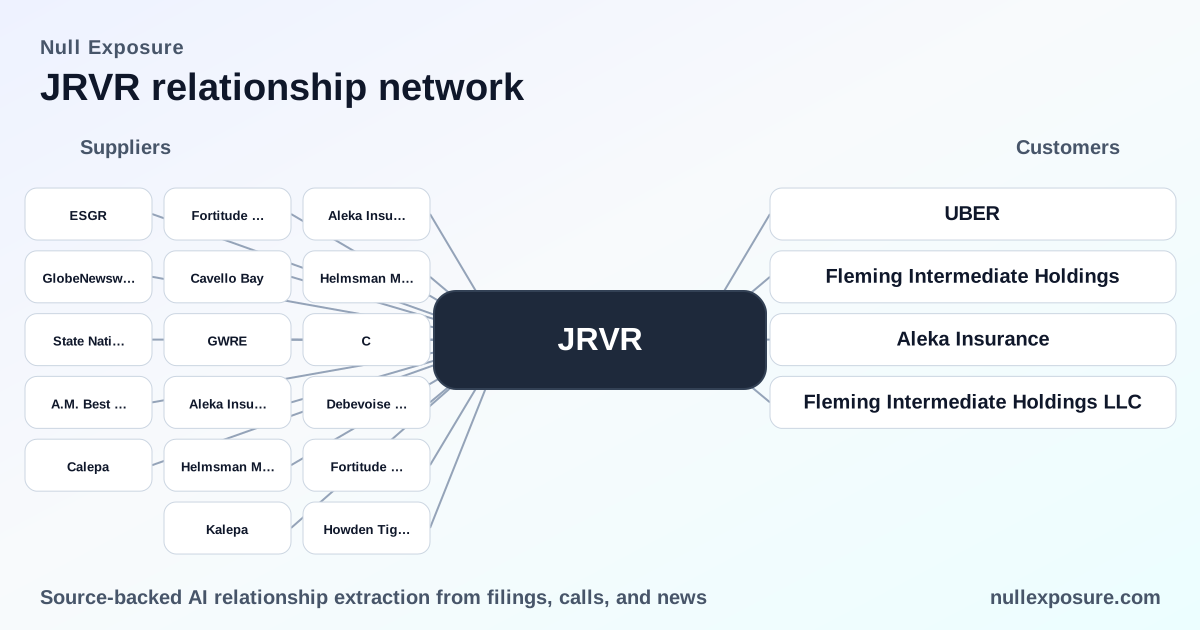
Below are plain-English summaries of each relationship surfaced in the results, followed by the original reporting context.
-
Fleming Intermediate Holdings — James River completed the sale of its third‑party casualty reinsurer, JRG Reinsurance Company, to Fleming for an estimated $277 million, a transaction that included pre-closing dividend mechanics and later spawned litigation over the purchase price and reserve treatment. This sale closed under court supervision and has been the subject of public dispute and regulatory commentary. (Sources: Reinsurance News; Bermuda Reinsurance Magazine; Insurance Business; Royal Gazette — referenced across FY2023–FY2024 reporting and 2026 coverage.)
-
Uber / Uber Technologies Inc. — James River executed loss portfolio transfer (LPT) and reinsurance arrangements tied to legacy Uber commercial auto business, with the company noting sizeable quarter loss activity attributable to the Uber LPT and describing Uber as a long-term insured partner. These transactions transferred substantial commercial auto liabilities into run‑off arrangements. (Sources: Reinsurance News; Royal Gazette; Bermuda Reinsurance Magazine — fiscal period FY2021 reporting and subsequent commentary.)
-
Aleka Insurance — James River ceded approximately $345.1 million of commercial auto liabilities to Aleka Insurance, a captive associated with Uber’s programs, as part of broader LPT and indemnity activity tied to legacy auto exposures. (Source: Bermuda Reinsurance Magazine — FY2021 discussion of LPT activity.)
-
Rasier — James River has posted restricted cash and funds‑held liabilities in a trust to secure claims administration obligations tied to Rasier commercial auto policies that are in run‑off; those funds are primarily sourced from collateral posted by Rasier and affiliates under indemnity and LPT agreements. This is reflected in company filings describing trust collateral held for a third‑party administrator responsible for Rasier claims. (Source: James River company filing summarized on StockTitan — FY2026 reporting.)
What these relationships mean for investors and operators
James River’s customer profile is a mix of large program partners and high-volume brokers plus many smaller accounts. The Fleming sale is a capital‑management event that reduces third-party casualty reinsurance exposure while generating immediate liquidity, but the subsequent litigation over purchase price and reserves introduces legal and reserve‑quality risk that investors must track. The Uber/Aleka/Rasier cluster represents legacy commercial auto risk that has been transferred or placed in run‑off: these arrangements removed underwriting flows but left capital and collateral mechanics (trust accounts, funds held, and potential future reimbursements) on the balance sheet.
-
Capital and reserve sensitivity: The JRG Re disposition generated cash and a pre‑closing dividend component, but contested reserve adjustments and a buyer lawsuit introduce earnings uncertainty tied to historical reserve management. (Reporting across FY2023–FY2024 and legal updates in FY2025–FY2026.)
-
Operational dependence on distribution partners: James River’s E&S business generated the majority of premiums through a handful of brokers and agencies, making distribution concentration a primary operational risk and a driver of premium volatility and pricing leverage.
-
Legacy run-off complexity: LPTs and run‑off arrangements with Uber, Aleka and Rasier convert underwriting liability into administered obligations secured by collateral, shifting claim‑payment timing risk into trust structures that require ongoing monitoring.
Constraints and company-level operating signals investors should factor in
The company filings and public reports surface several structural characteristics that define how counterparty relationships translate into financial outcomes:
-
Geographic concentration: James River’s business is overwhelmingly U.S.-centric; in recent years, 100% of gross written premiums originated from U.S.-based insureds and the E&S segment is active in every U.S. state and DC. This concentrates regulatory and market risk in the U.S. marketplace.
-
Concentration of counterparties: A very small number of brokers and agencies produce a large share of gross written premiums (one agent accounted for roughly $175.7 million and multiple brokers jointly produced more than $700 million in a single year), creating single‑point distribution risk.
-
Materiality and criticality of partners: The Excess & Surplus Lines segment produced roughly 71% of gross written premiums and 87.5% of net written premiums in the last reported year, indicating that lost or disrupted relationships in that channel would have an outsized impact on revenue.
-
Relationship roles: James River operates both as a seller of E&S paper and as a licensor/fronting partner in its Specialty Admitted business, earning fee income and retaining minority risk in fronting arrangements—a model that generates non‑underwriting revenue but ties outcome to partners’ loss performance.
-
Spend dispersion: The company’s book combines very large program accounts (>$100m bands) with numerous small accounts (average admitted account circa $26.8k), implying a mixed exposure profile where loss experience at large programs drives aggregate volatility while operational overhead is borne across many small accounts.
Practical takeaways for investors and risk managers
-
Monitor litigation and reserve quality tied to the JRG Re sale to Fleming; legal outcomes will feed directly into capital and retained earnings. (Coverage: Insurance Business and Bermuda Reinsurance Magazine, FY2025–FY2026.)
-
Track distribution concentration and any changes in broker relationships, as a handful of partners account for the majority of premium flow and therefore pricing leverage and renewal dynamics.
-
Watch trust and collateral mechanics on run‑off business (Rasier, Aleka/Uber), since those arrangements affect liquidity and funds‑held liabilities even after underwriting flow stops. (Filed disclosures in FY2026.)
For a consolidated view of transaction-level reporting and ongoing relationship monitoring, see our coverage at https://nullexposure.com/.
Bottom line
James River executes a strategy that mixes traditional E&S underwriting with fronting and selective portfolio disposals. The Fleming transaction reduced reinsurance exposure and provided liquidity, but introduced reserve‑quality litigation; the Uber/Aleka/Rasier cluster moved large legacy auto liabilities into trust‑backed run‑off arrangements. These facts combine to create a company profile with concentrated distribution risk, active capital redeployment, and residual run‑off complexity—precisely the set of dynamics investors and operators must price into valuation and risk frameworks.