Coffee Holding Co (JVA) — Customer Relationships and What They Mean for Investors
Coffee Holding Co. operates as a vertically integrated roaster and packager that monetizes through three core product lines: wholesale green coffee, private‑label roasting, and branded retail coffee, with a small hardware business through Sonofresco. The company recognizes revenue on shipment, sells into both large retail/wholesale customers and small roasters, and shows material customer concentration (one customer >10% of net sales in both FY2024 and FY2025). For investors and operators, the combination of spot revenue recognition, supply‑chain exposure and a concentrated customer base defines both the primary revenue driver and the principal operational risk to monitor. For additional customer‑level intelligence visit https://nullexposure.com/.
How Coffee Holding makes money and why customer relationships matter
Coffee Holding’s economics are straightforward: buy green beans, roast/pack, and sell finished product to supermarkets, wholesalers, and coffee operators, alongside private‑label contracts that drive steady volumes. Revenue is recognized upon shipment, which produces reliable near‑term revenue recognition but limited forward visibility and greater sensitivity to logistics and working capital timing. The company also sells tabletop roasting hardware via Sonofresco, a non‑core but complementary revenue stream that broadens product mix.
Direct customer relationships in the record — what to know
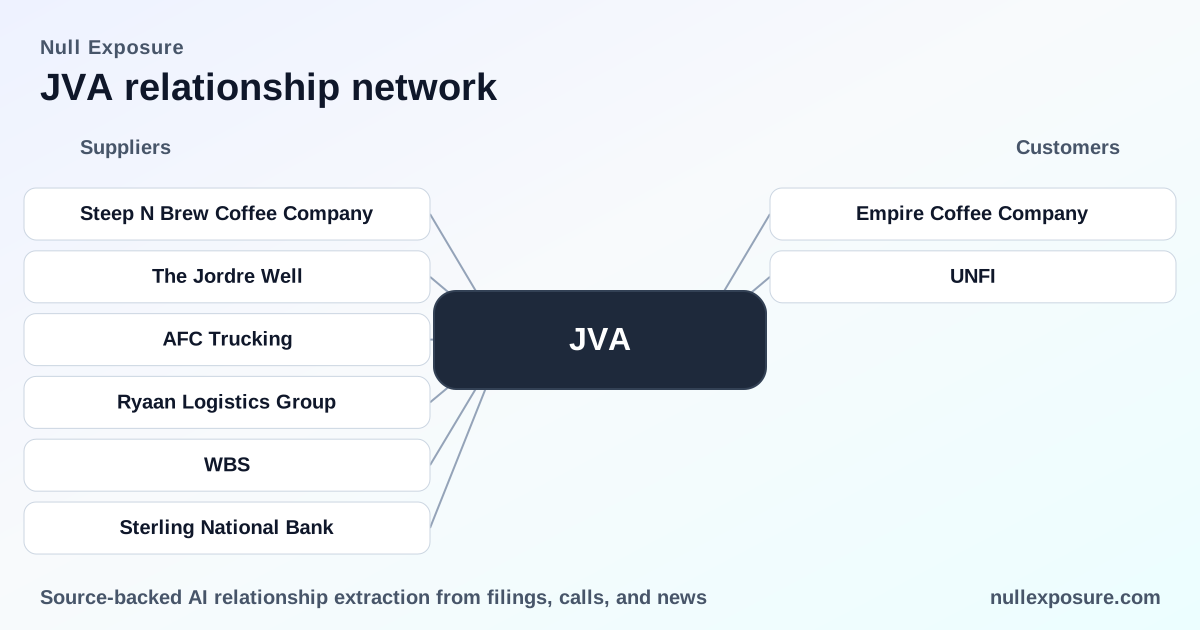
Empire Coffee Company
Operations of Second Empire will include roasting and packing for the Company’s existing customers as well as customers of Empire Coffee, indicating a capacity‑sharing or contract‑manufacturing arrangement that expands Coffee Holding’s processing footprint and addressable customer list. According to Coffee Holding’s FY2025 Form 10‑K, the Second Empire operations will handle roasting and packing for both companies’ customers (FY2025 10‑K).
UNFI
A missing shipment scheduled for transport from Coffee Holding’s La Junta, Colorado facility to a United Natural Foods (UNFI) distribution warehouse in Centralia, Washington was the subject of litigation, signaling that UNFI functions as a large distribution customer and that logistics incidents can create direct commercial disputes. Daily Coffee News reported on the company’s lawsuit regarding the missing coffee shipment, dated January 15, 2025.
United Natural Foods
United Natural Foods is identified in the same reporting as the intended consignee for the disputed shipment, reinforcing UNFI’s role as a distribution partner for Coffee Holding and highlighting third‑party freight/broker execution as a tangible operational risk. The Daily Coffee News article (Jan 15, 2025) describes the shipment routing and the ensuing legal action.
What the relationship map reveals about operating constraints and risk posture
Treating the documented constraints as company‑level signals, several clear operating characteristics emerge:
- Contracting posture — spot sales dominate. Revenue is recognized at shipment for many product lines, which is consistent with spot or short‑term contractual arrangements and reduces revenue visibility beyond immediate shipment windows.
- Customer concentration is material. The company disclosed one customer accounted for greater than 10% of net sales in both FY2024 and FY2025, a structural concentration that elevates counterparty risk and bargaining leverage dynamics.
- Counterparty mix spans large enterprises and small businesses. Coffee Holding’s client base includes both large retail/wholesale customers and independent/multi‑unit roasters, indicating diversified channels but divergent margin and credit profiles that complicate receivables and sales predictability.
- Geographic footprint is North America‑centric with limited APAC exposure. The firm sells primarily across the United States (with limited sales in Canada and certain Asian countries), which reduces FX complexity but concentrates trade, regulation and logistics risk regionally.
- Product mix is mature but includes a small hardware segment. Core product lines remain coffee‑centric, while Sonofresco tabletop roasters represent a nascent hardware channel that can supplement revenue but is not a primary profit engine.
Operational and commercial implications for investors and operators
- Logistics execution is a tangible, value‑at‑risk item. The UNFI shipment dispute demonstrates that third‑party freight brokers and distribution partners can directly generate revenue loss, legal costs, and reputational impacts; operations teams must treat logistics governance as a board‑level control.
- Spot recognition limits revenue visibility and increases working capital swings. With sales recognized on shipment, short‑term P&L is sensitive to order timing; procurement and inventory management must be tightly coordinated to avoid margin compression.
- Concentration amplifies counterparty leverage. A single customer representing >10% of sales creates negotiating exposure and economic vulnerability if that customer shifts volume or pricing; investors should focus on contract terms and customer retention metrics.
- Channel diversity tempers but does not eliminate risk. Sales across large enterprise accounts and small roasters provide demand diversification, but the mix also requires differentiated commercial strategies and credit policies.
Financial context that frames customer risk
Coffee Holding generated approximately $100.5 million in trailing revenue with EBITDA around $3.7 million, and a thin net profit margin (~1.9%), which ties customer performance directly to profitability. Market capitalization near $26.6 million implies limited valuation cushioning for prolonged customer or logistics disruptions. Investors should weigh the company’s modest margins and material customer concentration against any operational improvements that reduce shipment losses or expand recurring private‑label contracts.
Actionable investor checklist
- Monitor the identity and behavior of the >10% customer (the company discloses concentration but not the counterparty by name), including renewal cadence and margin terms.
- Assess logistics controls and third‑party broker selection given the UNFI shipment dispute; track legal developments and reserve impacts from the January 2025 incident.
- Evaluate the mix between large‑enterprise vs. small‑business customers to understand credit risk and seasonality; large accounts drive volume but small accounts add margin heterogeneity.
- Watch revenue recognition timing and inventory turns because spot sales concentrate working capital risk into the shipment window.
For further customer intelligence and relationship mapping, visit https://nullexposure.com/.
Bottom line
Coffee Holding is a mature, low‑margin roaster whose revenue engine is driven by shipment‑based sales to a mix of large retailers and small roasters, with material customer concentration and documented logistics exposure. These traits produce a clear investment tradeoff: stable product demand and established channels versus acute counterparty and execution risk that requires active oversight from both management and investors.