JX Luxventure: Distribution deals and AI integrations are reshaping a boutique luxury holding company
JX Luxventure Group Inc. (JXG) operates as an investment holding company that builds and monetizes luxury brands across fashion, hospitality, and lifestyle by combining brand strategy, distribution partnerships, and selective technology integrations. The company generates revenue through brand merchandising, licensing, and B2B distribution channels supported by recent agreements that embed chat‑enabled technology into sales and ERP workflows. Investors should view JXG as a small‑cap, high‑conviction operator pursuing revenue diversification through strategic commercial partnerships and technology-led product distribution.
For a broader view of specialized customer relationship reporting, visit https://nullexposure.com/.
Why recent announcements matter for valuation and execution
JXG’s recent press activity signals an operational pivot from pure brand curation to partner-driven distribution and direct‑to‑channel monetization. The contracts announced in March 2026 combine two strategic levers: (1) leveraging airline and wholesale distribution networks to scale product distribution (notably pet food and air‑ticket sales promotion), and (2) deploying conversational intelligence into ERP and customer channels to accelerate conversion and back‑office productivity.
Key company-level characteristics that define the operating model:
- Contracting posture: JXG is executing short‑to‑medium term commercial agreements with large third‑party distributors and carriers, indicating B2B partnership contracts rather than asset-heavy retail expansion.
- Concentration and diversification: The company is intentionally using multiple channel partners (airlines, wholesalers) to diversify go‑to‑market pathways while still relying on a relatively narrow set of large partners for scale.
- Criticality of relationships: These partners are distribution multipliers — airline and wholesale networks materially amplify reach for packaged goods like pet food and lifestyle products, making partner performance strategically critical to revenue growth.
- Maturity and cadence: The cluster of press releases in March 2026 reflects an active business‑development phase rather than steady state; execution risk will be measured by contract rollouts and revenue recognition in upcoming quarters.
Financial context: JXG reports TTM revenue of $46.8 million and gross profit of $8.48 million, with market capitalization near $34.5 million and EBITDA of $6.62 million, positioning it as a small but operationally profitable luxury holding company on a gross margin path to leverage these partnerships.
Customer relationships: the facts investors need to know
Below I summarize every customer relationship noted in public reporting, with source citations.
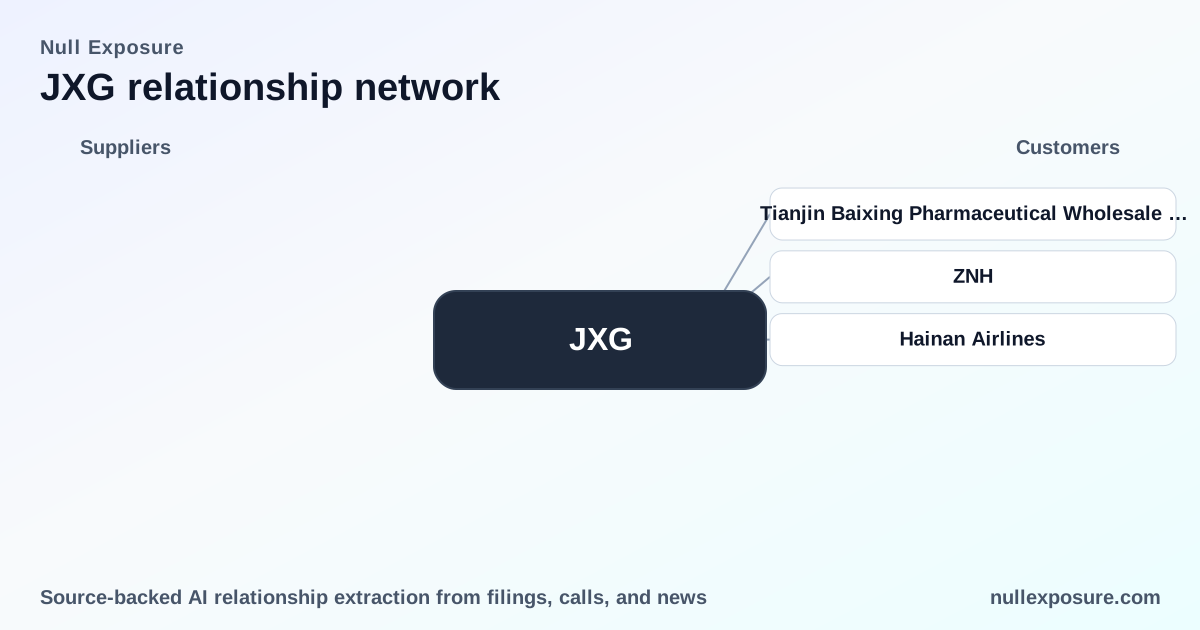
Tianjin Baixing Pharmaceutical Wholesale Co., Ltd.
JXG signed a USD 1,000,000 agreement to incorporate ChatGPT‑type technology into its ERP platform, indicating a paid implementation that both monetizes JXG’s technology stack and modernizes back‑office sales workflows. According to a PR Newswire release reported on Finviz on March 10, 2026, the contract value for this engagement is explicitly stated at $1.0 million.
China Southern Airline (ZNH) — first mention
JXG announced a major partnership with China Southern Airlines for pet food distribution across China, representing a channel‑led expansion into travel retail and cargo‑enabled logistics for consumer goods. This collaboration was disclosed via PR Newswire and cited on Finviz on March 10, 2026.
Hainan Airlines
JXG announced a collaboration with Hainan Airlines to promote air‑ticket sales through JXG’s channels and official accounts while incorporating chat‑enabled technology to support promotion and conversion. PR Newswire reported this development and Finviz captured the announcement on March 10, 2026, showing JXG leveraging its marketing assets to drive airline ticket sales and integrate conversational tools.
ZNH — second mention (duplicate entry)
A second press mention reiterates the partnership with China Southern Airlines (ZNH) for pet food distribution, confirming the company emphasized this arrangement in multiple communications. The duplicate item was recorded on Finviz with the same PR Newswire source on March 10, 2026.
What these relationships imply about revenue, margins, and risk
- Revenue upside is twofold: direct contractual revenue (the $1.0 million ERP integration) and distribution economics from physical goods sold through airline and wholesale channels. Airline and wholesale partnerships can deliver high‑velocity sales but typically at lower margins than direct luxury retail.
- Margins will depend on channel economics: airline retail and wholesale distribution often command lower gross margins but drive volume; the ERP/tech integration is higher‑margin professional service revenue. This mix will influence overall gross margin trends and EBITDA conversion.
- Execution and concentration risk are real: although JXG is diversifying channels, the company’s small market capitalization and concentrated partner roster mean the failure or underperformance of one or two relationships could disproportionately affect near‑term results.
- Governance and ownership signal commitment: insider ownership is ~35%, while institutional ownership is minimal (~0.27%), indicating management and founders retain significant control and are aligned with execution outcomes.
What investors should monitor next
- Contract rollouts and timing of revenue recognition for the China Southern and Hainan Airlines partnerships, and whether those arrangements include minimum purchase commitments, revenue shares, or one‑time marketing fees.
- Implementation milestones and invoicing schedules for the $1,000,000 ERP/ChatGPT integration with Tianjin Baixing, which will be an early indicator of JXG’s ability to monetize technology services.
- Channel margin dynamics as airline and wholesale sales scale versus branded retail sales; track gross profit contribution by channel in quarterly disclosures.
- Customer concentration metrics disclosed in filings and any changes to insider ownership or new institutional investors, which would alter governance and financing flexibility.
For additional structured analysis of how customer relationships translate into revenue signals and risk indicators, see the research hub at https://nullexposure.com/.
Bottom line: targeted partnerships, measurable execution risk
JX Luxventure is executing a commercial strategy that blends technology implementations and distribution partnerships to scale brand reach. The explicit $1.0 million ERP engagement provides a near‑term, high‑visibility revenue event, while airline and wholesale distribution agreements offer volume but introduce margin and execution variability. Investors should reward disciplined contract execution and transparent reporting on channel economics; absent that, the concentrated nature of partner reliance elevates near‑term operational risk.