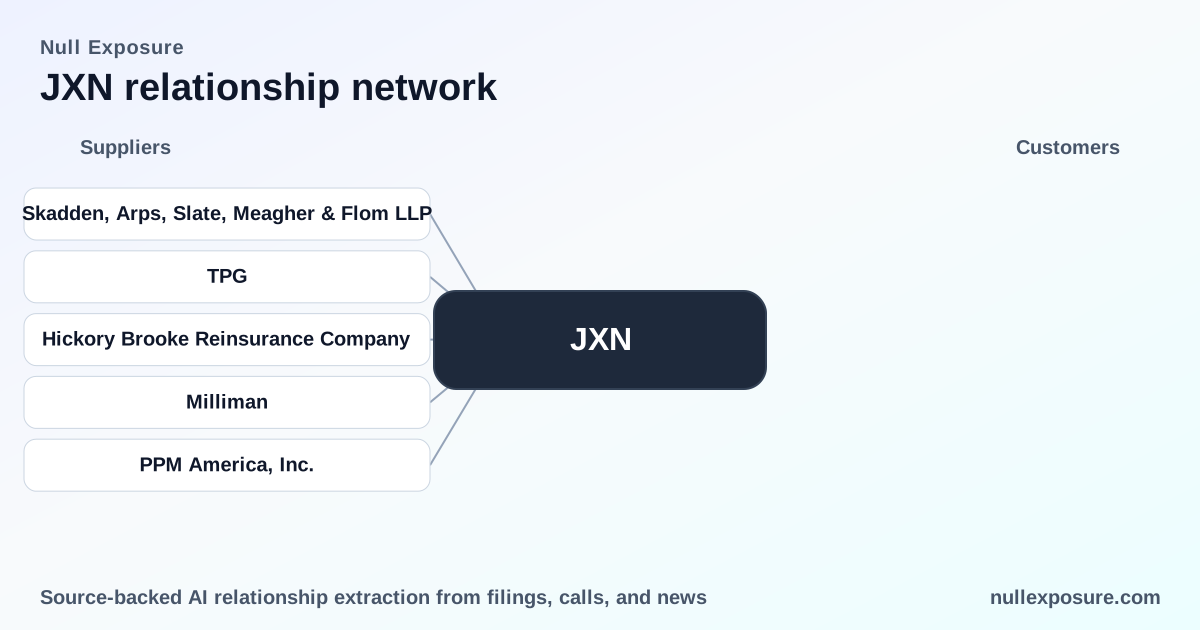
Jackson Financial (JXN): Strategic credit partnerships shore up annuity economics
Jackson Financial operates as a dual business: a retail and institutional life-insurance company that sells annuities and life products through a broad distribution network while managing a large investment portfolio to match long-duration liabilities and generate investment spread. The firm monetizes through annuity premiums, insurance spreads, and asset-management fees from its subsidiary PPM America; recent strategic agreements expand third‑party credit capabilities that support return generation on floating and private credit assets. For further context on counterparty relationships and customer exposure, see Null Exposure’s research hub: https://nullexposure.com/.
What changed: a long-term investment-management arrangement with TPG
Jackson announced a non‑exclusive investment-management arrangement with TPG that materially expands its access to private credit capabilities. The agreement provides Investment Grade Asset Based Finance and Direct Lending capabilities to complement PPM America, and is structured with a 10‑year initial term and automatic one‑year renewals through year 15, signaling a multi‑year commitment to external credit managers rather than building all capacity in-house. According to a Business Wire release distributed via FinancialContent (January 6, 2026), the partnership is intended to bolster Jackson’s private-credit allocation alongside PPM’s existing asset-management footprint.
Why the TPG tie-up matters for investors
- Immediate capability lift: The arrangement broadens Jackson’s access to direct lending and asset‑based finance, asset classes that carry yield and illiquidity premia attractive to annuity writers.
- Long-duration alignment: A decade‑plus contract horizon aligns with Jackson’s long-duration liability profile, reducing execution risk in scaling private credit exposure.
According to the company announcement (Business Wire / FinancialContent, Jan 2026), the deal is non‑exclusive and explicitly designed to complement PPM America’s capabilities.
How Jackson’s commercial engine and distribution monetize products
Jackson’s core go‑to‑market is the sale of annuities and life insurance across retail and institutional channels. The company sells products through independent broker‑dealers, wirehouses, banks, RIAs and platforms, capturing upfront and/or ongoing fee economics while retaining investment spread on the balance sheet. Jackson also runs asset management through PPM America, which generates fee income and is now complemented by external managers such as TPG for specialized credit exposure. This two‑pronged model—insurance product sales plus asset-management distribution—creates diversified revenue streams and a natural demand for fixed income and private credit that match policyholder liabilities.
Explore Null Exposure’s Jackson coverage for a consolidated view: https://nullexposure.com/.
Operating model constraints that shape the business
Jackson’s public disclosures and product architecture impose several structural characteristics that investors must consider:
- Counterparty mix: Jackson serves both individual retail customers and large institutional purchasers, reflecting a bifurcated distribution strategy that requires different contract terms and servicing models (company filings).
- Geographic footprint: North America is the core market—Jackson is licensed in all 50 states and DC—but the investment portfolio has EMEA and Latin American exposures through collateralized mortgage loans and residential mortgage holdings, which introduces cross‑border credit and regulatory considerations (FY2024 disclosures).
- Contracting posture and maturity: The business is built on long‑duration liabilities and long‑running operational commitments—the company administers approximately 79% of in‑force policies on an in‑house platform, indicating mature, internally managed operations that favor scale and control over rapid outsourcing.
- Role complexity: Jackson operates as both seller (of annuities and life insurance) and buyer (of investment management and credit solutions to support spread generation), creating counterparty dependencies on distribution partners and asset managers.
- Active relationship posture: Public statements and administration statistics signal an active, ongoing relationship set rather than a transitory set of engagements.
These constraints shape negotiation leverage, capital deployment flexibility, and operational risk—important inputs for credit and equity investors evaluating Jackson’s strategic choices.
Relationship map: what the public record shows
- TPG — Jackson entered a non‑exclusive, long‑term investment management arrangement with TPG to add Investment Grade Asset Based Finance and Direct Lending capabilities alongside PPM America; the contract has a 10‑year initial term with automatic renewals through year 15 (Business Wire release via FinancialContent, Jan 6, 2026).
This arrangement is the only customer/partner relationship surfaced in the latest public relationship sweep. The structure—non‑exclusive, long‑dated—signals Jackson’s preference for building multi‑year external partnerships to augment in‑house asset capabilities rather than attempting to internalize every increment of private credit expertise.
Risk profile and capital market signals investors should monitor
- Valuation and capital return: Price/book is 0.85 with a dividend yield ~2.8%, indicating the market prices Jackson below book but provides modest income to holders (company metrics, latest reporting).
- Ownership concentration: Institutions hold ~97% of the float, which increases sensitivity to institutional flows and professional portfolio rebalancing.
- Earnings quality: Jackson’s operating margin and revenue per share are meaningful, but EPS is currently negative on a TTM basis; investors should track investment spread compression or credit losses in private‑credit allocations.
- Operational concentration: Managing 79% of policies in‑house reduces third‑party dependency but raises operational scalability and upgrade risk if systems lag regulatory or distribution demands.
What to watch next
- Execution and placement of private credit transactions with TPG and PPM America; monitor realized yields, default experience, and leverage levels.
- Credit performance on U.S. commercial and residential mortgage collateral with EMEA and LatAm exposures.
- Distribution flows across broker‑dealers and platforms, which drive new premium intake and cross‑sell opportunities.
- Capital treatment and regulatory developments affecting annuity reserving and investment allocation flexibility.
Jackson’s strategic choice to combine internal asset management with long‑dated external partnerships like TPG is a deliberate, yield‑oriented approach designed to match long-term liabilities and enhance returns without materially increasing balance‑sheet volatility. For a concise, investor‑grade dossier and relationship tracking on Jackson and peer insurers, visit Null Exposure’s coverage hub: https://nullexposure.com/.