Jayud Global Logistics (JYD): Customer relationships that define growth and risk
Jayud Global Logistics operates cross-border freight and supply-chain services out of Shenzhen, monetizing through contracted logistics, freight forwarding and value-added logistics technology sold to enterprise customers. Revenue of $600.8M TTM is generated from recurring freight contracts and technology integrations, and the company supplements service margins with productized control systems for large clients. For investors evaluating customer relationships, the commercial picture is simple: longer-term service contracts and bespoke control systems drive revenue but the company is operating with negative margins and concentrated operational execution. Learn more at https://nullexposure.com/.
The commercial model in one line
Jayud sells logistics services (land, air, cross-border) and enterprise logistics controls to corporate shippers; it converts multi-year contracts into recurring service revenue while positioning proprietary logistics tooling as a margin lever. Key financial anchors: $600.8M revenue TTM, negative EBITDA (-$34.9M) and diluted EPS of -$2.23, which signal an early-scale, margin-improvement story rather than a mature cash generator.
What investors need to watch about customers
Customer relationships here are both revenue drivers and risk vectors. Long-duration service agreements give predictable volumes and operational leverage, while bespoke systems (the “Spider” logistics control tower) create switching costs but also concentrate delivery risk on Jayud’s execution. Low institutional ownership (0.012%) and modest market capitalization (~$41.6M) amplify sensitivity to any customer churn or contract disputes.
Customer relationships in the public record
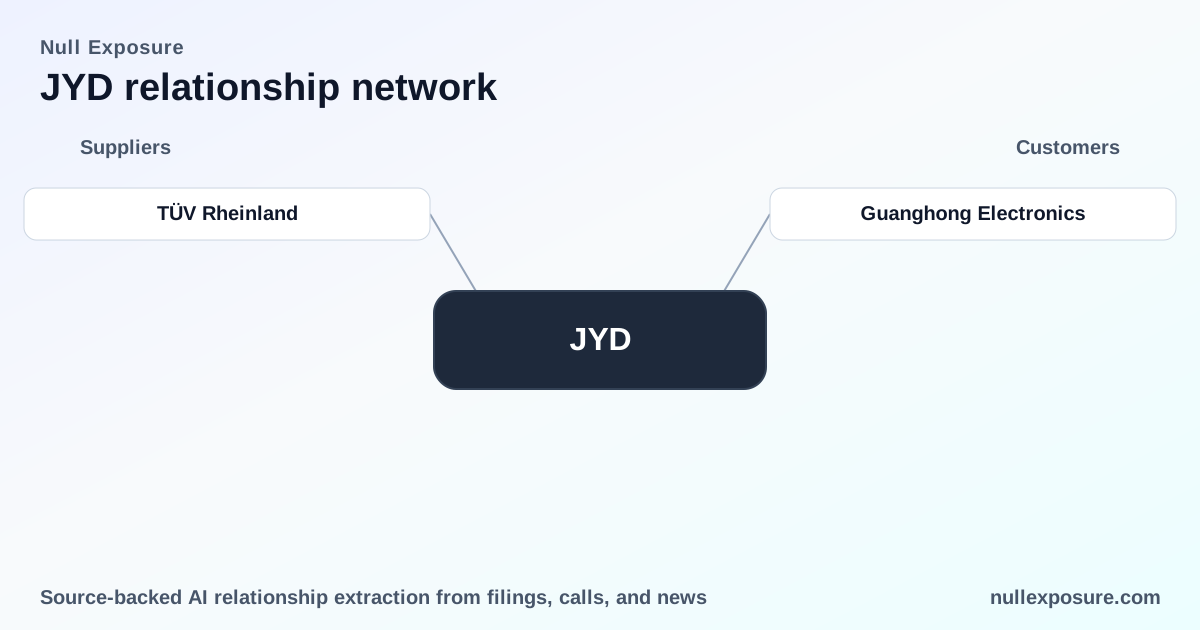
Guanghong Electronics — a multi-year logistics cooperation
Jayud signed a three-year cooperation agreement to provide comprehensive logistics and transportation services between China and Hong Kong, including land and air freight; this agreement is presented as a supply-chain efficiency upgrade for Guanghong. The engagement is reported in multiple press items in March–May 2026. Source: Intellectia news coverage (March–May 2026), for example https://intellectia.ai/news/stock/jayud-global-logistics-faces-securities-fraud-class-action-filed-in-ny-court (reported March 10, 2026).
Alibaba (BABA) — verified supplier status
Jayud is certified as an Alibaba Verified Supplier, a third-party endorsement that validates capability to serve large e-commerce and cross-border customers and supports marketplace credibility for trade flows. Source: The Globe and Mail press aggregation (March 9, 2026), https://www.theglobeandmail.com/investing/markets/stocks/BABA/pressreleases/61583/clsa-keeps-their-buy-rating-on-alibaba-group-holding-ltd-9988/.
Lenovo — logistics control tower (“Spider”) implementation
Jayud developed a logistics control system for Lenovo, called the Lenovo Service Control Tower (Spider), which is explicitly positioned to contribute to Lenovo’s strategy to build an intelligent global logistics network; the project is an example of Jayud’s move into higher-value logistics orchestration. Source: SEC filing/prospectus supplement cited on StockTitan (May 3, 2026), https://www.stocktitan.net/sec-filings/JYD/424b5-jayud-global-logistics-ltd-prospectus-supplement-debt-securitie-00fd7f415e10.html.
What these relationships mean for revenue quality and risk
- Contract tenor and predictability: The Guanghong three-year agreement demonstrates Jayud’s ability to secure medium-term, recurring revenue streams that support operational planning and utilization of assets.
- Validation and sales pipeline leverage: Alibaba verification acts as an external credibility signal that shortens sales cycles with digital-native shippers and marketplaces.
- Productized services create higher-margin potential: The Spider implementation for Lenovo shows Jayud selling not just transport but orchestration software—this increases per-customer revenue potential and raises switching costs, but it concentrates execution risk on Jayud’s platform reliability.
Company-level operating model signals (constraints and structure)
The research payload returned no formal third-party constraints. Presenting company-level signals drawn from the available data:
- Contracting posture: Jayud evidences a mix of multi-year commercial contracts and bespoke system integrations, which indicates a contracting posture skewed toward longer-term engagements rather than spot-market brokerage.
- Customer concentration and criticality: The public results highlight enterprise clients (Lenovo, partnership with Alibaba channels, Guanghong), suggesting a focus on large corporate customers whose logistics needs are critical to their operations, which raises the strategic importance of delivery reliability. Broad customer concentration metrics are not provided in the payload.
- Operational maturity: Financials signal early maturity — negative EBITDA and EPS alongside positive revenue growth (quarterly revenue growth +8.6% YoY) point to an expansion phase where sales scale precedes sustained profitability.
- Commercial leverage and execution risk: Productized control systems and multi-year contracts build commercial leverage, but they concentrate reputational and delivery risk on Jayud’s operational platform and execution teams.
Investor implications — what to prioritize in diligence
- Focus on contract selectivity and margin profile: quantify how the Spider and similar integrations are priced and whether they shift revenue mix toward higher-margin recurring licencing/managed services versus lower-margin freight.
- Test client concentration and dependency: confirm the revenue share of top customers and contract renewal terms for the largest accounts.
- Validate operational capacity and contingency planning: multi-year contracts increase exposure to execution failures; audit Jayud’s redundancy, insurance and SLA enforcement.
- Monitor governance and disclosure: low institutional ownership and modest float increase volatility and change the dynamic for activist or strategic investment.
For a deeper read on how Jayud’s customer relationships map to commercial value and investor risk, see our coverage hub at https://nullexposure.com/.
Bottom line
Jayud’s customer evidence shows a deliberate move from commodity freight toward contracted, higher-value logistics orchestration—a constructive revenue strategy but one executed at negative margins today. Investor returns will depend on the company’s ability to scale productized services, maintain executional discipline on multi-year accounts, and convert stronger top-line momentum into operating leverage.