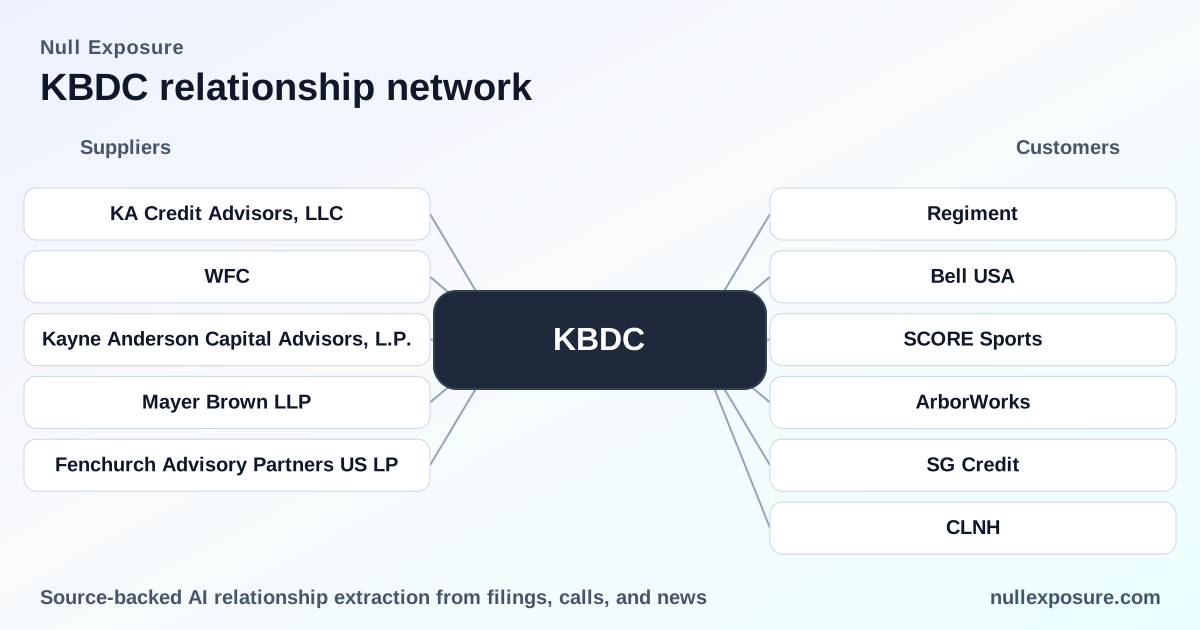
Kayne Anderson BDC (KBDC): Portfolio relationships that drive marks and income
Thesis: Kayne Anderson BDC is a middle‑market lender that generates income through secured and unitranche loans, PIK interest, and mark‑to‑market gains and losses on actively managed credit investments; the firm monetizes via coupon income, origination economics and periodic portfolio realizations while its NAV is sensitive to fair‑value adjustments across a concentrated set of private borrowers. Learn more about relationship intelligence and how it tracks to portfolio outcomes at https://nullexposure.com/.
How KBDC operates and what matters to investors KBDC is a business development company that invests primarily in first‑lien senior secured loans with selective exposure to unitranche and split‑lien structures. The firm's economics are driven by interest income (both cash and PIK), origination and structuring fees, and realized or unrealized valuation changes; fair‑value marks can outweigh coupon flows in quarter‑to‑quarter earnings, as the recent transcript highlights. KBDC targets U.S. middle‑market companies and uses an active monitoring approach through its advisor to protect downside and expedite workouts or restructurings.
Company‑level signals that shape counterparty risk
- Contracting posture — long‑dated loans: KBDC emphasizes loans with stated maturities typically three to six years, and has restructured facilities to extend maturities when appropriate (example: a Trademark Global restructure extended maturity to 2030). This underpins a lending book with meaningful maturity duration and recovery runway.
- Counterparty profile — middle‑market focus: The firm invests predominately in private, mid‑market borrowers where credit selection and sponsor relationships determine returns more than public market beta.
- Geographic concentration — U.S. centric: Investment activity is concentrated in North America, with due diligence and covenant frameworks oriented to U.S. legal and operating environments.
- Relationship posture — active portfolio management: KBDC’s advisor maintains monthly or quarterly engagement with portfolio companies and sponsors, indicating hands‑on surveillance rather than passive exposure.
- Sector signal — distribution exposure notable: The portfolio discloses material exposure to trading companies and distributors (~15%), a segment that carries specific working‑capital cyclicality and inventory risk for lenders.
Portfolio relationships cited in the earnings transcript Below are the portfolio counterparties called out in KBDC’s FY2026 earnings transcript and related press release; each entry includes a concise investor‑oriented takeaway and the transcript citation.
-
Regiment — KBDC recognized elevated PIK interest as interest income from its investment in Regiment was converted to PIK during the fourth quarter, increasing non‑cash interest accruals for the period. Source: KBDC earnings transcript (The Globe and Mail / Motley), March 10, 2026.
-
Bell USA — Bell USA was one of the drivers of negative fair‑value changes contributing to unrealized losses in the quarter, indicating mark pressure on this credit position. Source: KBDC earnings transcript (The Globe and Mail / Motley), March 10, 2026.
-
SCORE Sports — SCORE Sports was specifically identified among the investments that generated negative fair‑value movements, reflecting either industry stress or borrower‑specific deterioration that impacted NAV. Source: KBDC earnings transcript (The Globe and Mail / Motley), March 10, 2026.
-
ArborWorks — ArborWorks produced positive marks in the quarter and partially offset other unrealized losses, representing a credit that improved in fair value during the period. Source: KBDC earnings transcript (The Globe and Mail / Motley), March 10, 2026.
-
SG Credit — The SG Credit loan is described as the only fixed‑rate investment in the disclosed portfolio, closed in early Q3 2025 and carrying an 11% fixed coupon, which provides a rare fixed income anchor versus the prevailing variable‑rate book. Source: KBDC earnings transcript (The Globe and Mail / Motley), March 10, 2026.
-
Centerline (CLNH) — Centerline was noted alongside ArborWorks as a positive fair‑value contributor in the quarter; ticker disclosure appears as CLNH in the transcript references. Source: KBDC earnings transcript (The Globe and Mail / Motley), March 10, 2026.
What these relationships imply about risk and return
- Mark volatility dominates near‑term NAV dynamics. Multiple portfolio names were explicitly cited as drivers of unrealized losses and gains, which means quarter‑to‑quarter NAV moves will depend heavily on idiosyncratic credit events and valuations rather than purely on coupon accrual.
- PIK conversions increase short‑term cash strain visibility. The Regiment conversion to PIK raised non‑cash interest receipts; while PIK preserves economic yield, it reduces current cash flow, impacting distributable income until cash payments resume.
- Limited fixed‑rate ballast increases rate sensitivity. With SG Credit the lone fixed coupon at 11%, KBDC’s cash yield profile remains largely variable, leaving portfolio returns correlated to floating rates and spread movements.
- Concentration and sector weight matter. A meaningful allocation to distribution/trading companies creates exposure to working capital cycles; where several names are large enough to move NAV, single‑borrower outcomes translate to portfolio‑level earnings effects.
Strategic takeaways for investors and operators
- Active monitoring differentiates credit salvage opportunities. KBDC’s advisor engagement model supports workout and restructuring options, which is a positive governance signal for recoveries.
- Watch PIK activity as an earnings‑quality indicator. Rising PIK conversions are a reliable early signal that cash collections are weakening even if contractual income continues to accrue.
- Track mark drivers, not only yields. For NAV‑sensitive investors, follow reported fair‑value contributors and detractors (the names above) as the quickest read on portfolio momentum.
Where to look next Monitor subsequent quarterly disclosures for: (1) changes in PIK incidence across the book; (2) any migrations between fair‑value loss and recovery for Bell USA, SCORE Sports and Regiment; and (3) the evolution of maturity profiles and fixed‑rate exposure. For ongoing relationship tracking and portfolio impact analysis, visit https://nullexposure.com/ to see how these counterparties map to KBDC’s credit and NAV outcomes.
Bold final note: KBDC’s returns will remain a blend of current yield and mark realization — investors must read the names driving unrealized gains and losses to anticipate NAV direction, not just headline yield metrics.