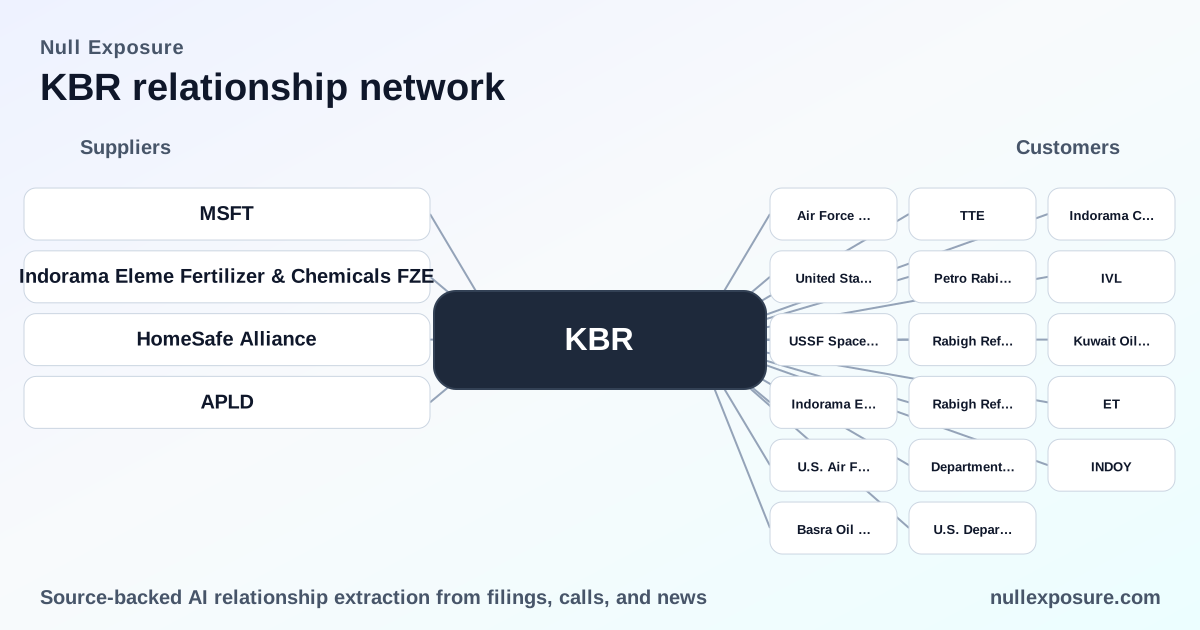
KBR’s customer map: durable government work, expanding industrial services, and where earnings will come from
KBR is an engineering and technology contractor that monetizes through long-term, fee-for-service and fixed‑price contracts across government and commercial markets: full‑lifecycle government solutions (defense, space, NASA), engineering‑procurement‑construction (EPC) and long‑term catalyst/maintenance supply agreements for hydrocarbon and petrochemical clients. Revenue mixes toward government services and multi‑year industrial supply/maintenance contracts drive predictable backlog, while mission‑critical program exposure creates concentration and operational execution risk. Learn more at https://nullexposure.com/.
How KBR makes money — a concise investor view
KBR sells technical expertise and integrated programs rather than widgets. Government revenue comes from multi‑year task orders, systems engineering and mission support that lock in recurring professional services; commercial revenue comes from EPC projects, long‑dated catalyst supply agreements and outsourced maintenance contracts that convert engineering IP into annuity‑like streams. High government share (reported 57% of consolidated revenue in FY2024) underpins cash generation but concentrates political and program risk; long-term industrial contracts increase revenue visibility but raise execution and warranty exposure.
Operating constraints that shape credit and growth dynamics
- Long‑term contracting posture: KBR’s disclosures and recent award set demonstrate multi‑year contracts extending to the 2030s and beyond, supporting backlog visibility and revenue recognition over long horizons.
- Government‑heavy counterparty mix and criticality: The firm is a primary service provider to US and allied governments, which delivers stable demand yet exposes KBR to program funding cycles and contract scrutiny.
- Geographic diversification with regional concentration: KBR operates globally with material footprints in North America and EMEA, and meaningful activity in APAC, which smooths cyclicality but keeps geopolitical and local‑partner risks.
- Service provider and maturity signal: The business is oriented to services and long‑standing client relationships — a mature portfolio that rewards scale, domain knowledge and program continuity.
- Large spend bands: Multiple recent awards exceed $100m, reinforcing the company’s role as a mid‑to‑large contract counterparty and the associated performance and cash‑flow stakes.
These are company‑level signals drawn from KBR disclosures and recent awards; they form the framework for assessing each customer relationship below.
Customer relationships and recent contract evidence
Below are the customer relationships surfaced in public reporting and what each announcement means for revenue, backlog or positioning.
-
Air Force Research Laboratory (AFRL) — KBR won tasking focused on digital engineering and assured communications tied to AFRL modernization priorities; the award underlines KBR’s technology‑forward role supporting U.S. research arms. Source: Finance Yahoo press report on award (Feb–Mar 2026), https://finance.yahoo.com/news/kbr-secures-77-million-u-110000449.html.
-
United States Space Force (USSF) — KBR was awarded a firm‑fixed‑price task order totaling $77M (part of Decision Support for HQ Analysis), strengthening Mission Technology Solutions work with space domain analytics and decision support. Source: Finance Yahoo (Feb–Mar 2026), https://finance.yahoo.com/news/kbr-secures-77-million-u-110000449.html.
-
USSF Space Systems Command (SSC) — The SSC is a named partner in the AFRL/USSF award, reflecting KBR’s role across integrated space research and systems modernization efforts. Source: Finance Yahoo (Feb–Mar 2026), https://finance.yahoo.com/news/kbr-secures-77-million-u-110000449.html.
-
U.S. Air Force — KBR secured a potential $149M contract to support system modernization and operator readiness at Eglin AFB, illustrating continued DoD base and operations support revenue. Source: GovConWire (Mar 2026), https://www.govconwire.com/articles/kbr-air-force-eglin-system-modernization.
-
Department of the Air Force — KBR received multiple task orders (approximately $103M reported) to deliver data analysis and technical expertise across Air Force and USSF programs, signaling durable multi‑year government services demand. Source: Sahm Capital summary (Feb 2026), https://www.sahmcapital.com/news/content/kbr-awarded-103-million-in-strategic-contracts-supporting-the-department-of-the-air-force-2026-02-09.
-
U.S. Department of Transportation — Volpe National Transportation Systems Center — KBR won a five‑year, $200M blanket purchase agreement to deliver IT, systems engineering and analytics to the Volpe Center, expanding civil‑transport professional services. Source: GlobeNewswire / WashingtonTechnology (Apr–May 2026), https://www.globenewswire.com/news-release/2026/04/27/3281384/0/en/kbr-s-mission-technology-solutions-awarded-200-million-to-accelerate-safer-smarter-us-transportation-systems.html and https://www.washingtontechnology.com/contracts/2026/03/kbr-wins-200m-transportation-it-support-recompete/412488/.
-
Federal Aviation Administration (FAA), Federal Highway Administration, NHTSA, FMCSA and other DOT modal agencies — The TTEMS award spans multiple DOT modal agencies (including FAA, FHWA, NHTSA, FMCSA), positioning KBR as an integrator across federal transport policy and safety programs. Source: GlobeNewswire (Apr 2026), https://www.globenewswire.com/news-release/2026/04/27/3281384/0/en/kbr-s-mission-technology-solutions-awarded-200-million-to-accelerate-safer-smarter-us-transportation-systems.html.
-
United States Department of Defense’s Transportation Command (TRANSCOM) — TRANSCOM appears in litigation‑related reporting tied to the HomeSafe household goods contract; the item highlights reputational and contingent liability vectors from large government outsourcing programs. Source: OpenPR investigation reporting (2026), https://www.openpr.com/news/4387043/investigation-announced-for-long-term-investors-in-shares.
-
Office of the Secretary of War, Cost Assessment and Program Evaluation Joint Data Support Division — KBR’s Mission Technology Solutions won an ID/IQ multi‑award vehicle with a $510M ceiling to provide joint data and analytic support, reinforcing defense analytics positioning. Source: Pulse2 coverage (May 2026), https://pulse2.com/kbr-wins-510-million-contract-to-provide-joint-data-and-analytic-support-to-department-of-war/.
-
Basra Oil Company (BOC) — KBR was awarded Integrated Field Management Services for the Majnoon oil field in Iraq (large, multi‑year field management assignment), an example of converting EPC/IP capability into long‑term operations revenue in the Middle East. Source: GlobeNewswire and JPT coverage (Feb–Mar 2026), https://www.globenewswire.com/news-release/2026/02/23/3242416/0/en/KBR-Awarded-Transformational-Oil-Development-Project-in-Iraq.html and https://jpt.spe.org/kbr-wins-contract-for-iraqs-supergiant-majnoon-field.
-
TotalEnergies (TTE) — KBR provided front‑end engineering design work on parts of the $27B Gas Growth Integrated Project (GGIP) in Iraq, aligning KBR with major oil‑major led decarbonization/flaring‑reduction projects. Source: JPT (Mar 2026), https://jpt.spe.org/kbr-wins-contract-for-iraqs-supergiant-majnoon-field.
-
Kuwait Oil Company — Public reporting notes KBR delivering heavy‑oil and energy security FEED support, demonstrating KBR’s regional hydrocarbon FEED relevance. Source: Yahoo Finance news roundup (Mar 2026), https://finance.yahoo.com/news/kbr-wins-149m-air-force-174200454.html.
-
Indorama Eleme Fertilizer & Chemicals FZE / Indorama Group — KBR secured a 10‑year global catalyst supply contract for Indorama’s ammonia asset portfolio, creating a decade‑long industrial supply revenue stream and marking a strategic expansion in process‑technology annuities. Source: ChemAnalyst / GlobeNewswire / MarketScreener (Feb–Mar 2026), https://www.chemanalyst.com/NewsAndDeals/NewsDetails/kbr-secures-10-year-catalyst-supply-agreement-with-indorama-for-ammonia-assets-41311 and https://www.globenewswire.com/news-release/2026/02/23/3242416/0/en/KBR-Awarded-Transformational-Oil-Development-Project-in-Iraq.html.
-
Petro Rabigh / Rabigh Refining & Petrochemical Company — KBR signed a 10‑year general maintenance services contract (with a two‑year option) for polymer plants at Rabigh, evidencing strategic long‑term outsourcing of maintenance services in KSA. Source: QuiverQuant / Intellectia / ChemAnalyst (Mar 2026), https://www.quiverquant.com/news/KBR+and+Petro+Rabigh+Sign+10-Year+Maintenance+Services+Contract+for+Polymer+Plants+in+Saudi+Arabia and https://intellectia.ai/news/stock/kbr-and-petro-rabigh-sign-strategic-maintenance-contract.
-
Saudi Aramco Total Refining and Petrochemical Company (SATORP) — KBR won a seven‑year general maintenance services contract (with optional extension) at the Jubail petrochemical complex, reinforcing KBR’s position on large Middle East maintenance platforms. Source: InsiderMonkey / Sahm Capital (Mar–Apr 2026), https://www.insidermonkey.com/blog/kbr-kbr-invests-in-applied-computing-to-expand-ai-capabilities-1729898/.
-
Zallaf Exploration, Production and Refining (Libya) — KBR was awarded project management and technical services for the South Refinery Project in Libya with work planned over ~50 months, expanding presence in North African refining projects. Source: InsiderMonkey (Mar 2026), https://www.insidermonkey.com/blog/kbr-kbr-invests-in-applied-computing-to-expand-ai-capabilities-1729898/.
-
Saudi Aramco Total Refining (repeat coverage) — Multiple outlets flagged the Jubail maintenance award and KBR’s expanded Middle East maintenance footprint. Source: SimplyWallSt reporting (2026), https://simplywall.st/stocks/us/commercial-services/nyse-kbr/kbr/news/kbr-kbr-valuation-check-after-first-ai-investment-and-new-mi.
-
NASA — KBR’s Mission Technology Solutions unit is supporting Artemis II with astronaut training, mission planning and real‑time operations support under longstanding human spaceflight contracts; this underscores high‑criticality, mission‑support revenue. Source: SimplyWallSt coverage (2026), https://simplywall.st/stocks/us/commercial-services/nyse-kbr/kbr/news/evaluating-kbr-kbr-after-its-expanded-role-in-nasas-artemis.
-
TOYO — Industry reports reference a partnership between Toyo and KBR for ammonia production technique work, showing continued collaboration with global EPC players on low‑carbon ammonia technology. Source: RigZone (Jan 2025 cited in later summaries), https://www.rigzone.com/news/modec_toyo_get_approval_in_principle_from_abs_for_blue_ammonia_fpso-31-jan-2025-179489-article/.
-
Energy Transfer (ET) — Mentioned in earnings call context as a client/project sensitivity (Lake Charles project pause), indicating pipeline/EPC revenue is exposed to customer project changes. Source: InsiderMonkey earnings call transcript (Q4 2025), https://www.insidermonkey.com/blog/kbr-inc-nysekbr-q4-2025-earnings-call-transcript-1705264/.
-
Shell (SHEL) — Reporting on preliminary Venezuelan oil deals notes KBR named among engineering partners, signaling involvement in large, geopolitically sensitive downstream/upstream restorations. Source: TradingView proxy of Zacks article (2026), https://www.tradingview.com/news/zacks:6e59cb365094b:0-chevron-shell-eye-major-oil-deals-to-revive-venezuela-output/.
-
Department of Defense / DoD (company‑level exposure) — Coverage references HomeSafe contract termination and broader DoD program impacts; DoD exposure is a primary financial and operational lever for KBR. Source: SimplyWallSt analysis and OpenPR investigations (2026), https://simplywall.st/stocks/us/commercial-services/nyse-kbr/kbr/future and https://www.openpr.com/news/4387043/investigation-announced-for-long-term-investors-in-shares.
Note: multiple press releases and trade outlets report the same awards across different press IDs; the items above reflect those published sources and the fiscal‑period context (chiefly FY2026 reporting windows).
Investment implications — what investors should watch
- Revenue visibility is high but concentrated. The combination of multi‑year government task orders and long‑term industrial supply/maintenance contracts supports predictable revenue; 57%+ U.S. government revenue is both a strength and a concentration risk.
- Execution risk is the main earnings swing factor. Large fixed‑price or performance‑based awards (Majnoon IFMS, Rabigh maintenance, Indorama catalyst supply) create backlog but also raise delivery, warranty and working‑capital exposure.
- Program scrutiny and litigation are live risks. Public reporting on HomeSafe/TRANSCOM issues illustrates reputational and contingent liability exposure when large government contracts underperform.
- Growth vectors: mission tech and AI‑enabled services. Recent Mission Technology Solutions wins (space, defense analytics, DOT) and KBR’s investments in applied computing point to higher‑margin, recurring software/analytics work incrementally improving margin profile.
For a concise dashboard of KBR’s client concentration and contract cadence, visit the KBR customer intelligence hub at https://nullexposure.com/ — or explore company filings and recent press releases for itemized award detail.
Bold takeaway: KBR’s value rests on converting deep technical franchise and long‑term contracts into reliable cashflow while managing execution and program‑funding volatility.