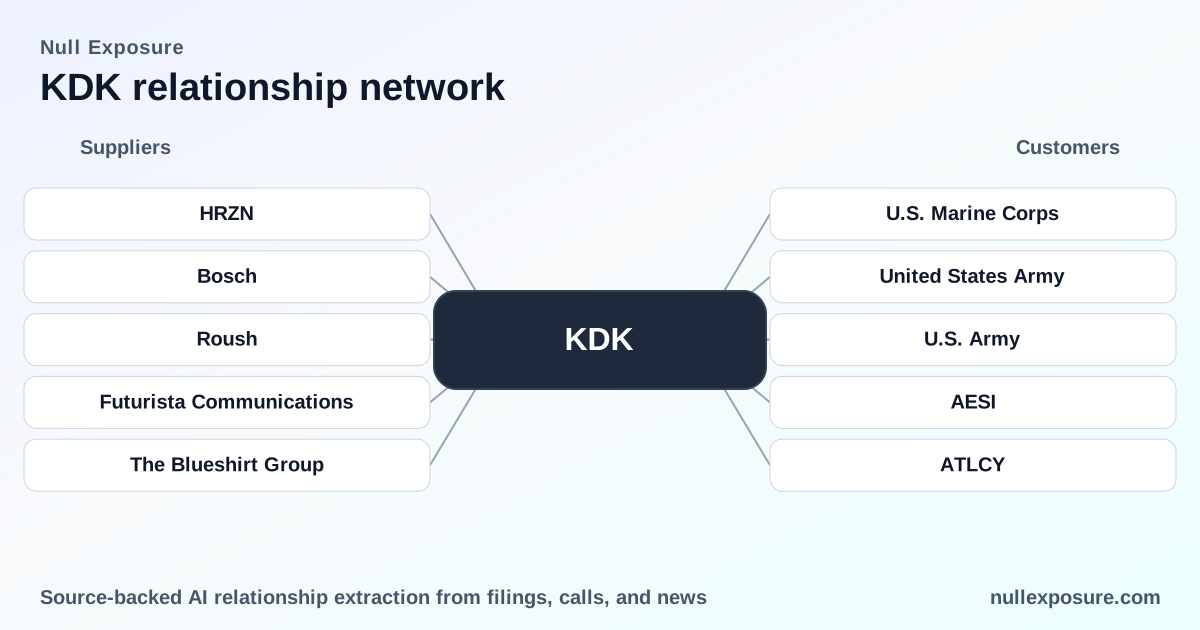
Kodiak AI (KDK): Customer Relationships Signal a dual commercial‑defense go‑to‑market with concentrated industrial scale
Kodiak AI builds and sells the Kodiak Driver — an AI-powered autonomous driving system — and monetizes through a combination of commercial fleet deployment agreements, truck orders, and defense program contracts. Revenue remains nascent versus operating losses, so the company’s trajectory is defined by converting pilot deployments into scale orders and funding defense integrations that raise strategic value for government customers.
For a concise, sourced snapshot of Kodiak’s customer footprint and what it implies for investors, continue below. For a focused data view and tracking of these relationship signals, visit https://nullexposure.com/.
Key takeaways up front
- Dual customer vector: Kodiak sells into commercial logistics (anchor customer Atlas/Atlas Energy Solutions and Martin Brower) and into defense programs (U.S. Army RCV work and a new U.S. Marine Corps award).
- Commercial concentration risk: Atlas is the clear commercial anchor; Atlas committed to an initial 100‑truck order and currently hosts the majority of Kodiak’s operational fleet.
- Strategic defense value: Military contracts (RCV, Marine ROGUE‑Fires) provide non‑recurring revenue and evidentiary value that supports product credibility and potential follow‑on funding.
- Early revenue base vs. operational scale: Kodiak reports Revenue TTM ~$3.8M while operating at large negative margins, so customer relationships are more strategic validation than near‑term margin drivers.
What the reporting actually documents — every relationship from the sources
U.S. Marine Corps
Kodiak announced a contract award from the U.S. Marine Corps to integrate the Kodiak Driver into an autonomous ground vehicle program, specifically for the ROGUE‑Fires carrier vehicle (press releases in February 2026). This is a program‑level development contract that positions Kodiak as an integrator for expeditionary military ground platforms (GlobeNewswire, Feb 11, 2026: https://www.globenewswire.com/news-release/2026/02/11/3236087/0/en/U-S-Marine-Corps-Awards-Kodiak-AI-Autonomous-Ground-Vehicle-Development-Contract.html).
United States Army
Kodiak has a prior, material engagement with the U.S. Army, having been selected in 2022 for the Robotic Combat Vehicle (RCV) program and received roughly $30 million under that engagement, positioning the company as a defense autonomous‑systems supplier (GlobeNewswire release summarizing RCV work, referenced in the company’s communications, FY2026 reporting: https://www.globenewswire.com/news-release/2026/02/11/3236087/0/en/U-S-Marine-Corps-Awards-Kodiak-AI-Autonomous-Ground-Vehicle-Development-Contract.html).
Atlas Energy Solutions (Atlas / AESI / ATLCY)
Atlas Energy Solutions is Kodiak’s commercial anchor in industrial logistics: Kodiak operates autonomous trucks in the Permian Basin under an Atlas agreement, Atlas committed to an initial 100‑truck order, and Kodiak has scaled to 20 fully driverless trucks in operation for Atlas after recent incremental deployments (FreightWaves Mar 2026; TruckNews May 2026; GlobeNewswire Mar–May 2026 reporting: https://www.freightwaves.com/news/kodiak-ai-partners-with-bosch-to-scale-autonomous-truck-platform and https://www.trucknews.com/technology/kodiak-doubles-driverless-fleet-unveils-triple-trailer-capability/1003211488/).
Martin Brower
Kodiak has expanded commercial routes beyond the Permian Basin with foodservice logistics partner Martin Brower, launching a second driverless route after initial deployments; this demonstrates the company’s move into repeatable industrial routes outside oil‑field logistics (MLQ.ai coverage, FY2026: https://mlq.ai/news/kodiak-ai-ceo-stresses-operations-as-key-to-autonomous-trucking-success/).
General Dynamics Land Systems
Kodiak is named as an integrator in a collaborative military program alongside General Dynamics Land Systems, participating in development of autonomous platforms tied to new counter‑UAS and high‑power microwave systems — signaling Kodiak’s role as a supplier to larger defense prime systems (markets.financialcontent.com coverage, Mar 2026: https://markets.financialcontent.com/stocks/article/gnwcq-2026-3-24-epirus-general-dynamics-land-systems-and-kodiak-ai-unveil-new-autonomous-hpm-system-for-counter-uas?Language=english%2F1000).
Epirus
Kodiak’s autonomous driving stack is integrated with Epirus’ Leonidas high‑power microwave payload on a commercial truck chassis to create the Leonidas AGV, reflecting Kodiak’s capability to serve as the autonomy layer on third‑party mission equipment platforms (financialcontent coverage, Mar 2026: https://markets.financialcontent.com/stocks/article/gnwcq-2026-3-24-epirus-general-dynamics-land-systems-and-kodiak-ai-unveil-new-autonomous-hpm-system-for-counter-uas?Language=english%2F1000).
FIX (Comfort Systems USA)
Analyst commentary on Comfort Systems USA (FIX) referenced Kodiak’s contribution to expanding a skilled workforce and project execution — an indirect signal that Kodiak’s engagements are influencing partner operational staffing and local construction/execution for large infrastructure projects (SimplyWallSt coverage, FY2026: https://simplywall.st/stocks/us/capital-goods/nyse-fix/comfort-systems-usa/future).
(If you want the raw press‑release trail and daily coverage consolidated in one place, see https://nullexposure.com/.)
How these relationships define Kodiak’s operating model and business model constraints
- Contracting posture: Kodiak operates a hybrid commercial‑and‑government contracting model — pursuing defense development contracts while scaling commercial anchor customers to convert technology into recurring revenue. Defense awards are programmatic and milestone‑driven; commercial agreements are landlord/route and fleet deployment oriented.
- Customer concentration: The commercial revenue and operational scale are concentrated around Atlas; Atlas’ public commitment to an initial 100 trucks plus the current 20 deployed fleet creates a single‑customer risk profile for industrial revenue.
- Criticality and strategic value: Defense partnerships (U.S. Army RCV, U.S. Marine Corps ROGUE‑Fires, integrations with primes like General Dynamics) give Kodiak strategic criticality beyond revenue contribution — these contracts generate validation, IP embedding, and potential follow‑on work from government budgets.
- Maturity and scale: Operational deployments are industrial but still limited relative to the trucking market. Kodiak’s reported Revenue TTM ~$3.8M and negative operating margins indicate a company in the commercial‑validation stage rather than mass scale (company financials, latest quarter 2025‑12‑31).
Upside drivers and principal risks for investors
- Upside drivers: conversion of Atlas and other pilot programs into sustained truck orders and SaaS/maintenance revenues; defense contract follow‑ons and prime integrations that open larger DoD budgets; margin improvement through scale and platform licensing.
- Principal risks: commercial concentration on Atlas, limited current revenue base relative to market opportunity, high cash burn while scaling hardware and operations, and the usual execution complexity of autonomous vehicle regulatory and safety regimes.
Bottom line
Kodiak’s customer relationships present a clear strategic duality: commercial anchor deployments that prove operational capability and a set of defense integrations that elevate the company’s strategic valuation. The investment case hinges on converting Atlas‑scale pilots into durable revenue streams while leveraging defense contracts for credibility and follow‑on growth. For continued monitoring of these relationship signals and their market impact, visit https://nullexposure.com/ for regular updates and consolidated sourcing.