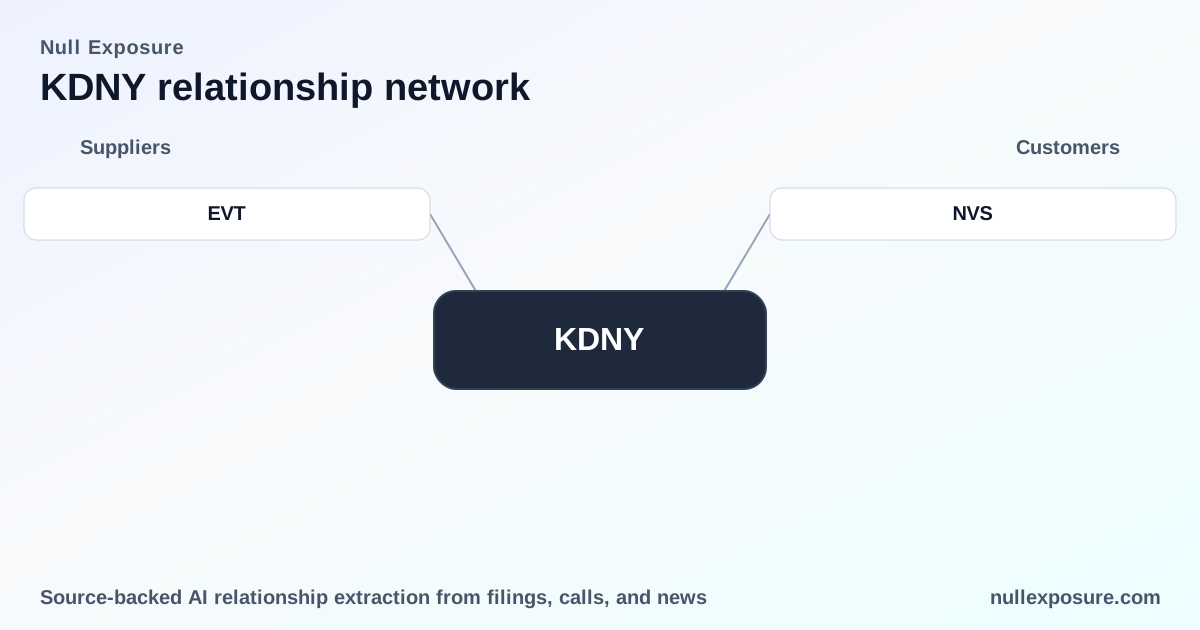
KDNY customer map: Novartis and Merck — what investors need to know
KDNY generates revenue through B2B contracts with major pharmaceutical companies, monetizing its capabilities by selling services and/or products into drug development and commercialization workflows. The company's customer roster includes large-cap industry names, which shapes its revenue stability, bargaining dynamics, and exposure to partnership-driven volatility. For more background on customer-level intelligence and verification, visit https://nullexposure.com/.
Why the customer list defines the investment thesis
KDNY’s commercial model is rooted in a small number of high-profile customers rather than broad retail distribution. That positioning produces two core realities for investors: strong counterparty credit on the revenue side when customers are investment-grade pharmas, and concentration risk on the downside if one of those relationships shifts or terminates. Contracting posture is therefore enterprise-oriented — long sales cycles, negotiated terms, and performance milestones are the likely norm.
The Novartis relationship and what it signals
Novartis is listed among KDNY’s customers in media-derived relationship data. Public reporting in March 2026 highlighted Novartis’s strategic activity in acquiring Chinook Therapeutics for US$3.5 billion, underscoring Novartis’s continued dealmaking in specialty therapeutics and adjacent capabilities that large pharma pursues through partnerships and acquisitions (Investors Business Daily, March 10, 2026 — https://www.investors.com/news/technology/kdny-stock-meet-chinook-the-company-novartis-is-spending-to-acquire/).
A separate May 2026 Globe and Mail piece traced talent flows from Chinook into new ventures, reinforcing that Novartis is actively consolidating kidney disease expertise and related teams (The Globe and Mail, May 3, 2026 — https://www.theglobeandmail.com/business/article-borealis-chinook-biotech/). For KDNY, having Novartis as a customer signals alignment with top-tier pharma priorities and access to deep-pocketed partners — but also exposure to strategic shifts at those partners.
The Merck connection in plain terms
Merck also appears in KDNY’s customer relationships as reflected in historical collaboration coverage. A GlobeNewswire release from June 2020 documented out-licensing and collaboration activity involving programs that had relationships with major pharma partners including Merck (GlobeNewswire, June 2, 2020 — https://www.globenewswire.com/news-release/2020/06/02/2042120/0/en/Aduro-Biotech-and-Chinook-Therapeutics-Announce-Definitive-Merger-Agreement.html). Merck’s presence on KDNY’s customer list provides additional validation that KDNY serves established commercial R&D players, which supports revenue quality but keeps the company tied to program-level decisions made by drug developers.
What the full relationship set tells investors
KDNY’s disclosed customer relationships in public reporting are concentrated among large pharmas. Taken together, these relationships imply:
- High-revenue-per-customer economics driven by enterprise contracts with global drug developers.
- Concentration risk because a small number of customers account for a disproportionate share of demand dynamics and negotiation leverage.
- Counterparty quality is strong: customers like Novartis and Merck provide reliable payment profiles and signal market validation for KDNY’s offerings.
- Strategic dependency on the product and portfolio decisions of customers — M&A, licensing, and R&D reprioritization at customers materially affects KDNY’s demand pipeline.
If you want a consolidated view of customer-level signals across your portfolio, explore our company pages at https://nullexposure.com/.
Operating-model constraints and business-model characteristics
Because the dataset of explicit constraints for KDNY is empty, these observations are presented as company-level signals rather than relationship-specific findings:
- Contracting posture: enterprise-sourced, negotiated agreements that likely include performance milestones and renewal-dependent revenues.
- Concentration: elevated — multiple data points reference the same counterparty class (large pharmaceutical groups), indicating a small number of high-impact customers.
- Criticality: customer importance to KDNY is high — loss of one major relationship would materially affect top-line stability, while each customer derives less existential risk from KDNY alone given their scale.
- Maturity: relationships are heterogeneous in vintage; public press references span transactional news and legacy collaborations, indicating a mix of established and transactional engagements rather than uniform long-term strategic partnerships.
Risks investors should weight
- Customer concentration risk: revenue volatility if one large customer reduces spend or changes providers.
- Program-level dependency: KDNY’s revenue is exposed to customers’ R&D and M&A cycles (for example, the Novartis acquisition activity reported in 2026 alters partner priorities).
- Negotiation leverage: large pharmas typically command favorable terms; KDNY must defend margin structure and contract duration.
Potential catalysts to watch
- New contract announcements with additional blue-chip pharma clients (reduces concentration).
- Renewals or expansions with Novartis and Merck reported in filings or press releases (confirms durable demand).
- Any public disclosures showing KDNY’s role in late-stage programs for customer pipelines (increases revenue visibility).
Bottom line for investors
KDNY sells into a small set of high-quality pharmaceutical customers, which delivers revenue credibility but concentrates execution risk. Novartis and Merck are explicitly present in the customer map through public reporting; those relationships anchor KDNY’s commercial positioning while creating single-counterparty exposure that investors must monitor through customer announcements and program developments.
For analysts building a thesis or scenario model, prioritize tracking: 1) contract renewals and milestone schedules, 2) customer program outcomes that drive spend, and 3) any diversification away from a few large customers. For ongoing monitoring and verification of customer-level signals, visit https://nullexposure.com/ for our company pages and relationship feeds.