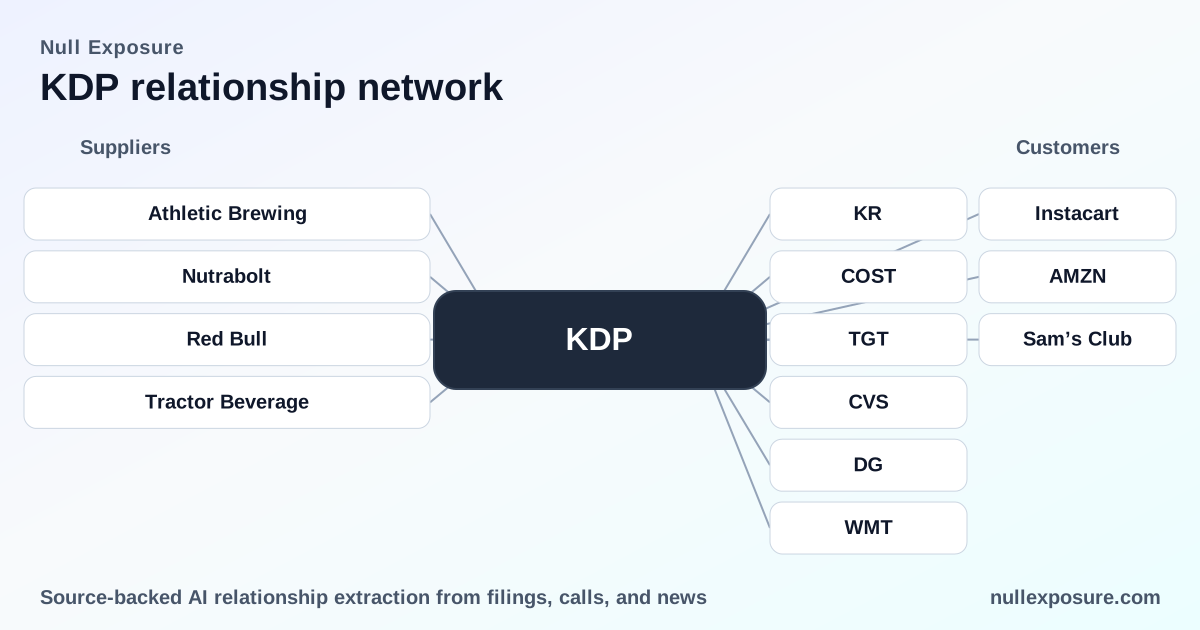
Keurig Dr Pepper (KDP): Customer Relationships That Drive Shelf Presence and Margin Stability
Keurig Dr Pepper monetizes through a dual-channel beverage model: manufacturing and selling branded beverages and single‑serve systems, and licensing long‑term manufacturing/distribution arrangements with bottlers and retailers. Revenue derives from finished goods sales to national retailers and wholesale distribution partners, while recurring income and margin stability stem from sticky category placements (K‑Cup pods, Dr Pepper SKUs) and exclusive, long‑dated bottler licenses.
For a concise map of those commercial ties and what they mean for investors, see NullExposure’s coverage at https://nullexposure.com/.
Why customer relationships are an investment-grade lens
Customer concentration, distribution exclusives, and retail placement determine KDP’s working capital cadence and pricing leverage. Large retail partners drive volume and promotional spend; bottler licenses lock in long-term footprint. That combination produces predictable cash flows in a consumer‑defensive sector but concentrates execution risk around a handful of major accounts.
Customer map: who moves KDP’s products and why it matters
Below is a line-by-line review of every customer relationship flagged in public sources. Each entry is a plain-English take with the cited source.
Coca‑Cola Consolidated (COKE)
Coca‑Cola Consolidated distributes products for several beverage companies, and public filings and press reporting list Keurig Dr Pepper among those lines it distributes in its territories, providing KDP with regional distribution capacity beyond its own network. According to MarketScreener coverage, Coca‑Cola Consolidated explicitly includes Keurig Dr Pepper in its distributor mix (March 2026).
Source: MarketScreener, Coca‑Cola Consolidated press coverage (Mar 9, 2026; May 2, 2026).
Walmart (WMT)
Walmart is a named major customer in KDP’s 2024 Form 10‑K, accounting for more than 10% of total net sales, which places Walmart in the company’s top‑tier concentration bucket and directly influences promotional intensity and private‑label assortment. KDP’s 10‑K lists Walmart as a material customer across multiple segments (FY2024).
Source: Keurig Dr Pepper 2024 Form 10‑K (filed FY2024; disclosure surfaced Feb 2026).
Target (TGT)
National chains such as Target are core retail outlets for Dr Pepper and other KDP brands; these relationships secure shelf space and promotional support in mid‑market department grocery assortments. This placement is referenced in market writeups describing Dr Pepper’s national retail footprint (March 2026).
Source: ad‑hoc‑news overview of Dr Pepper retail distribution (Mar 10, 2026).
Costco (COST)
Costco carries multi‑packs and club formats for KDP brands, providing high‑velocity, bulk sales that complement supermarket and convenience formats and help smooth channel mix volatility. Retail coverage lists Costco among national chains carrying Dr Pepper (Mar 10, 2026).
Source: ad‑hoc‑news retail overview (Mar 10, 2026).
CVS (CVS)
CVS represents the convenience and pharmacy channel for KDP SKUs, supporting everyday single‑serve and impulse purchases that drive higher ASPs and margin per unit. Press coverage cites CVS as a national chain stocking Dr Pepper (Mar 10, 2026).
Source: ad‑hoc‑news retail overview (Mar 10, 2026).
Dollar General (DG)
Dollar General brings KDP exposure to discount and rural markets where small‑format pack sizes and price promotions are important; the chain is listed among national outlets carrying Dr Pepper (Mar 10, 2026).
Source: ad‑hoc‑news retail overview (Mar 10, 2026).
Kroger (KR)
Kroger anchors grocery exposure and trading‑area scale for KDP brands, driving category promotions and national private‑label comparisons; Kroger is named in reporting as a leading retailer for Dr Pepper (Mar 10, 2026).
Source: ad‑hoc‑news retail overview (Mar 10, 2026).
Sam’s Club
Sam’s Club operates as a bulk/warehouse channel partner for KDP consumer packs, similar to Costco in format and volume concentration; industry coverage groups Sam’s Club with club retailers that stock Dr Pepper (Mar 10, 2026).
Source: ad‑hoc‑news retail overview (Mar 10, 2026).
Amazon Fresh / Amazon (AMZN)
Online grocery channels including Amazon Fresh list Dr Pepper multi‑packs and mini‑cans, giving KDP incremental direct‑to‑consumer visibility and a digital pricing channel that impacts assortment strategy. Coverage of online grocery listings highlights Amazon Fresh (Mar 10, 2026).
Source: ad‑hoc‑news on online grocery listings (Mar 10, 2026).
Instacart
Instacart and similar online grocery apps carry KDP SKUs, extending promotional mechanics and price elasticity analysis into the digital basket where competitive pricing and delivery fees affect unit economics. Industry reporting includes Instacart among the online platforms listing Dr Pepper (Mar 10, 2026).
Source: ad‑hoc‑news on online grocery listings (Mar 10, 2026).
Pizza Inn / RAVE (RAVE)
KDP partners with restaurant chains for themed marketing activations; Pizza Inn’s collaboration to create in‑store "Fansville" experiences demonstrates KDP’s use of restaurant partnerships to drive brand engagement beyond retail. RestaurantNews reported a Dr Pepper partnership with Pizza Inn for promotional sweeps (Mar 10, 2026).
Source: RestaurantNews coverage of Pizza Inn partnership (Mar 10, 2026).
Starbucks (SBUX)
KDP completed the JDE Peet’s acquisition and announced renewed agreements around Starbucks‑branded K‑Cup pods, underlining KDP’s role as a holder of licensed pod manufacturing and brand relationships in the single‑serve coffee category. SimplyWallSt summarized these developments alongside Q1 2026 results (May 3, 2026).
Source: SimplyWallSt news on KDP Q1 2026 and Starbucks K‑Cup agreements (May 3, 2026).
J.M. Smucker / SJM (SJM)
J.M. Smucker’s filings identify Keurig as a single‑source supplier for K‑Cup pods used in the Keurig system, which signals supplier concentration in the pod ecosystem and reciprocal dependency between CPG brand owners and KDP’s manufacturing. SJM’s 2025 Form 10‑K notes Keurig as the single‑source supplier (FY2025).
Source: SJM 2025 10‑K (filed Apr 30, 2025).
Operating model constraints and what they signal for investors
- Contracting posture — long‑term, exclusive bottler licenses: KDP states that in the U.S. and Canada it typically grants exclusive, long‑term manufacturing and distribution licenses to bottlers for defined geographies. This is a strategic restraint that preserves footprint and shelf continuity while limiting short‑term renegotiation risk.
- Geographic focus — North America centric: Public disclosures position KDP as a leading beverage company in North America, indicating that revenue sensitivity is concentrated on NA retail and wholesale channels rather than being broadly global.
- Concentration — material retail customers: Walmart is explicitly disclosed as accounting for more than 10% of net sales, creating a material concentration risk that influences pricing, promotions, and net working capital exposure.
- Relationship roles — manufacturer, distributor, seller: KDP operates across the value chain—manufacturing pods and beverages, distributing via bottlers, and selling to retailers—giving it control over margins but also exposing it to channel execution complexity.
- Maturity — institutionalized partnerships: The combination of long‑term licenses and repeat retail listings points to mature, contractualized relationships rather than ad hoc spot sales, supporting stable cash flow but concentrating contract renewal risk.
Investment implications: where the risk and optionality lie
KDP’s model delivers stable, defensive cash flows underpinned by a small set of powerful retail partners and long‑dated bottler contracts. The core upside for investors is margin expansion from pod volumes and cross‑category mix improvement (coffee plus cold beverages) following the JDE Peet’s integration and renewed licensed partnerships. The core downside is customer concentration and promotional intensity, particularly the outsized share tied to Walmart.
For deeper commercial signal monitoring and scenario modeling, visit NullExposure’s research hub at https://nullexposure.com/.
Bottom line: KDP’s customer network is broad across national retailers and online platforms, but a handful of relationships—anchored by Walmart and long‑term bottler licenses—drive the company’s revenue and operational leverage. Investors should balance that stability against concentration and promotional risk when building positions.