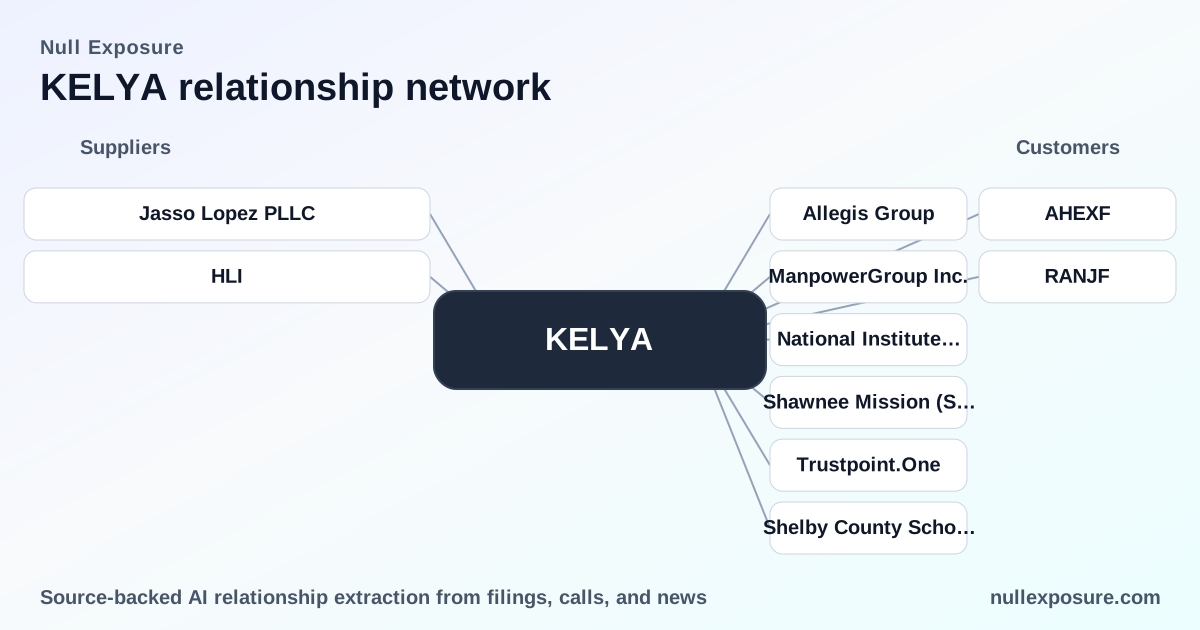
KELYA Customer Relationships: Who Kelly Services Sells To and Why It Matters for Investors
Kelly Services operates as a global specialty staffing and workforce-solutions provider that monetizes by placing temporary and permanent talent, delivering outcome-based projects, and outsourcing payroll and recruitment functions to employers across sectors. Revenue is transaction-driven—largely billed on an hourly or per-unit basis for temporary staffing—while outcome and RPO/MSP contracts supplement recurring services. For deeper coverage of customer exposures and signals, visit https://nullexposure.com/.
How Kelly’s commercial model translates into cash flow
Kelly generates the bulk of its revenue by contracting to supply labor and talent solutions to a broad customer base. The company invoices temporary staffing on an hourly or per-unit basis, recognizes revenue when the service is delivered, and complements this with outcome-based engagements and payroll or MSP arrangements that have longer-term billing profiles. According to Kelly’s FY2025 disclosure, no single customer accounted for more than 10% of consolidated revenue and no one government contract exceeded roughly 2% of total revenue, which drives a low concentration risk profile but reinforces dependence on volume and efficient matching.
Kelly reports material operations across the Americas, Europe and Asia-Pacific, with North America—especially the United States—making up the dominant share of revenue in FY2025. This geographic mix creates currency and regional demand exposure but also dilutes counterparty concentration.
Operating constraints and what they reveal about risk and strength
The company-level disclosures present a clear set of operational characteristics that shape customer risk and contract dynamics:
- Contracting posture: short-term, transaction-led billing. Kelly invoices most staffing services by the hour or unit, which supports cash flow visibility but increases revenue cyclicality tied to employment demand.
- Counterparty mix: government, education, mid-market and very large enterprises. The client base spans small and mid-sized employers to Fortune 500 companies and government/education institutions, which diversifies revenue types and payment-risk profiles.
- Geographic maturity: global footprint with North America concentration. Revenue is materially concentrated in the Americas, supporting stable demand in the U.S. while exposing Kelly to regional labor-market cycles.
- Materiality: low single-customer concentration. No customer represented more than 10% of revenue in FY2025 and no single government contract represented more than about 2% of revenue—this lowers client-default risk but means overall performance depends on broad market demand rather than a few large contracts.
- Role and stage: active service provider with scale in staffing and outsourcing. Kelly remains a large provider of temporary and permanent staffing, RPO, MSP and payroll outsourcing; the firm reported placing approximately 375,000 workers in 2025.
These constraints collectively mean Kelly’s earnings are resilient to single-client shocks but sensitive to macro labor demand, margin pressure from competitive pricing, and the operational complexity of scaling hourly-billed services.
Customer landscape, one relationship at a time
Below are every customer or counterparty referenced in the collected results, with a concise plain-English summary and the original source noted.
Allegis Group — competitor listed in the FY2025 10‑K
Kelly names Allegis Group among its largest competitors in its FY2025 10‑K filing, positioning Allegis as a direct market rival in staffing and workforce solutions. According to the FY2025 10‑K, Allegis is listed alongside Randstad, Adecco and ManpowerGroup as principal competitors.
ManpowerGroup Inc. — competitor listed in the FY2025 10‑K
ManpowerGroup is cited in the FY2025 10‑K as one of Kelly’s largest competitors, underscoring the company’s placement in a concentrated global staffing market where pricing and scale determine share. The FY2025 10‑K explicitly groups ManpowerGroup with Randstad, Adecco and Allegis.
National Institutes of Health (NIH) — awarded a multi‑year contract (public sector)
Kelly was reported to have been awarded a five‑year contract with the NIH, reflecting the company’s capacity to win multi‑year public-sector engagements in scientific and clinical staffing. A news report covering the award notes the five-year NIH contract and cites Kelly as the contractor.
Shawnee Mission School District — education outsourcing partner for substitute staffing
Kelly Education is the district’s substitute services partner and filled roughly 90.81% of classroom openings, demonstrating Kelly’s role as a primary staffing vendor for a large U.S. school district. Local reporting on substitute-pay and staffing performance documents the partnership and fill-rate statistic in FY2023.
Trustpoint.One — purchaser of Kelly’s legal division in a corporate transaction
Kelly sold its Kelly Legal Managed Services unit to Trustpoint.One in a prior restructuring, signaling selective divestitures as part of portfolio management rather than a customer relationship. Industry coverage of the 2019 transaction records the divestiture to Trustpoint.One for an undisclosed sum.
Shelby County Schools — contracted to staff facilitators
Local reporting shows Shelby County Schools contracted with Kelly Services to provide facilitators, illustrating Kelly’s footprint across U.S. K‑12 districts as a supplier of temporary and specialist education staff. The 2021 coverage references contract documents showing Kelly as the staffing provider.
Adecco Group — competitor cited in the FY2025 10‑K
Adecco Group is included by name in Kelly’s FY2025 10‑K as a primary competitor, highlighting major global staffing firms that set pricing and service benchmarks in the labor‑supply market. The FY2025 10‑K enumerates Adecco alongside Randstad, ManpowerGroup and Allegis.
RANJF — identifier associated with Randstad in the FY2025 10‑K results
The results include RANJF as an identifier associated with Randstad when Kelly lists its principal competitors in the FY2025 10‑K, reinforcing that Randstad is a named peer in international staffing markets. The FY2025 10‑K uses Randstad (and the RANJF reference in the results) in describing competitive peers.
Randstad — competitor listed in the FY2025 10‑K
Randstad is named explicitly in Kelly’s FY2025 10‑K as one of its largest competitors, confirming competitive pressure from global staffing conglomerates. The FY2025 10‑K places Randstad alongside Adecco, ManpowerGroup and Allegis.
Key takeaways for investors and operators
- Low single-customer concentration reduces revenue tail‑risk from client loss, but also means macro demand drives performance. FY2025 disclosures confirm no single customer >10% of revenue and no government contract >2%.
- Revenue mix is largely short‑term and hourly-billed, which supports cash conversion but results in sensitivity to employment cycles and margin compression.
- Government and education are material client segments, giving Kelly access to multi‑year public contracts while adding procurement and compliance complexity.
- Competitive landscape is dominated by a few global players—Randstad, Adecco, ManpowerGroup and Allegis—so pricing and scale advantages remain strategic risks.
For a systematic view of customer exposures and how they translate into credit and operational risk, see the platform summary at https://nullexposure.com/.