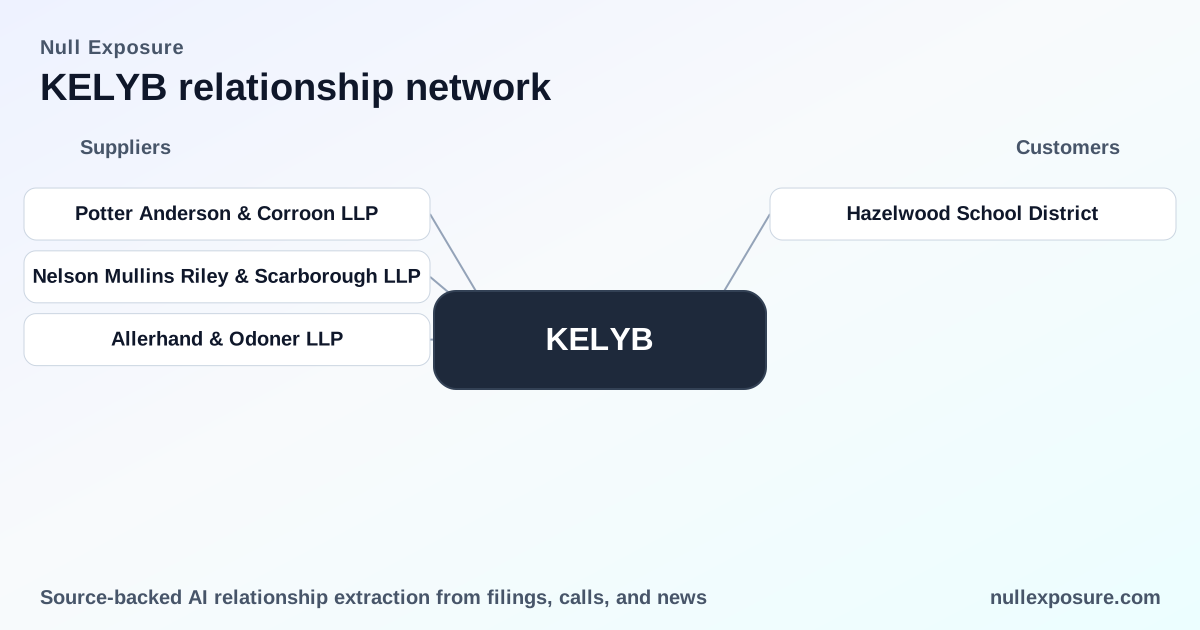
Kelly Services B (KELYB) — Customer Intelligence: Hazelwood School District
Kelly Services monetizes a global workforce platform by selling hourly staffing, permanent placement fees and outcome-based talent solutions to public and private employers. The company’s core revenue is usage-based hourly billing for temporary staff and payroll services, supplemented by recruiting and managed services; this structure produces high revenue throughput but correlates directly with labor demand and client staffing volumes. For deeper, customer-level intelligence and relationship mapping, visit https://nullexposure.com/.
Why the Hazelwood relationship matters to investors
Hazelwood School District engaged virtual-instruction provider Stride for several classrooms and contracted classroom facilitators to maintain on-site supervision; when facilitators are hired through Kelly Services, Hazelwood’s programed staffing costs rise materially. A March 2026 report by The Pitch KC documented that Hazelwood’s Stride rollout included facilitator costs of $35,000–$50,000 per classroom when sourced via Kelly Services, and that the district planned to spend roughly $1.3 million for Stride services at Hazelwood East alone (news report, March 10, 2026).
Hazelwood School District — what the relationship is, in plain English
Hazelwood contracted Stride for virtual teaching and used Kelly Services to supply on-site facilitators who supervise students in Stride-taught classrooms; Kelly therefore acts as a service provider supplying temporary educational staff to a U.S. public-school customer. The Pitch KC reported the facility-level cost range and the district’s planned spend for the initiative (The Pitch KC, March 2026).
How this single relationship fits Kelly’s operating model
Kelly’s customer relationships are characterized by a few consistent business-model attributes that shape economics and risk:
- Usage-based contracting: Kelly invoices staffing services on an hourly or unit basis, so revenue scales directly with hours deployed. This drives strong top-line sensitivity to labor demand cycles and client scheduling patterns; the company discloses staffing contracts are generally negotiated and invoiced per hour or per unit (company filings, FY2025).
- Broad counterparty mix: Kelly serves a continuum of clients—from mid-market firms to very large enterprises and government and education institutions—so client types include public-sector customers like Hazelwood as well as Fortune 500 companies (company disclosures).
- Geographic diversification: The business operates across the Americas, Europe and Asia-Pacific, which provides revenue diversification but introduces operational complexity and local compliance requirements (company filings).
- Low single-contract concentration: Kelly reports that no single contract represented more than 2% of total revenue in 2025, indicating low counterparty concentration and limited single-customer revenue risk (company disclosures, FY2025).
- Service-provider posture: The company’s role is predominantly that of a seller and service provider—delivering temporary staffing, RPO, MSP and payroll outsourcing rather than long-term capital goods—creating recurring, transaction-driven cash flows (company filings).
Those characteristics explain why the Hazelwood engagement is economically meaningful at a program level (tens of thousands per room) but immaterial to enterprise revenue concentration, consistent with the company’s disclosure that no one contract exceeds 2% of revenue.
Financial context that frames customer risk
Kelly’s latest reported quarter (through 2025-12-31) shows revenue of approximately $4.25 billion and EBITDA around $97 million, but the company is running negative net income per share (Diluted EPS -7.24) and a negative profit margin (~-6%), indicating thin overall profitability despite high revenue throughput (company financials, latest quarter). Enterprise multiples are modest — EV/Revenue ~0.11 and EV/EBITDA ~15.4 — suggesting the market values Kelly as a low-margin, high-volume service operator.
- Implication for customer exposure: Usage-based revenue and low contract concentration lower catastrophic counterparty risk, but margins are thin enough that loss of scale or weak utilization trends (e.g., lower demand for school-year facilitation or delays in contract starts) will compress profits quickly.
- Public-sector dynamics: Working with school districts and other government entities requires compliance, background checks, and multiyear procurement processes; these contracts can be stable when secured but are typically price-competitive and administratively burdensome.
Relationship-by-relationship summary (complete coverage)
Hazelwood School District — Kelly provides classroom facilitators to support Stride virtual instruction; the district’s rollout included planned spending of roughly $1.3 million at Hazelwood East, with facilitator costs of $35,000–$50,000 per room when sourced via Kelly Services (The Pitch KC, March 10, 2026).
Investment implications and what to watch
- Revenue sensitivity: Kelly’s usage-based billing model is a double-edged sword — it accelerates revenue with hiring demand but pushes operating leverage downward when utilization falls. Monitor quarterly staffing hours and utilization metrics relative to revenue guidance.
- Contract immateriality: With no single contract >2% of revenue (2025 disclosures), headline risk from individual customer disputes is limited, but cumulative losses across many small contracts during a weak labor cycle will still impact margins materially.
- Public and education exposure: Contracts like Hazelwood’s highlight Kelly’s exposure to education procurements; investors should track policy shifts around virtual instruction and school budgeting cycles, which can create step changes in demand for facilitator services.
- Margin recovery levers: Given the thin profitability, margin improvement will require either higher-rate placements, improved pricing on managed services, or scale efficiencies in payroll/process outsourcing.
For sector-level customer intelligence and to map additional counterparty relationships with the same rigor, see https://nullexposure.com/.
Final read
Kelly operates as a high-throughput, usage-priced staffing aggregator with global reach and diversified counterparty exposure. The Hazelwood School District engagement underscores Kelly’s role in public-sector, program-level staffing where individual engagements can be significant at the program level but are not material to company-wide concentration metrics. Investors should balance the company’s revenue scale against thin profitability and monitor utilization trends and public-sector procurement developments as primary drivers of near-term performance.