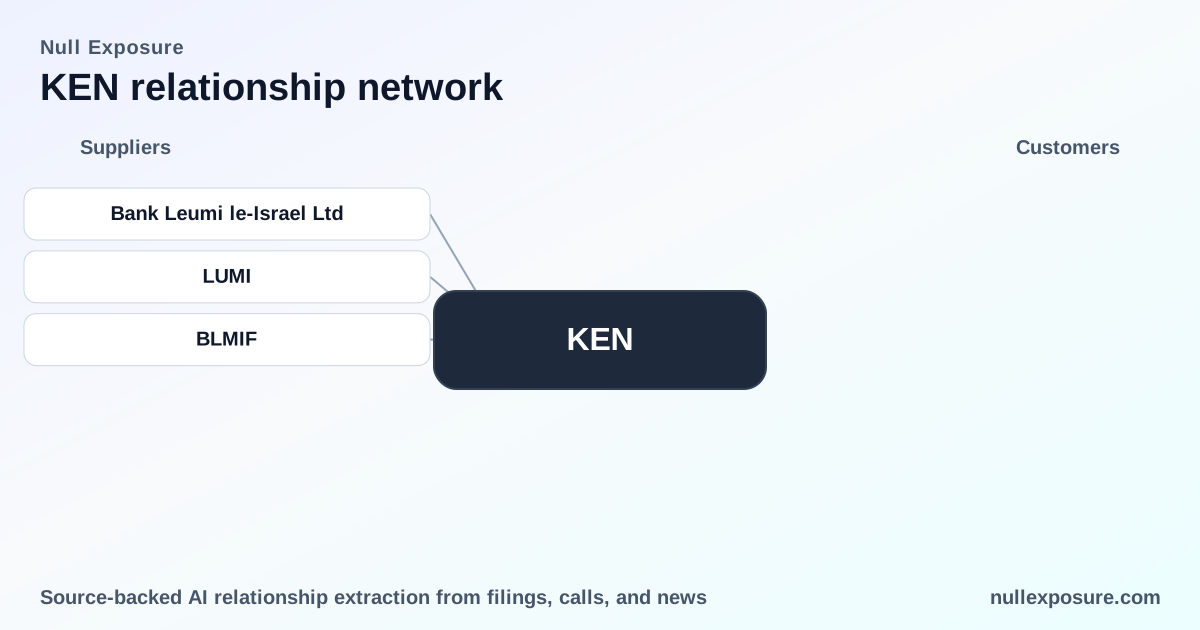
Kenon Holdings (KEN) — Customer relationship briefing for investors and operators
Kenon Holdings is an owner, developer and operator of power-generation assets in Israel and internationally, monetizing through the sale of electricity and the cash flows of its project portfolio. Revenue is generated primarily from long‑term offtake and power‑sale relationships with large counterparties, while capital allocation decisions and dividends (Kenon’s FY dividend per share was $3.85; dividend yield ~4.14%) drive investor returns. For deeper signal-level diligence on customer exposure and concentration, visit https://nullexposure.com/.
H2: Quick thesis — why customer relationships matter for Kenon Kenon’s business is a contract-driven utility play: cash flow stability and valuation depend directly on who buys the power, how those contracts are priced and indexed, and how concentrated revenue is across counterparties. Where a single counterparty accounts for the dominant share of sales, counterparty credit, contract tenure and renegotiation risk become the company’s principal operational exposures. The company-level financial metrics (TTM revenue roughly $872M; operating margin ~9.4%) frame scale, but counterparty detail determines near-term earnings volatility and the tilt of capital deployment.
H2: Customer roster — what the available signals show This section covers every customer relationship captured by the source feed. Each relationship is summarized in plain language with the original source cited.
H3: OPC Israel — the dominant buyer According to an Intellectia financial summary (FY2026), OPC Israel accounted for 79.7% of reported sales, equivalent to $212.00M. This single-customer concentration is material for near-term revenue and cash-flow predictability (Intellectia, May 2026 — https://intellectia.ai/en/stock/KEN/financials).
H3: CPV — a secondary revenue stream Intellectia’s FY2026 note also lists CPV as “another important revenue stream,” indicating a meaningful but unspecified contribution beneath OPC Israel’s dominance (Intellectia, May 2026 — https://intellectia.ai/en/stock/KEN/financials).
H2: What these relationships imply about Kenon’s operating model
- Concentration: The data establishes very high customer concentration in FY2026. With OPC Israel reported at nearly 80% of sales, Kenon’s revenue profile is effectively single-counterparty driven in the period covered. That concentration elevates earnings and liquidity sensitivity to that counterparty’s credit and contract stability.
- Contracting posture: Kenon operates like an independent power producer with bilateral offtake relationships. The economics and risk transfer depend on contract tenors, price-indexation clauses and credit support language; those details are not present in the feed and must be confirmed in counterparty contracts or company disclosures.
- Criticality: For the buyer side, an arrangement where one buyer purchases the bulk of output suggests operational criticality — Kenon’s asset utilization and cash generation are tied to that buyer’s consumption profile. For investors, criticality means operational disruption or a contract termination would have immediate EBITDA impact.
- Maturity and disclosure: The source feed does not surface contract maturities or explicit guarantees. Company-level signal: no contract-level constraints were captured in the search feed, so investors should treat contract maturity and credit enhancement as open due diligence items.
H2: Risk and value levers — what to monitor Kenon’s valuation and operational risk profile are shaped by a narrow set of indicators tied to these customers:
- Counterparty credit risk: With OPC Israel representing the bulk of sales in FY2026, validate OPC Israel’s balance sheet, payment history and any credit support (parent guarantees, letters of credit).
- Contract length and pricing mechanics: Long-term fixed-price offtakes reduce volatility; short-term or index-linked contracts transfer commodity and regulatory risk back to Kenon.
- Concentration mitigation: Track whether management is pursuing merchant diversification, additional PPAs or asset sales to reduce single-counterparty dependence.
- Regulatory and geopolitical exposure: Kenon’s Israeli assets are subject to local regulatory regimes; a dominant local buyer increases sensitivity to domestic policy shifts.
- Dividend sustainability and capex: Given Kenon’s dividend profile and modest operating margins, customer stability is a direct input to free cash flow available for distributions.
H2: Investment implications and next steps for diligence
- Primary takeaway: Customer concentration is the defining operational risk for Kenon in FY2026 — OPC Israel is the economic center of gravity for sales.
- Institutional buyers should demand contract-level information: tenor, termination triggers, price indexation, and credit support. Operators evaluating counterparties should obtain payment histories and performance metrics.
- Monitor CPV’s contribution on a quarterly basis; although described as “important,” the absence of quantified share implies it is materially smaller than OPC Israel in the period cited.
For actionable, source-level signals and continuous monitoring of Kenon’s customer exposures, consider a subscription at NullExposure: https://nullexposure.com/.
H2: Bottom line — how to position on Kenon’s customer profile Kenon is a utility-scale operator whose near-term cash-flow and dividend profile are highly dependent on a very small number of counterparties, with OPC Israel explicitly reported as the dominant buyer in FY2026 and CPV noted as a secondary stream. That structure produces a clear risk/reward: stable returns when contracts and counterparties perform, and concentrated downside when one counterparty’s credit or contractual terms change. Investors and operators should prioritize contract diligence and counterparty credit analysis ahead of valuation adjustments or operational plans.
Sources referenced in this briefing include Intellectia’s Kenon financial summary and relationship notes (May 2026) accessed at https://intellectia.ai/en/stock/KEN/financials.