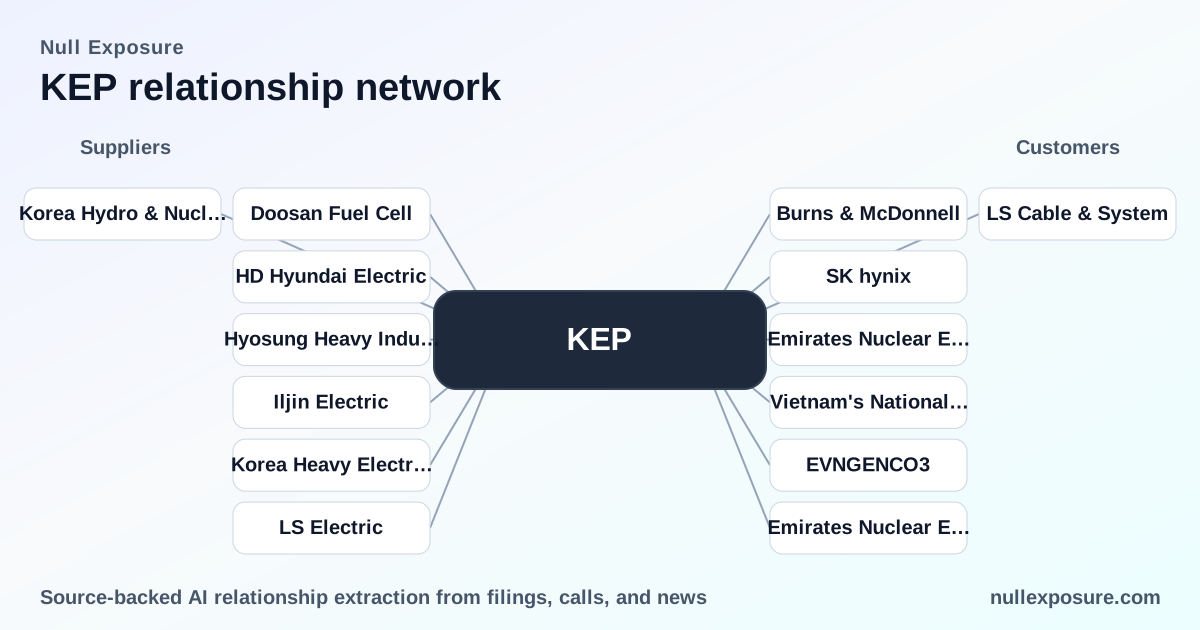
KEP Customer Landscape: Strategic partners, export muscle, and concentrated national exposure
Korea Electric Power Corporation (KEPCO, ticker KEP) is an integrated utility that monetizes through regulated domestic electricity sales and an expanding suite of engineering, construction and consulting services exported alongside Korean-built generation and grid projects. Domestic tariffs and capital-intensive infrastructure give the company stable cash flow, while overseas EPC, digital-platform and transmission consulting contracts create incremental, higher-margin revenue and project risk exposure. For a focused view on customer-level exposures and how they drive revenue mix, see NullExposure’s coverage: https://nullexposure.com/.
How KEPCO operates with customers — contracting posture, concentration and criticality
KEPCO operates as a state-influenced, capital-intensive incumbent utility that balances regulated monopoly cash flows with competitive, contract-based international projects. Key operating-model signals for investors:
- Contracting posture: Long-term, government-backed domestic franchise on power generation and distribution, paired with fixed-price and negotiated EPC/consulting contracts internationally; government coordination is a consistent feature of major projects.
- Concentration: Heavy domestic customer base and a relatively small set of large strategic counterparties for export projects and industrial off-takers, increasing single-project concentration risk on major overseas contracts.
- Criticality: KEPCO provides essential infrastructure — projects for strategic industrial clients (e.g., chip fabs) or national-scale transmission lines are mission-critical for counterparties, which supports stickiness but raises political and sovereign risk.
- Maturity: The core utility business is mature and cash-generative; international business lines are commercial extensions with project-level variability and litigation exposure.
These characteristics shape a hybrid risk profile: stable regulated earnings plus episodic project risk from international customers and strategic industrial partners.
Customer relationships — what was observed (all results covered)
Burns & McDonnell (BusinessKorea, March 2026)
KEPCO has agreed to provide technical consulting—including design review and equipment performance testing—for Burns & McDonnell’s U.S. 765kV transmission grid projects, leveraging KEPCO’s domestic experience with extra-high-voltage systems. Source: BusinessKorea, March 2026 — https://www.businesskorea.co.kr/news/articleView.html?idxno=260736
SK hynix MOU for underground power grid (Korea JoongAng Daily, Jan 2026)
KEPCO signed an MOU with the Gyeonggi provincial government to construct an underground power grid that will allow SK hynix to secure roughly 3 GW of additional capacity for new fabrication plants at the Yongin complex. Source: Korea JoongAng Daily, January 22, 2026 — https://koreajoongangdaily.joins.com/news/2026-01-22/business/economy/Gyeonggi-govt-Kepco-sign-MOU-to-build-underground-power-grid-for-SK-hynixs-chip-manufacturing-complex/2506641
Emirates Nuclear Energy (Korea JoongAng Daily, March 2026)
KEPCO is negotiating a settlement for additional costs with Emirates Nuclear Energy, the project owner that commissioned the UAE nuclear plant, reflecting active dispute resolution and cost-recovery negotiation on a large overseas nuclear contract. Source: Korea JoongAng Daily, March 27, 2026 — https://koreajoongangdaily.joins.com/news/2026-03-27/business/industry/Kepco-KHNP-reportedly-agree-to-resolve-UAE-plant-project-dispute-at-home/2555632
Emirates Nuclear Energy Company — ENEC cost dispute (Pulse / MK, March 2026)
KHNP demanded reimbursement from KEPCO while KEPCO insists that additional costs must first be recovered from ENEC, underscoring contractual pass-through and client-collection complexity on nuclear EPC projects. Source: Pulse (March 2026) and complementary MK coverage — https://pulse.mk.co.kr/news/english/11931383
PSEG technical cooperation (MK / AJU Press, April–May 2026)
KEPCO will provide technical consulting and cooperate with U.S. utility PSEG on 765kV extra-high-voltage transmission projects in the United States, signaling KEPCO’s strategy to export grid engineering know-how to developed markets. Source: MK and AJU Press reporting (April–May 2026) — https://www.mk.co.kr/en/economy/12029765 and https://m.ajupress.com/amp/20260428141770454
EVNGENCO3 IDPP contract in Hanoi (BusinessKorea, March 2026)
KEPCO signed a contract to supply an Intelligent Digital Power Plant (IDPP) platform to EVNGENCO3 in Hanoi, representing direct sales of digital control and plant-optimization technology to a major Vietnamese state utility affiliate. Source: BusinessKorea, March 6, 2026 — https://www.businesskorea.co.kr/news/articleView.html?idxno=264700
PVN MOU on Ninh Tuan Nuclear No.2 (MK, August 2025 reporting referenced in 2026 coverage)
KEPCO signed an MOU with Vietnam’s National Industrial Energy Corporation (PVN) related to the Ninh Tuan nuclear project, which expands KEPCO’s footprint in Southeast Asian nuclear and large-generation project discussions. Source: MK coverage (reported in FY2026 cycle) — https://www.mk.co.kr/en/economy/11938220
LS Cable & System partnership on SFL-R integration (Offshore-Energy, March 2026)
KEPCO integrated its Smart Fault Locator – Real Time (SFL-R) into LS Cable & System’s cable asset-management platform, creating a combined offering for underground and submarine cable diagnostics and operations. Source: Offshore-Energy, March 2026 — https://www.offshore-energy.biz/south-korean-duo-working-together-to-globalize-hvdc-asset-management-solutions/
SK hynix (duplicate listing with local ticker) (Korea JoongAng Daily, March 2026)
Reiterating the strategic role of the Gyeonggi MOU, KEPCO’s underground grid investment is explicitly linked to SK hynix’s expansion and capacity needs at Yongin, reinforcing the utility’s role as a capacity enabler for large industrial off-takers. Source: Korea JoongAng Daily (March 2026) — https://koreajoongangdaily.joins.com/news/2026-03-27/business/industry/Kepco-KHNP-reportedly-agree-to-resolve-UAE-plant-project-dispute-at-home/2555632
Emirates Nuclear Energy Company (Korea Times, Feb–Mar 2026)
Government officials advised KEPCO and KHNP to resolve the legal dispute over the UAE plant at home, highlighting political and sovereign dimensions to the ENEC cost-recovery negotiation. Source: Korea Times, February–March 2026 — https://www.koreatimes.co.kr/amp/business/companies/20260227/govt-advises-kepco-khnp-to-resolve-legal-dispute-over-uae-plant-project-at-home
What these customer ties imply for valuation and risk
- Revenue diversification through exports: Partnerships and contracts with PSEG, Burns & McDonnell, EVNGENCO3, PVN and LS Cable & System show KEPCO converting domestic engineering capabilities into international fee and product sales, supporting an uplist in non-regulated revenue streams.
- Project and legal risk concentration: The recurring ENEC/ENEC-company dispute illustrates a material counterparty and contract-collection risk that can create episodic costs or reserves affecting near-term earnings.
- Strategic domestic customers drive large capital projects: The SK hynix MOU demonstrates KEPCO’s role as a critical infrastructure enabler for strategically important industrial clients, which produces revenue visibility but also deep single-client concentration for project-level spending.
- Technology export and platform monetization: The IDPP sale and SFL-R integration indicate a move into digital and diagnostics products that generate recurring service and license-like revenue, enhancing margin profile over time.
For a consolidated view of counterparties, exposures and the project timeline that informs cash-flow risk, visit NullExposure: https://nullexposure.com/.
Bottom line for investors
KEPCO combines a low-beta, regulated earnings base with a growing—but uneven—portfolio of international EPC, consulting and digital sales. The upside is better margin mix and export-driven growth; the primary risk is concentrated, project-level dispute and cost-recovery exposure (illustrated by the ENEC case) and the political overlay in large nuclear and cross-border projects. Investors should value KEPCO as a cash-generative utility with incremental execution risk tied to a small set of large, strategic counterparties and government coordination.
No relationship-level constraints were presented in the source material; company-level signals described above capture the operating posture, concentration and maturity profile that define KEPCO’s customer-driven revenue model.