Kirby Corporation (KEX): Customer relationships and what they mean for investors
Kirby Corporation operates the largest domestic tank barge fleet in the United States and monetizes through two core vectors: tank-barge transportation services (KMT) that haul petrochemicals, refined products and agricultural chemicals, and a distribution & services business (KDS) that sells parts, after-market services and manufactures specialized equipment. The company generates roughly $3.42 billion of trailing revenue and collects durable cash flows from a mix of term contracts and aftermarket product sales; its economics are driven by fleet utilization, contract tenor, and industrial-service margin expansion. Learn more at https://nullexposure.com/.
How Kirby actually makes money — a concise operating model
Kirby’s commercial model is straightforward and capital intensive. The marine segment (KMT) provides transportation by tank barge across the Mississippi system, the Gulf Intracoastal Waterway and coastwise routes. The distribution and services segment (KDS) sells parts, performs maintenance and manufactures/remanufactures specialized equipment such as power generation units and pressure pumping units for industrial customers. According to company disclosures, KMT generated 59% of Kirby’s revenues in 2024, firmly anchoring enterprise revenue to transportation services.
Two structural characteristics matter for investors:
- Contracting posture: Company filings show a clear tilt toward term contracts—about 65% of inland revenues and ~99% of coastal revenues were under term contracts in 2024—reducing short-term volatility in marine cash flows while leaving meaningful spot exposure (35% inland) that links revenue to commodity and freight-cycle variability.
- Customer concentration and materiality: Kirby reports that no single customer in either KDS or KMT accounted for 10% or more of revenues across recent years, indicating diversified counterparty exposure despite KMT’s material share of total revenue. These are company-level signals from the firm’s public filings (2024).
Collectively, the model is capital-heavy, contract-stable, and geographically domestic—Kirby operates primarily in North America and benefits from scale on inland and coastal routes.
What management publicly named as customers — direct relationships called out
Below I cover every customer relationship referenced in the public material provided.
-
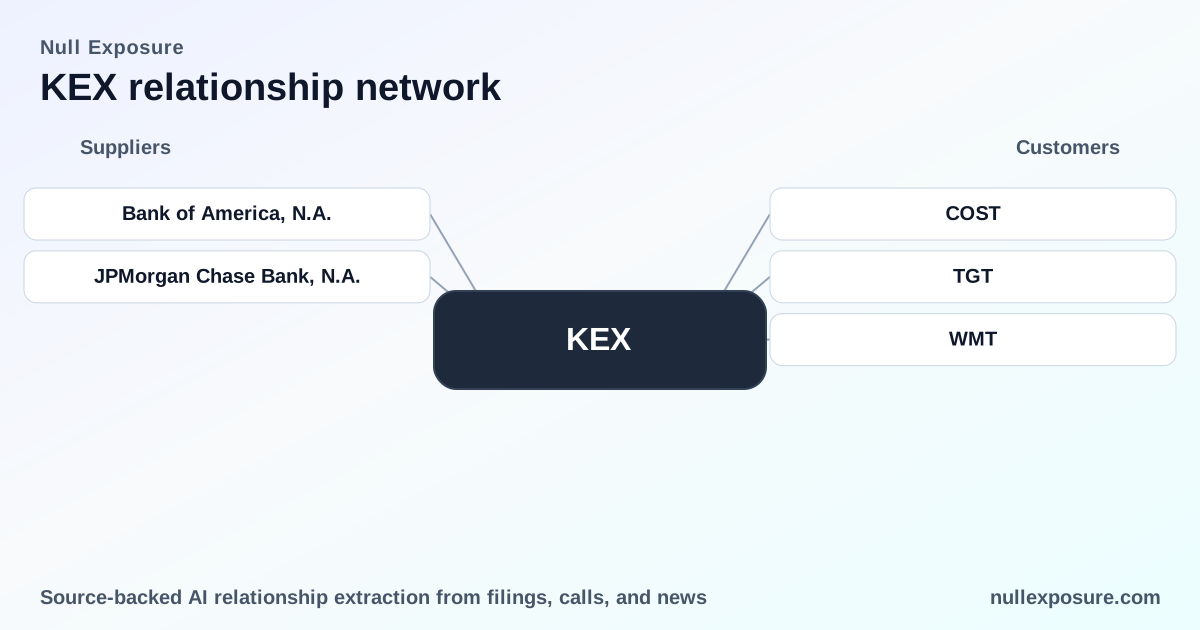
Costco — Management highlighted that Kirby rents large, trailer-mounted electric power units to major retailers including Costco for site power needs, signaling KDS’s power-generation equipment is deployed to large retail customers. This was discussed on Kirby’s Q4 2025 earnings call transcript in March 2026. (Source: Q4 2025 earnings call transcript, 2026-03-10.)
-
Target — The company stated it rents trailerized megawatt-class power units to customers such as Target, demonstrating direct commercial relationships between KDS equipment rentals and large national retailers. (Source: Q4 2025 earnings call transcript, 2026-03-10.)
-
Walmart — Management explicitly named Walmart as a recipient of large rented power trailers, showing KDS complements marine operations with onshore power generation services to big-box customers. (Source: Q4 2025 earnings call transcript, 2026-03-10.)
-
WMT — The data set includes a separate WMT entry that duplicates the Walmart mention; the underlying reference is the same Q4 2025 earnings call where Walmart/WMT were cited as users of trailerized power units. Investors should treat this as the same customer mention captured twice in the record. (Source: Q4 2025 earnings call transcript, 2026-03-10.)
These public references illustrate that Kirby’s distribution and services arm is not only a traditional parts and maintenance supplier but is actively renting and deploying power-generation assets to large enterprise retail customers, widening revenue streams beyond barge transport.
(If you want a single view that combines contract-level intelligence with public customer mentions, you can explore more on the NullExposure homepage: https://nullexposure.com/.)
What the relationship mix implies for revenue stability and growth
The combination of term-heavy marine contracts and enterprise customers for equipment rentals creates a hybrid cash flow profile:
- Revenue stability: Coastal operations provide highly contracted cash flow (nearly 100% term) and underpin the business through multi-year contracts. Inland operations carry more spot risk but still retain a majority in term contracts, smoothing revenue volatility.
- Diversified demand drivers: KDS provides countercyclical upside — equipment manufacturing and rentals to retailers and industrials diversify revenue away from the commodity-linked shipping cycle.
- Geographic concentration: Kirby is essentially a North American operator; its exposure is to U.S. industrial and retail activity rather than global trade lanes, which concentrates macro sensitivity on U.S. energy, refining and retail investment cycles.
Key risk and opportunity takeaways for investors
- Risk — spot exposure in inland transport: With about 35% of inland revenues on spot contracts, earnings can compress if barge utilization or commodity flows decline. This is a real operational lever on quarterly results.
- Opportunity — aftermarket and equipment rentals to large retailers: Public mentions of Walmart, Target and Costco indicate KDS can secure large, repeatable enterprise contracts for power-generation rentals, expanding margins and utilization of manufactured assets.
- Concentration nuance: While KMT is a material driver (59% of revenues), the company’s customer base is broad—no single KDS or KMT customer exceeded 10% of revenue—reducing counterparty risk despite segment-level concentration.
- Domestic exposure benefits and limits: Being the nation’s largest domestic tank-barge operator creates defensive scale for domestic energy and chemicals flows; however, the business is exposed to U.S. macro cycles rather than benefiting from global trade diversification.
Bottom line: what to watch next
Investors should track three levers to assess Kirby’s risk-adjusted upside: marine contract renewals and term-vs-spot mix, KDS contract wins and utilization of rental power assets to large retailers, and freight / refining activity that drives barge volumes. The March 2026 earnings call confirms management is actively commercializing equipment rentals to major retailers, a positive structural diversification event that complements the company’s term-contract backbone.
For deeper, relationship-level analytics and ongoing monitoring of customer mentions and contract posture, visit https://nullexposure.com/ — the firm aggregates and contextualizes these signals for investor due diligence.
Overall, Kirby combines long-duration marine cash flows with an expanding industrial-services platform, creating a balanced and investible cash-flow profile for investors focused on industrial infrastructure and mid-cycle growth.