KeyCorp (KEY) — Customer Relationships that Drive the Bank’s Capital‑Markets and Lending Franchise
KeyCorp operates and monetizes a two‑headed banking model: a Consumer Bank that gathers deposits and services retail and small‑business clients, and a Commercial / Institutional franchise — KeyBank and KeyBanc Capital Markets — that underwrites, syndicates, and administrates corporate credit and capital‑markets transactions. Revenue accrues from net interest on commercial and consumer loans, fee income from loan servicing and investment banking, and recurring trust/asset‑management fees. For investors, understanding Key’s customer relationships is a direct window into its underwriting reach, fee pipeline, and balance‑sheet sensitivity to large syndicated credits and CRE servicing flows.
If you want a consolidated view that maps those client ties to transactional activity, visit https://nullexposure.com/ for our platform overview.
What the relationship map tells investors about Key’s operating model
Key’s client roster in recent filings and press releases highlights several defining business characteristics:
- Concentrated commercial lending and capital‑markets intermediation. Multiple entries show Key acting as administrative agent, joint lead arranger, bookrunner, placement or servicing agent — consistent with Key’s commercial lending and investment‑banking role. This is a company‑level signal, not tied to any single client.
- Broad counterparty mix across segments. Evidence supports exposure to large enterprises, middle‑market firms, small businesses and retail customers — reinforcing diversification but also mixed credit‑cycle sensitivity across business lines.
- Geographic focus in North America. Substantially all revenue and the branch footprint are U.S.‑centric, which concentrates macro and regulatory exposure regionally.
- Service provider role that creates fee durability — and operational dependencies. Key retains loan servicing rights and acts as administrative agent and servicer on CRE and securitizations, generating noninterest income while creating operational reliance on servicing controls.
- Mature relationships and repeat syndication activity. Several multi‑year credit facilities and repeat bookrunning roles indicate durable, ongoing commercial ties rather than one‑off mandates.
Below I catalogue the relationships cited across public notices and filings to give investors a transaction‑level read on Key’s customer franchise.
Relationship catalog — transaction‑level summaries and sources
- BOOM — KeyBanc acted as sole bookrunner and KeyBank N.A. served as administrative agent on a five‑year syndicated credit for DMC‑Global’s acquisition financing in 2021, underwriting a $150M term loan and $50M revolver. Source: GlobeNewswire press release (2021).
- BLND — KeyBanc Capital Markets served as a book‑running manager on Blend Labs’ IPO process. Source: PYMNTS report on IPO coverage (2021).
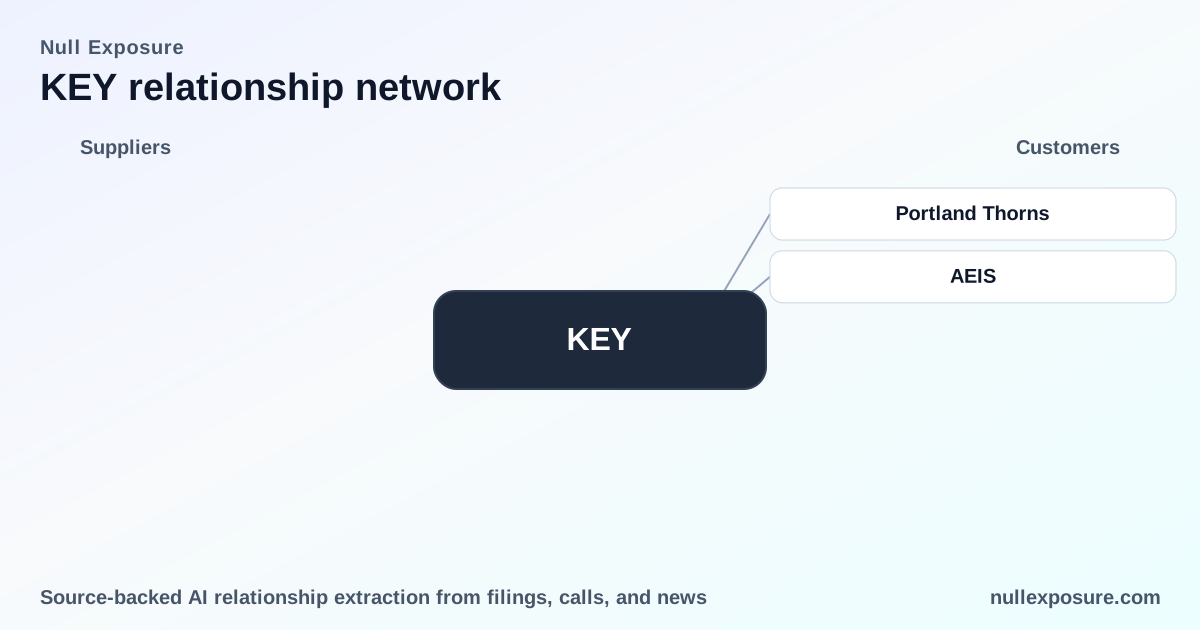
- Portland Thorns — KeyBank signed a multi‑year retail‑bank partnership with the Portland Thorns as an official retail banking partner. Source: market coverage summarized on Finviz (2026).
- PFLT — KeyBanc Capital Markets acted as co‑structuring agent on PennantPark Floating Rate Capital’s $356.5M securitization refinancing. Source: The Globe and Mail press release (2026).
- GOOD (Gladstone Commercial) — KeyBank led a bank group as joint lead arranger and book manager on an amended and upsized credit facility and also served as co‑placement agent on debt issuance. Source: company press releases and Marketscreener/PR outlets (2025–2026).
- NHPBP / NHPAP (National Healthcare Properties) — KeyBank served as a documentation agent in the closing of a $550M senior unsecured credit facility. Source: CityBiz and GlobeNewswire (2025).
- PINE (Alpine Income Property Trust) — KeyBank acted as administrative agent under a prior credit agreement that was later repaid when Alpine refinanced; KeyBanc also co‑managed public offers for the REIT. Source: Alpine press release and QuiverQuant/GlobeNewswire (2025–2026).
- LRFC (Logan Ridge / Portman Ridge) — LRFC refinanced a credit facility with KeyBank, improving the combined company’s borrowing base post‑merger. Source: GlobeNewswire merger announcement (2025).
- BKD (Brookdale Senior Living) — KeyBank’s real‑estate business provided Freddie Mac loan origination financing to extend portions of Brookdale’s 2027 maturities. Source: Brookdale press release and industry outlets (2026).
- METCV (Ramaco Resources) — KeyBank increased and amended Ramaco’s revolver to $500M, including a $150M accordion and maturity extension to 2030. Source: Ramaco press release and SimplyWallSt coverage (Dec 2025/2026).
- LXP / LXP‑P‑C (LXP Industrial Trust) — KeyBanc Capital Markets served as joint lead arranger/bookrunner while KeyBank N.A. acted as administrative agent on a $600M revolver and $250M term loan package. Source: GlobeNewswire press release (2026).
- WELL (Welltower) — KeyBanc served as a U.S. joint lead arranger on a $6.25B amended revolving facility; KeyBank acted as administrative agent and L/C issuer. Source: Welltower press release and TradingView briefings (2026).
- SMA (SmartStop Self Storage REIT) — KeyBank led a multi‑bank syndicate as administrative agent on a $500M multi‑currency credit facility supporting North American expansion. Source: Pulse2 and TradingView coverage (2026).
- MDV‑P‑A (Modiv Industrial preferred) — KeyBank acted as agent / counterparty on a credit agreement amendment for Modiv Industrial. Source: TradingView filing summary (2026).
- HRZN (Horizon Technology Finance) — KeyBank provided a revolving credit facility (the “Key Facility”) referenced alongside NYL and securitization facilities as part of HRZN’s financing stack. Source: EDGAR/press filings and earnings notes (2024–2026).
- NXDT‑P‑A (New DCT Preferred) — Historical revolving credit agreement with KeyBank provided LIBOR‑based financing capacity to the REIT. Source: EDGAR/advfn filing excerpt (2018 description referenced in 2026 filings).
- CTO (CTO Realty Growth) — A 2030 term loan was provided by a syndicate led by KeyBank as Administrative Agent. Source: company filing summarized on Yahoo Finance (2025).
- BRSP (BrightSpire) — KeyBank served as servicer (and special servicer arrangements named KeyBank) on a CRE CLO issuance and servicing agreement dated Feb 2026. Source: SEC‑filing summary and TradingView press (2026).
- HTFC (Horizon Technology Finance / HTFC) — The company noted no outstanding borrowings on its $150M KeyBank facility at period end and executed amendments to loan/servicing agreements with KeyBank in early 2026. Source: earnings transcripts and press (2026).
- TRINI / TRIN (Trinity Capital / Trinity‑related disclosures) — Trinity reported approximately $208M available borrowing capacity under a KeyBank credit facility and highlighted a $200M secured term loan provided by KeyBank to expand lending capacity. Source: PR Newswire and SimplyWallSt coverage (2025–2026).
- VTEX — KeyBanc Capital Markets acted as joint bookrunner for VTEX’s IPO filing. Source: PR Newswire coverage (2021).
- MWH (Solv Energy / MWH) — KeyBanc Capital Markets was listed among bookrunners on Solv Energy’s IPO pricing. Source: Bitget/TradingView and Markets FinancialContent (2026).
- DV (DoubleVerify) — KeyBanc Capital Markets acted as co‑manager on a placement alongside William Blair and others. Source: MarketBeat news alert (2026).
- SNDA (Sonida Senior Living / combined transaction) — KeyBanc Capital Markets served as a joint lead arranger in the merger financing for Sonida. Source: CityBiz merger coverage (2026).
- VNO‑P‑N (Vornado preferred) — KeyBank National Association was named special servicer on a $525M refinancing for a Manhattan office asset. Source: CommercialSearch and ConnectCRE (2026).
- RC (Ready Capital) — KeyBank acted as servicer and master servicer on notes tied to a small and mid‑balance commercial property loan offering. Source: AmericanBanker coverage (2022 filing referenced 2026).
- CDR‑P‑C (Cedar Realty Trust Series C) — KeyBank led the bank group as Administrative Agent on an amended $185M credit facility used in preferred‑share repurchases and balance‑sheet restructuring. Source: CityBiz/SEC filing summaries (2021–2025).
- AEIS (Advanced Energy Industries) — KeyCorp provides research and investment coverage on AEIS as part of its institutional services. Source: local market coverage summarizing KeyCorp analyst activity (2026).
- HASI (Hazardous Assets / Hannon Armstrong notes) — KeyBanc Capital Markets participated as an underwriter on a notes placement (principal amounts listed in SEC underwriting table). Source: SEC underwriting table (2026).
- RXRX (Recursion Pharmaceuticals) — KeyBanc acted as co‑placement agent on a private placement led by Kinnevik in historical reporting. Source: PR Newswire release (2022 referenced 2026 aggregation).
- SWX (Southwest Gas Holdings) — KeyBanc was among book‑running managers on a secondary offering. Source: QuantisNow/Markets reporting (2025).
- ROCK (Gibraltar Industries) — Gibraltar terminated its KeyBank facility in favor of new financing with Bank of America, indicating a client migration away from Key on that relationship. Source: TradingView transaction note (2026).
- LMAT (LeMaitre Vascular) — KeyBank and Truist provided a credit facility to support an acquisition. Source: MassDevice M&A coverage (2020 note surfaced in 2026 aggregation).
- AHT‑P‑D (Ashford Hospitality preferred) — The company obtained a PPP loan through Key Bank in historical reporting. Source: Bisnow PPP loan roundup (2020 referenced in later aggregation).
- BHM (BlueRock Homes Trust) — An acquisition was financed in part through borrowings from an existing KeyBank credit facility. Source: GlobeNewswire press release (2025).
- GOODO (Gladstone Commercial commentary) — Additional investor‑facing transcripts reiterate KeyBank’s role as joint lead arranger and book manager across several Gladstone financings. Source: Investing.com/InsiderMonkey earnings transcripts (2025–2026).
(Several of the above client names and tickers are referenced multiple times across filings and press releases between 2021–2026, reflecting repeat syndication and servicing activity.)
Investment implications and risk signals
- Revenue durability from fees is real: servicing, administrative agent fees and recurring syndication mandates create noninterest revenue streams that are less rate‑sensitive than net interest income.
- Concentration across CRE and corporate lending is material: commercial and industrial loans are the single largest loan component; syndication and servicing relationships expose Key to CRE cycle risk and credit migration. Monitor loan performance metrics and agent/servicer operational controls.
- Customer mix supports diversification but ties performance to U.S. commercial real‑estate and middle‑market cycles. Investors should track syndicated credit rollovers and large‑borrower health.
For a focused data view and a transaction‑level dashboard of these relationships, visit our platform at https://nullexposure.com/ — it’s the quickest way to map Key’s commercial franchise to measurable deal flow and counterparties.
Conclusion: Key’s public relationship trail shows a bank that successfully monetizes underwriting and servicing roles across middle‑market and large corporate clients while maintaining a broad consumer deposit base; the same footprint delivers fee diversification but concentrates credit and operational risk in North American CRE and corporate lending.