KeyCorp Depositary Shares Series E (KEY-P-I): What its customer links tell investors
KeyCorp’s depositary preferred shares (KEY-P-I) represent claims on a bank franchise that monetizes through traditional commercial and consumer banking channels—net interest margin, fee income, and corporate banking services delivered by KeyBank, the company’s primary operating subsidiary. For preferred shareholders, the stability of distributions and the board’s capital decisions hinge on the bank’s franchise health, which is partly visible through customer and community relationships: philanthropic partnerships, commercial sponsorships, and retail-facing deals that drive reputation, cross-sell volume, and regulatory goodwill. For a concentrated read on recently documented customer ties, see NullExposure’s analysis at https://nullexposure.com/.
Why customer relationships matter for preferred investors
Preferred stockholders do not participate in daily deposit flows, but they absorb the downstream effects of reputation, regulatory capital consumption, and revenue diversification driven by customer-facing activity. Customer partnerships that enhance deposit acquisition, brand visibility, or regulatory goodwill improve franchise tailwinds for preferred distributions. Conversely, reputational or regulatory disputes thin the margin of safety for fixed claims.
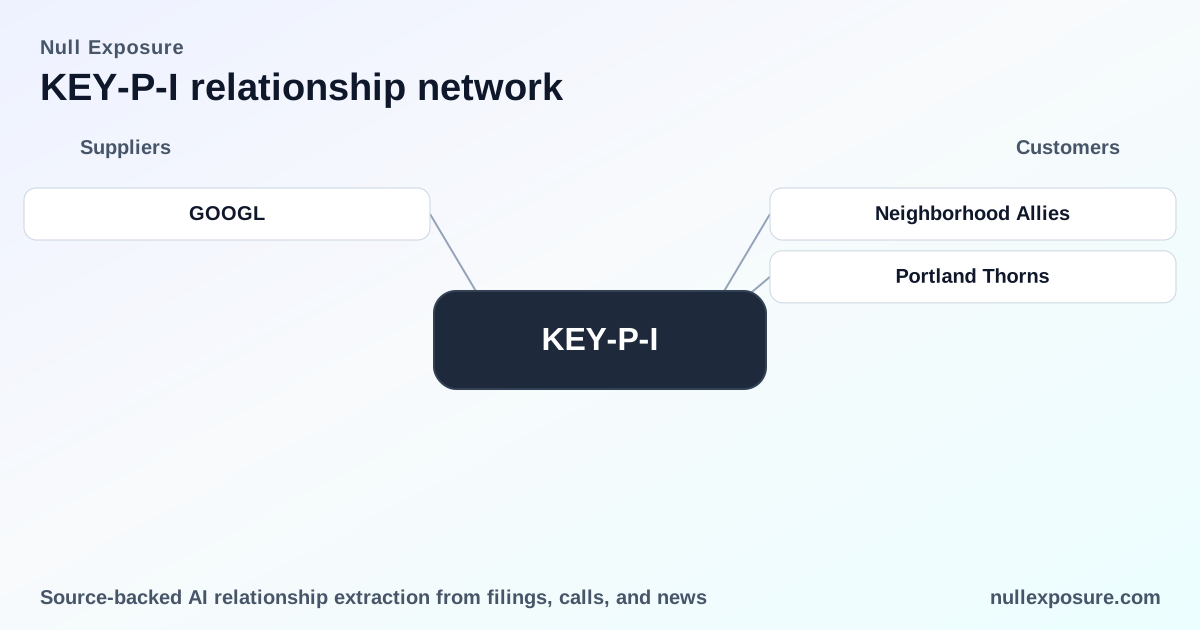
The dataset examined records two public customer relationships tied to KeyBank’s outreach and sponsorship activities. The public record shows a mix of philanthropic funding and a commercial sports sponsorship—both non-core revenue levers with asymmetric reputational value. The absence of documented contractual constraints in the reviewed material is a company-level signal about the scope of recorded encumbrances: no explicit contract restrictions or encumbrance clauses were flagged against customer relationships in this source set.
Explore these relationship signals in the context of KeyCorp’s capital profile on the homepage: https://nullexposure.com/.
What the filings and press coverage actually document
-
Neighborhood Allies — In a community partnership track record, KeyBank Foundation awarded Neighborhood Allies $300,000 in 2018 and a further $400,000 in 2021 to support neighborhood revitalization, financial counseling, and programs targeted at Black entrepreneurs and homeowners. This is documented by Shelterforce’s reporting on local community investments and key promises related to minority homeowners (Shelterforce, Feb 24, 2023). https://shelterforce.org/2023/02/24/ncrc-claims-keybank-broke-promises-failed-black-homeowners/
-
Portland Thorns — KeyBank signed a multi‑year commercial agreement naming it the Official Retail Bank of the Portland Thorns, positioning KeyBank for retail-facing brand exposure and hospitality/merchandising opportunities connected to the club (PR Newswire, FY2025). https://www.prnewswire.com/news-releases/91-of-companies-prioritize-tariff-impact-management-in-keybanks-latest-middle-market-pulse-survey-302479637.html
How each relationship translates into business signal strength
Neighborhood Allies: philanthropy and community programs. The documented grants—$300k (2018) and $400k (2021)—indicate sustained community investment and targeted programs to increase financial inclusion among Black residents and small-business entrepreneurs. This relationship reads as a reputational and regulatory-relief asset under community reinvestment expectations, not a material revenue driver (Shelterforce, 2023). https://shelterforce.org/2023/02/24/ncrc-claims-keybank-broke-promises-failed-black-homeowners/
Portland Thorns: commercial sponsorship and retail visibility. The multi-year naming agreement as the club’s Official Retail Bank positions KeyBank for direct consumer engagement and merchandising synergies in regional markets; this is a revenue-adjacent, brand-building contract rather than a large commercial-credit exposure (PR Newswire, FY2025). https://www.prnewswire.com/news-releases/91-of-companies-prioritize-tariff-impact-management-in-keybanks-latest-middle-market-pulse-survey-302479637.html
Operational constraints and model characteristics investors should note
- Contracting posture: The public evidence indicates a combination of grant-based relationships and multi-year commercial sponsorships, which reflect low-contractual complexity for philanthropic ties and multi-year commitments for sponsorships that lock in marketing spend and brand exposure.
- Concentration: The two relationships reviewed are diverse in type but not in scale—one nonprofit grant partner and one sports sponsorship—so they do not indicate high revenue concentration risk at the customer level.
- Criticality: Both relationships deliver reputational and retail marketing value rather than critical operational dependencies; neither represents a single large counterparty whose failure would threaten cash flows backing preferred distributions.
- Maturity and durability: Philanthropic grants show repeat funding across years, suggesting programmatic commitment; sponsorships are explicitly multi-year, implying medium-term stability of the exposure.
- Constraint signal: The dataset contains no listed contractual constraints for customer relationships, which is a company-level signal consistent with unencumbered partnerships in the reviewed coverage.
Investment implications: calibrating risk, reputation, and upside
For preferred shareholders, the immediate takeaway is simple: documented customer links emphasize reputation management and retail brand-building rather than concentrated commercial exposure. KeyBank’s philanthropic investments support regulatory standing and community relationships that lower political and social risk; its sponsorships support retail deposit and fee generation indirectly through increased brand visibility.
Key monitors for investors:
- Regulatory reputational risk: community funding commitments and any public criticisms around them (as reflected in media coverage) should be tracked for potential regulatory or brand fallout.
- Marketing ROI on sponsorships: multi-year retail bank agreements translate into measurable deposit and card activation metrics over time; investors should watch bank disclosures and segment performance for evidence of cross-sell lift.
- Capital allocation discipline: the balance between philanthropy, marketing spend, and capital returns to preferred holders affects distribution stability—monitor shareholder communications and capital policies.
Bottom line and next steps
- Key takeaway: The relationships documented are strategic for reputation and retail visibility, not material credit exposures; they support franchise economics indirectly and therefore are relevant to preferred holders assessing distribution durability.
- Risks to watch: Public criticism of community commitments and the ROI of sponsorships on deposit growth can influence franchise momentum and capital decisions.
For a concise briefing and updates as these customer ties evolve, return to NullExposure’s hub at https://nullexposure.com/.