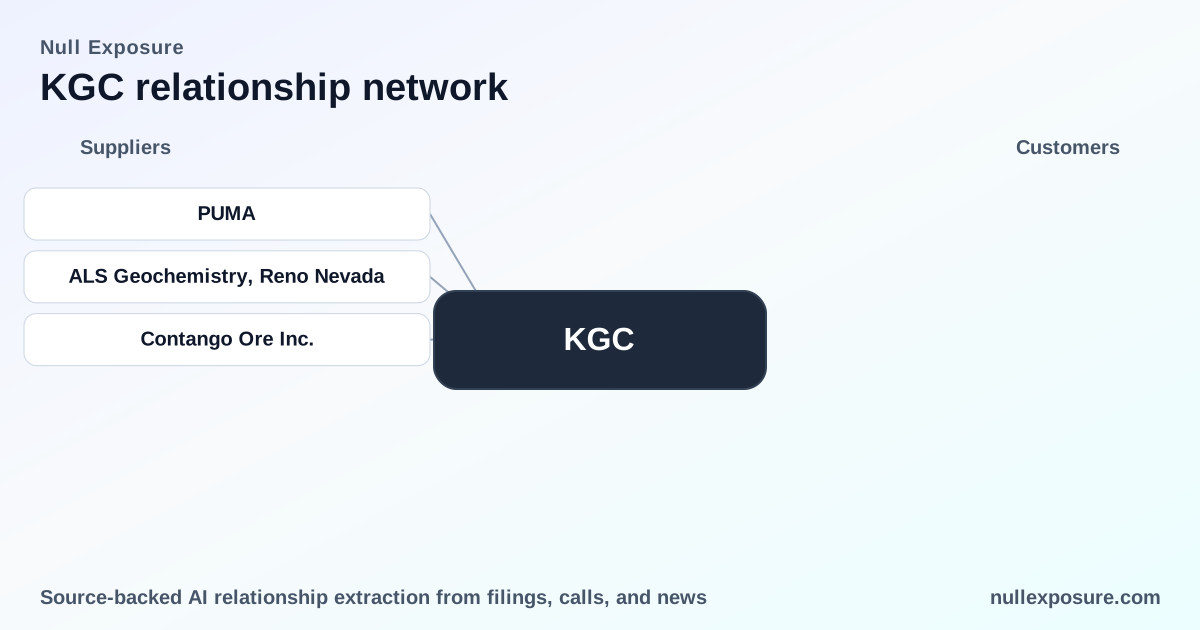
Kinross Gold (KGC): How customer relationships and JV processing shape operational optionality
Kinross Gold operates as an integrated gold producer that earns revenue through mine production, toll-processing and operator services across North America, South America, Africa and Russia. The company monetizes by producing refined gold from its own mines and by providing processing capacity and operating services to joint-venture partners, creating recurring cash flow and margin capture at its milling complexes—most prominently Fort Knox in Alaska. With ~USD 34.4bn market cap, EBITDA profitability and a conservative dividend, Kinross leverages operator-led partnerships to extend throughput without proportionate capital outlay. For a concise map of Kinross’s partner exposure and sourcing citations, visit https://nullexposure.com/.
What investors need to know up front
Kinross’s customer-facing relationships in recent public reporting and press coverage emphasize operator-led processing arrangements and joint-venture stakes rather than pure third‑party tolling contracts. These relationships create a hybrid revenue profile: direct metal sales from Kinross-controlled assets plus processing/service revenue and operational control premiums when Kinross acts as operator. Key investment implications: concentrated operational linkages around Fort Knox and an expanding operator footprint (e.g., Manh Choh, PWC) that increase near-term throughput but also tie Kinross to partners’ project timelines.
Relationship-by-relationship read — each reported mention explained
CTGO — PR Newswire (March 9, 2026)
Contango/Ore (CTGO) and Manh Choh: Ore mined at Manh Choh is trucked to Kinross’s Fort Knox mine and milling complex in Fairbanks, Alaska for processing; operations commenced in Q3 2024. This release frames Kinross as the processing operator and Fort Knox as the receiving mill for Manh Choh ore, linking Kinross’s Fort Knox throughput to third-party ore flows. (PR Newswire, March 9, 2026)
RGLD — Tikr blog (May 3, 2026)
Royal Gold (RGLD) coverage referenced Kinross’s Great Bear project: Kinross’s Great Bear in Ontario targets first production around the end of 2029, indicating multi-year development timelines that influence Kinross’s production profile and royalty/streaming partner cadence. (Tikr, May 3, 2026)
CTGO — MarketMinute / FinancialContent (May 2, 2026)
Contango/Manh Choh JV reporting: Contango holds a 30% interest in the Manh Choh mine while Kinross is the 70% operator that trucks high‑grade ore to the Fort Knox mill, underscoring a material JV relationship where Kinross provides operating capability and processing infrastructure. (MarketMinute via FinancialContent, May 2, 2026)
CTGO — The Deep Dive (March 9, 2026)
Merger context and operational role: The operating Manh Choh mine is currently 30% owned by Contango with the remainder owned by Kinross Gold, which is the current operator; ore is trucked to Fort Knox for processing and operations began in the prior year. This narrative reinforces Kinross’s role as operator and processor in the Alaskan corridor. (The Deep Dive, March 9, 2026)
CTGO — Finviz corporate update (March 9, 2026)
Joint-venture structure and land position: Contango holds a 30% interest in the Peak Gold JV, which leases roughly 675,000 acres at Manh Choh, while the remaining 70% is held by KG Mining (Alaska) Inc., an indirect Kinross subsidiary that operates the JV. That scale of land position and formal operator posture is commercially significant for future resource conversion and processing volumes. (Finviz corporate update, March 9, 2026)
DVS — The Newswire (March 9, 2026)
Dolly Varden Silver reporting on the merger: Ore mined at Manh Choh is trucked to Kinross’s Fort Knox mine and milling complex for processing; operations began in Q3 2024. The Dolly Varden coverage echoes the same operational linkage and reiterates the Fort Knox processing relationship in the context of corporate consolidation. (The Newswire, March 9, 2026)
RLYG — Newsfile / Riley Gold technical report (May 3, 2026)
Riley Gold technical report disclosure: The PWC project is operated by Kinross Gold U.S.A., Inc. under an exploration earn‑in agreement executed in March 2024, establishing Kinross as an operator on an earn‑in basis and showing the company’s strategic use of earn‑in agreements to extend its pipeline. (Newsfile / Riley Gold, May 3, 2026)
What the relationship map collectively signals
- Operational model: Kinross operates and processes ore for JV partners and earn‑in projects, capturing both mined metal sales and processing/operational premiums. The persistent Fort Knox role across multiple partner mentions identifies that mill as a strategic asset for third‑party throughput.
- Concentration and criticality: The relationships are concentrated around the Manh Choh — Fort Knox corridor and several earn‑in projects; this creates operational criticality where Fort Knox throughput is a nexus for both Kinross production and partner-sourced ore.
- Contracting posture and maturity: Public references describe formal JV interests and an earn‑in agreement (March 2024), indicating contractual commitments with multi‑year horizons and operator responsibilities rather than ad hoc service deals.
- Revenue implications: These relationships expand near-term throughput without equivalent greenfield capex, improving free cash flow conversion and EBITDA leverage when partner ore is processed through Kinross infrastructure.
- Timing and development risk: Project timelines (e.g., Great Bear first production targeted ~2029) create a staggered production profile that investors should model explicitly.
Note: no explicit constraints or contractual excerpts were provided in the source set beyond the relationship descriptions above; this is a company-level signal rather than a relationship-specific constraint.
Investment implications and risk checklist
- Upside: Operator economics at Fort Knox and operator-led earn‑ins support margin expansion and optionality to process third‑party ore, boosting short-term cash generation without equivalent capital spend.
- Downside: Concentration of partner ore flows into a single milling hub creates single-point operational risk; any disruption to Fort Knox has outsized revenue and processing exposure.
- Development timeline risk: Projects like Great Bear extend Kinross’s long-term resource base but push production and free-cash-flow contributions beyond a multi-year horizon.
- Governance and JV exposure: A 70/30 operating structure in Manh Choh gives Kinross operational control but also means capex and environmental permitting responsibilities fall to the operator.
Next steps for analysts and ops teams
- Review Kinross’s Fort Knox throughput and downtime history and model partner-sourced ore volumes against mill capacity. For a consolidated view of partner mentions and source citations, see https://nullexposure.com/.
- Build scenario analyses around mill outage risk, JV partner funding shortfalls, and alternate processing options to stress test EBITDA and free cash flow.
Bold takeaway: Kinross’s customer relationships are less about arm’s-length sales and more about operator-driven processing and JV control, which amplifies both the company’s margin capture and its operational concentration risk.