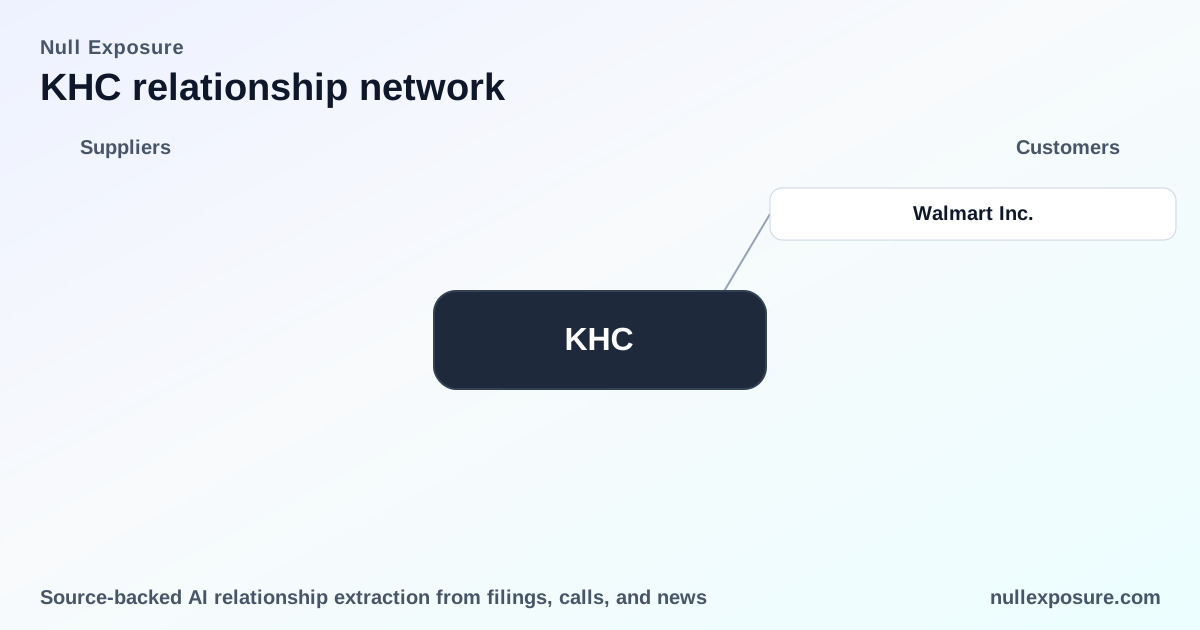
Kraft Heinz’s customer footprint: concentration, channels, and where revenue really flows
Kraft Heinz monetizes a global portfolio of packaged food and beverage brands by selling finished goods through a mix of large retail accounts, e‑commerce platforms, foodservice partners and licensed arrangements; revenue is driven by broad grocery distribution and a small number of very large customers that account for a disproportionate share of sales. Investors should treat KHC as a branded consumer‑goods company with high channel concentration, significant North American exposure, and active efforts to extend reach via e‑commerce and strategic partnerships. For a concise view of related customer relationships and source references, visit https://nullexposure.com/.
Why the customer map matters for valuation and risk
Kraft Heinz operates with a typical packaged‑foods contracting posture: it is a seller into a distribution ecosystem dominated by large retail chains and online marketplaces, and a licensor where brand IP is shared under long‑running agreements. The company discloses meaningful customer concentration—one retailer alone accounted for roughly one‑fifth of net sales—which has direct implications for pricing power, trade promotion spend, and working capital volatility. At the same time, KHC’s footprint is not purely domestic: while North America dominates revenue, management explicitly positions the company as a global marketer of its platforms and brands.
Key operating characteristics to note:
- Concentration: The five largest customers in North America represented ~46% of North America net sales in 2025, signaling high counterparty weight in procurement and pricing negotiations (company filing, FY2025).
- Geography: North America is the core revenue engine ($18.6B of $24.9B net sales in 2025), but management frames growth as global across multiple product platforms (10‑K disclosures, FY2025).
- Channel diversity with single‑account risk: KHC sells through its own sales force and through brokers/distributors, but also relies on large mass merchants and e‑commerce resellers—an approach that widens reach but concentrates revenue with major retailers.
- Licensing exposure: KHC has granted perpetual licenses in at least one external arrangement (Groupe Lactalis affiliate), reflecting non‑core IP arrangements that affect strategic optionality (10‑K excerpt).
Customer roll call: the relationships driving sales and distribution
Below I cover every customer relationship noted in available filings and press reports, with concise takeaways and sources.
Walmart Inc.
Walmart is KHC’s largest single customer, representing approximately 21% of Kraft Heinz’s net sales in 2025, 2024, and 2023, making it a material counterparty whose buying decisions and category resets directly affect KHC top‑line stability. According to KHC’s FY2025 Form 10‑K, Walmart accounted for this share of net sales (KHC 2025 10‑K).
Source: KHC 2025 Form 10‑K (khc-2025-12-27), FY2025.
Amazon
Amazon is listed as a national retailer for new product distribution—Capri‑Sun Hydrate will roll out on Amazon alongside other major retailers—signaling KHC’s continued emphasis on e‑commerce distribution as a complement to brick‑and‑mortar channels. The product launch announcement (Capri‑Sun Hydrate) confirms Amazon as a go‑to online channel for new SKUs (KHC press release, May 2026).
Source: Kraft Heinz press release, “Capri‑Sun Unveils Hydrate,” May 2026.
Target
Target is a named retail launch partner for new Capri‑Sun product introductions, reinforcing KHC’s placement strategy that pairs mass merchandisers with e‑commerce presence to accelerate national distribution. The retail rollout was described in KHC’s May 2026 product announcement.
Source: Kraft Heinz press release, “Capri‑Sun Unveils Hydrate,” May 2026.
BurgerFi (BFIIW)
Kraft Heinz is trialing the HEINZ REMIX™ machine in BurgerFi company‑owned stores in South Florida and plans incremental rollouts based on pilot success, indicating a strategic push into foodservice innovation and customization that could generate incremental foodservice revenue and marketing lift. Industry coverage describes trials and planned expansions of the Remix machine in early 2026 (Restaurant Business and FoodChain Magazine reporting, March 2026).
Source: Restaurant Business Online (Mar 2026) and FoodChain Magazine (Mar 2026).
NFL (NFLDF / NFL partnership)
Kraft Heinz signed a multi‑year global condiment partnership with the NFL, becoming the league’s first global condiment partner in a five‑year deal, a move designed to elevate brand reach at high‑visibility events and create new promotional and retail opportunities tied to sports sponsorship. Industry commentary reported the agreement in early April 2026 (IndexBox blog coverage referencing April 3, 2026).
Source: IndexBox blog summary referencing April 3, 2026 NFL partnership announcement (reported Apr 2026).
Constraints and what they imply about KHC’s business model
The company disclosures and evidence form a clear set of constraints that affect operating flexibility and financial risk:
- North America dominance: Net sales by segment show North America produced ~$18.6B of $24.9B total net sales in 2025, so U.S. retail dynamics and trade terms materially affect consolidated results (10‑K, FY2025).
- Global ambition vs. concentrated revenue: Management positions the business as global across multiple product platforms, but the revenue profile remains heavily weighted to North America, creating a tension between geographic growth targets and existing concentration (10‑K, FY2025).
- Material customer concentration: The five largest customers in North America accounted for ~46% of North America segment net sales in 2025; this elevates counterparty negotiation risk and trade‑promotion sensitivity (10‑K, FY2025). Large retailer relationships are critical to revenue, not optional extras.
- Multi‑role go‑to‑market posture: Kraft Heinz is principally a seller of finished goods but also uses distributors and resellers and has licensed IP in specific arrangements, reflecting a multi‑channel commercial model that increases reach but complicates margin management (10‑K excerpts).
- Licensing commitments: KHC disclosed perpetual licenses granted to an affiliate of Groupe Lactalis for certain cheese brands, a structural contractual commitment that influences brand control and long‑term strategy (10‑K, FY2025).
Investment implications: what to watch next
- Monitor Walmart negotiations and shelf placements closely; any shift in Walmart assortment or promotional intensity will have outsized P&L effects given the ~21% revenue share.
- Track e‑commerce rollouts (Amazon) and new product launches—these are lower‑cost distribution channels that can boost velocity but also increase promotional competition. The Capri‑Sun rollout across Amazon, Target and Walmart is a useful near‑term case study (May 2026 product announcements).
- Follow foodservice pilots—HEINZ REMIX™ tests at BurgerFi indicate product and channel innovation that can lift margins if successfully monetized across franchise and chain partners.
- Watch sponsorship activation effectiveness from the NFL deal; branded presence at major events can drive short‑term demand spikes but needs measured ROI on incremental sales.
For investors building a thesis on KHC, the balance between concentration risk (large retailers), channel diversification (e‑commerce and foodservice), and brand monetization (licensing and partnerships) will determine upside versus downside over the next 12–24 months. For a detailed map of KHC’s customer relationships and supporting source links, visit https://nullexposure.com/.