Classover's Solana Facility Exit Rewrites the KIDZ Capital Playbook
Classover Holdings operates a live, interactive K‑12 online education platform that monetizes through course fees and program subscriptions while relying on recurring student enrollments and occasional capital raises to fund growth. The company generates modest top‑line revenue (roughly $3.37M TTM) but operates at a material operating loss, which has driven experimental financing strategies — including an equity purchase facility tied to a Solana‑focused treasury approach that the company has now terminated. For investors and operators evaluating KIDZ customer and counterparty relationships, the financing relationship with Solana counterparties is the dominant outward signal in public coverage and carries outsized implications for liquidity and strategic posture.
If you want a concise tracking tool for these exposures, visit https://nullexposure.com/ for ongoing coverage and real‑time relationship flags.
The Solana story in one paragraph
Classover executed an equity purchase agreement that would have allowed the sale of up to $400 million of Class B common stock to a Solana‑linked counterparty as part of a broader digital‑asset treasury strategy; the agreement later was formally terminated, signaling a shift away from that treasury design and a removal of an anticipated, albeit unconventional, liquidity source. Termination converts a potential large financing option into a material reduction in optionality and forces the company back toward traditional capital markets or operating cash flow to fund growth.
What the public records show and why it matters
-
In May 2025, financial press coverage reported that Classover had entered an equity purchase agreement with a counterparty identified as Solana Strategies, preparing to sell up to $400 million of Class B common stock under that facility. That coverage established the initial financing link between Classover and the Solana‑oriented counterparty. (Report: StockstoTrade, May 2025.)
-
In March 2026, AccessWire reported that Classover's board had unanimously approved termination of the $400 million Equity Purchase Facility Agreement with Solana Strategic Holdings LLC, expressly ending the company's Solana‑focused digital asset treasury strategy. (Report: AccessWire, March 2026.)
-
Also in March 2026, TradingView published a note confirming Classover’s decision to terminate the equity purchase facility with a Solana‑branded counterparty, reiterating that the arrangement would have allowed sales of up to $400 million of Class B common stock. (Report: TradingView, March 2026.)
Taken together, these three public items trace the full arc from intent to unwind: from the announcement of a large potential equity financing to an explicit corporate decision to terminate that arrangement within a year.
Relationship-by-relationship notes (complete coverage)
-
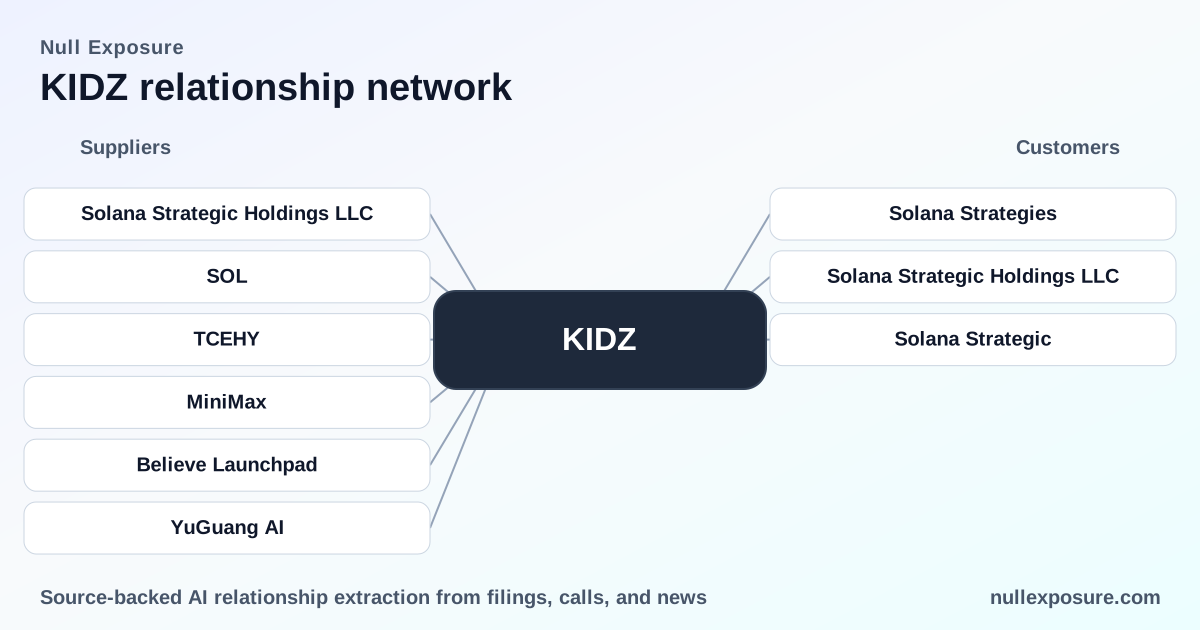
Solana Strategies — Coverage in May 2025 reported Classover’s equity purchase agreement that would permit sales of up to $400M in Class B common stock, establishing the counterparty as the planned primary channel for a large equity raise. (Source: StockstoTrade, May 2025.)
-
Solana Strategic Holdings LLC — In March 2026 Classover’s board unanimously approved termination of the $400M Equity Purchase Facility with Solana Strategic Holdings LLC, formally ending the company’s Solana‑focused digital asset treasury approach. (Source: AccessWire, March 2026.)
-
Solana Strategic — Independent press coverage in March 2026 reiterated that Classover will terminate the equity purchase facility that had allowed up to $400M of Class B common stock sales, confirming the company’s decision across outlets. (Source: TradingView, March 2026.)
What this indicates about Classover’s operating model and business model characteristics
With no contract constraints cited in the public feed, treat the following as company‑level signals drawn from the balance of disclosures and publicly reported metrics:
-
Contracting posture: Classover adopted an opportunistic, finance‑centric contracting posture by engaging an equity purchase facility tied to a non‑traditional, Solana‑oriented counterparty. The later termination signals a pivot away from experimental treasury tactics toward more conventional financings or organic funding.
-
Concentration risk: The proposed $400M facility concentrated a large portion of potential near‑term financing into a single counterparty channel, creating concentration of capital access that was material relative to the company’s current market cap and operating profile.
-
Criticality: For a company with limited revenue and negative operating margins, a large equity facility represented critical optionality for execution of growth plans. Termination reduces that optionality and elevates the importance of alternative capital sources or near‑term cash generation.
-
Maturity: Public metrics show a small market capitalization and low institutional ownership (roughly 6.1% institutional stake), signaling an early or still‑immature capitalization profile where management actions on treasury strategy materially affect perceived solvency and runway.
Key metrics supporting these signals: Revenue TTM ≈ $3.37M, negative EBITDA, market capitalization ≈ $1.12M, and limited institutional ownership (≈6.08%) (public filings and market data, FY2026 quarter reports).
Strategic implications for investors and operators
-
Liquidity profile shifts immediately. The termination eliminates a single large potential equity source and forces the company to pursue alternative capital strategies or compress growth plans to preserve cash. Investors should re‑price capital risk accordingly.
-
Removal of crypto‑treasury exposure is a governance signal. Management withdrawing the Solana‑linked facility indicates a deliberate de‑risking of treasury allocation away from digital assets; this improves regulatory and reputational posture but worsens short‑term funding breadth.
-
Operational focus must tilt toward revenue durability. Given the firm’s low revenue base and negative margins, management needs to demonstrate higher retention, improved gross margins, or credible commitments from diversified capital partners to restore confidence.
If you want a centralized feed for counterparty and customer relationship changes like this one, check ongoing monitoring at https://nullexposure.com/.
Tactical watchlist for the next 90–180 days
- Track SEC filings for any new equity purchase facilities, committed lines of credit, or convertible financings that replace the terminated facility.
- Monitor quarterly cash balance, burn rate, and any disclosure on funding runway; those are now the clearest indicators of whether the company can execute without dilutive emergency financing.
- Watch customer retention and cohort revenue growth; improvement in organic cash generation reduces reliance on capital markets.
- Review insider and institutional buy/sell activity for signals of conviction given the low institutional base.
Bottom line
The Solana facility episode is a liquidity and governance inflection point for Classover (KIDZ). What began as an ambitious, unconventional attempt to access large equity liquidity via a Solana‑linked counterparty ended with a board‑approved termination that strips away a major financing option and simultaneously reduces crypto exposure. For investors, the practical consequence is a higher premium on traditional financing access and execution of operational improvements; for operators, the consequence is a narrower margin for execution without new, diversified capital commitments.