Classover Holdings (KIDZW) — Customer and Counterparty Profile for Investors
Classover Holdings operates an education-technology platform delivering online interactive live courses for K‑12 students and monetizes primarily through course sales and related student-facing revenue streams. Investors evaluating KIDZW’s customer and counterparty relationships should focus on the company’s early-stage operating posture, a recent and explicit pivot away from a large digital‑asset treasury arrangement, and the implications this has for counterparty risk and balance‑sheet strategy. For a dedicated view of related exposures and research tools, visit https://nullexposure.com/.
Early-stage posture and what that means for commercial relationships
Classover’s public disclosures show a mixed maturity signal. A company filing for the year ended December 31, 2024 states that the company had not commenced operations and did not generate operating revenues until the Closing Date, which establishes an early-stage contractual posture and limited historical customer performance to benchmark. At the same time, company-reported figures through the latest quarter (2026-03-31) show RevenueTTM of $3,366,400, GrossProfitTTM of $1,917,800 and a negative EBITDA of $-3,238,994, indicating the business is generating revenue but remains loss-making.
Operationally this produces several concrete characteristics for investors and operators to track:
- Contracting posture: nascent and prospect-stage in earlier filings, which historically leads to short, conditional commercial agreements and greater sensitivity to go-to-market execution.
- Business concentration: likely concentrated, given the small absolute revenue base and the company’s need to scale customer acquisition to achieve margin leverage.
- Criticality: customer relationships are high‑impact but still maturing, meaning early churn or weaker-than-expected course uptake will materially affect results.
- Maturity: transitioning from pre-revenue to revenue generation, requiring close monitoring of retention metrics, cohort economics, and cash runway.
The counterparty event every investor should factor in
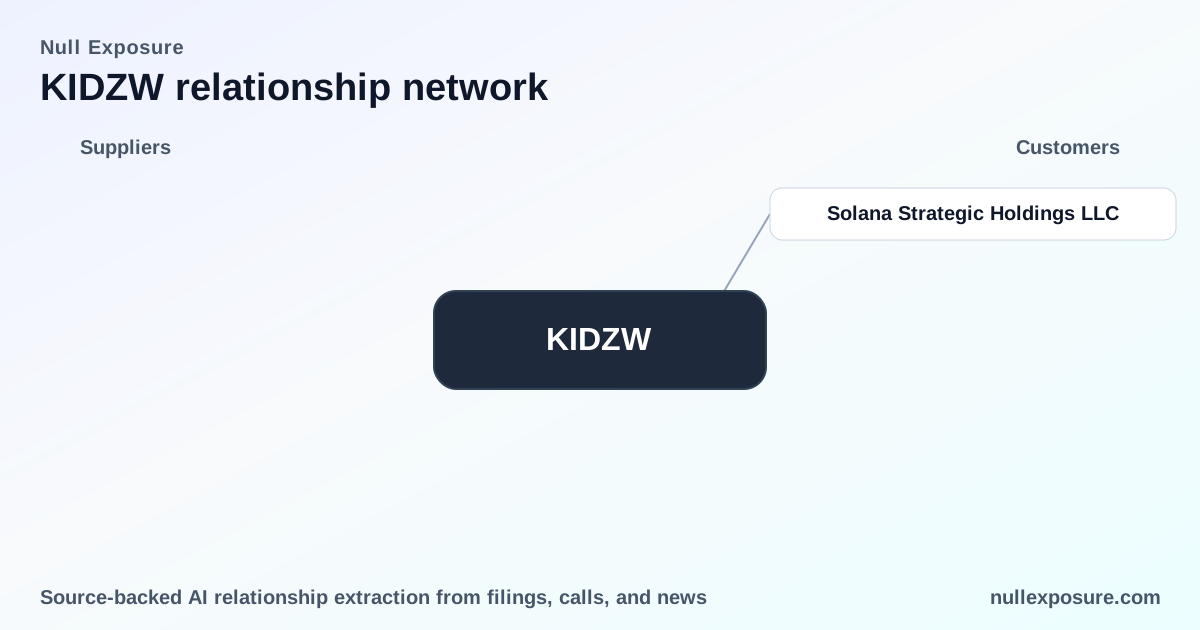
Solana Strategic Holdings LLC — equity facility terminated
Classover’s board unanimously approved termination of a $400 million Equity Purchase Facility Agreement with Solana Strategic Holdings LLC, thereby formally ending its Solana-focused digital-asset treasury strategy. According to a news report on March 10, 2026, Classover announced this action as part of a pivot away from holding Solana-linked treasury assets (NewsPressNow, March 10, 2026; article on termination of facility).
Implication in plain English: Classover had a planned or executed treasury strategy that used a large equity-purchase facility tied to a single counterparty focused on Solana; the company has now closed that channel and removed that concentrated exposure from its treasury plan.
How the Solana termination affects customer and treasury risk
The termination of the $400 million facility is a discrete, material counterparty action with direct implications for Classover’s financial policy and counterparty exposure:
- Removes a concentrated, single‑counterparty treasury relationship that carried market and execution risk tied to digital-asset valuations and liquidity windows.
- Signals a strategic shift in treasury conservatism, which reduces exposure to crypto market volatility and counterparty settlement risk that could otherwise cascade into operational funding for customer acquisition and course delivery.
- Does not directly alter teaching or customer contracts, but it changes the company’s balance-sheet flexibility and the funding profile available for scaling commercial operations.
Source: Newspressnow article on March 10, 2026, reporting Classover’s board decision to terminate the Equity Purchase Facility with Solana Strategic Holdings LLC.
Company‑level constraint that affects relationship assessment
According to the company’s filing for the period ending December 31, 2024, Classover had not commenced operations as of that date and did not generate operating revenues until the Closing Date. Treat this as a company-level signal about maturity rather than a counterparty-specific fact. For counterparty diligence this implies:
- Short or conditional early contracts with customers and vendors should be expected.
- Counterparties will face an early-stage counterparty that is building commercial track record, increasing the importance of contractual protections, milestones, and payment terms.
What investors and operators should watch next
The following items translate the relationship and constraint signals into actionable monitoring points for investors and operators:
- Customer traction and retention metrics: recurring revenue, cohort retention, and average revenue per student will drive valuation more than one-off balance-sheet moves.
- Disclosure of replacement treasury policy: look for Board or management communication on how freed capacity from the terminated Solana facility will be redeployed — into cash reserves, traditional treasury instruments, or growth investment.
- Counterparty concentration in payments and delivery: with an early-stage commercial posture, verify that payment processors, content providers and instructors are not concentrated in a way that creates single points of failure.
- Cash runway and capital access: negative EBITDA and limited historical operations increase the importance of transparent financing plans and covenant structures.
- Contract terms with customers and suppliers: insist on clear termination, milestone and escrow provisions given Classover’s transitionary stage.
For deeper visibility into how these dynamics influence counterparty and customer risk, the platform at https://nullexposure.com/ provides tools and analysis relevant to investors assessing early-stage counterparties.
Bottom line for investors evaluating KIDZW relationships
The Solana facility termination is a material de‑risking step that removes a large, concentrated digital-asset counterparty exposure from Classover’s balance sheet. However, the company remains in an early commercial phase, and its customer relationships and revenue performance will determine value creation going forward. Investors should treat counterparty moves like the Solana termination as balance‑sheet and policy signals, but rely primarily on rolling customer metrics and capital‑structure clarity to assess execution risk and upside.
Key takeaway: reduced crypto counterparty risk but elevated execution risk on customer revenue scaling — monitor retention, disclosure on treasury redeployment, and contractual structure of new customer relationships.