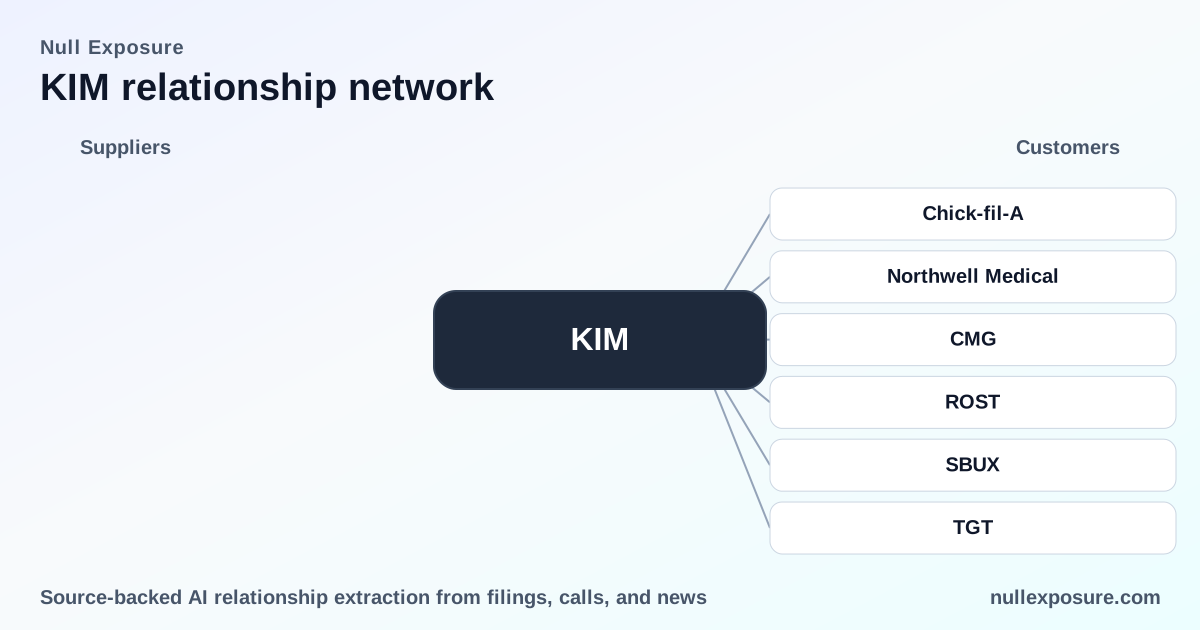
Kimco Realty (KIM) — Customer Relationships, Real-World Signals, and Investment Takeaways
Kimco is an income-focused REIT that owns and operates open‑air, grocery‑anchored shopping centers across the United States and monetizes primarily through long‑term leases that produce stable base rent, percentage rents tied to tenant sales, and selective asset dispositions. The company also extracts value through portfolio optimization — including the sale of ground‑leased parcels — while maintaining a predominantly North American footprint and high reported leasing coverage. For a concise data view and relationship monitoring, visit https://nullexposure.com/.
How Kimco’s customer set drives predictable cash flow
Kimco’s operating model is anchored in multi‑year lease contracts (generally 5–25 years) that deliver recurring minimum rent plus escalation clauses and occasional percentage rent tied to tenant sales. That contract posture creates a highly predictable revenue base and institutional counterparty mix dominated by major national and regional retailers. The company discloses significant U.S. concentration — more than 100 million square feet of GLA across 30 states — and reports portfolio occupancy levels that support near‑term cash flow stability. These are company‑level signals drawn from Kimco’s public disclosures and investor presentations.
- Contracting posture: The company’s income is concentrated in long‑term leases with escalation and sales‑based protections, supporting revenue durability and inflation pass‑through mechanics.
- Counterparty profile: Kimco’s tenants are principally large enterprises (national retailers and grocers), which reduces small‑tenant volatility but increases sensitivity to the retail macro cycle.
- Geographic footprint and concentration: The portfolio is U.S.‑centric, meaning macro risks are tied to U.S. consumer demand and regional retail dynamics.
- Role and maturity: Kimco operates as landlord and occasional seller of ground‑leased assets, and its relationships are predominantly active and operational, with leasing and redevelopment activity ongoing.
Relationship-by-relationship: what investors should know
Below are every counterpart referenced in the source material, with a concise plain‑English summary and the original source noted.
Target (TGT)
Target anchors the Shops at 82nd center, contributing significant traffic and stable base rent as a grocery‑anchored center tenant. According to Kimco’s Q4 2025 earnings call, Target is listed among the center’s marquee tenants (Q4 2025 earnings call, March 2026).
Chick‑fil‑A
Chick‑fil‑A is part of the tenant roster at Shops at 82nd, representing an in‑line restaurant operator that supports daytime and evening foot traffic. This was cited in Kimco’s Q4 2025 earnings commentary (Q4 2025 earnings call, March 2026).
Chipotle (CMG)
Chipotle is another restaurant tenant at Shops at 82nd, providing high sales density per square foot and contributing to the center’s grocery‑anchored demand profile (Q4 2025 earnings call, March 2026).
Starbucks (SBUX)
Starbucks anchors daily customer frequency at Shops at 82nd and is identified by management as part of the property’s strong tenant mix (Q4 2025 earnings call, March 2026).
Northwell Medical
Northwell Medical occupies space in Shops at 82nd, underscoring Kimco’s use of healthcare and service tenants to diversify foot traffic beyond retail. This tenant was named in the Q4 2025 earnings call (Q4 2025 earnings call, March 2026).
Ross Dress for Less (ROST)
Kimco executed a package deal with Ross Dress for Less that included six leases completed within 30 days from approval to execution, demonstrating operational leasing velocity and relationship depth with value apparel operators (Q4 2025 earnings call, March 2026).
Walmart (WMT)
Kimco sold a ground‑leased parcel that included the Walmart and Sam’s Club at Dulles Town Crossing in Sterling, VA for $24.3 million, an example of monetizing non‑core or capital‑intensive land interests while retaining portfolio cash flow profiles (Kimco Q1 2026 results press release, Apr–May 2026; reported via GlobeNewswire/ManilaTimes/The Globe and Mail).
Sam’s Club
Sam’s Club was part of the same ground‑leased Dulles Town Crossing sale (included in the Walmart parcel sale), showing Kimco’s willingness to transact large single‑tenant ground‑leased assets (Kimco Q1 2026 results press release, Apr–May 2026; GlobeNewswire/ManilaTimes/The Globe and Mail).
Lowe’s Home Improvement (LOW)
Kimco sold a ground‑leased Lowe’s parcel at Mission Bell Shopping Center in Tampa, FL for $22.8 million, illustrating selective asset disposition to recycle capital (Kimco Q1 2026 results press release, Apr–May 2026; GlobeNewswire/ManilaTimes/The Globe and Mail).
American Signature
American Signature’s bankruptcy was called out as a tenant‑specific issue that created localized occupancy noise but did not change Kimco’s broader credit trend, indicating that single‑tenant retail bankruptcies are monitored but currently isolated (Kimco commentary reported in FY2026 press materials, May 2026).
Painted Tree
Kimco disclosed limited exposure to filings associated with Painted Tree, presenting localized portfolio noise that management signals is contained and not a systemic credit driver for the portfolio (FY2026 press commentary, May 2026).
What these relationships imply for cash flow and risk
Kimco’s tenant mix is anchored by large national retailers and everyday service providers, providing base rent stability. The presence of grocery‑anchored configurations and service/healthcare tenants (e.g., Northwell) increases defensive demand for the properties. Kimco’s ability to sell ground‑leased parcels (Walmart/Sam’s Club, Lowe’s) demonstrates an active capital‑management playbook that supplements rent roll with realized gains and liquidity.
At the same time, the portfolio is sensitive to retail credit events at the tenant level — bankruptcies like American Signature create localized vacancy and leasing pressure. Kimco’s disclosures frame these as isolated rather than systemic, but investors should track tenant concentration among anchor tenants and the pace of re‑leasing.
Checklist for investors and operators
- Revenue durability: Long‑term leases with escalations and sales‑based components underpin predictable cash flow.
- Counterparty quality: The tenant roster is skewed to large enterprises, reducing small‑tenant churn but increasing exposure to national retail cycles.
- Asset‑recycling optionality: Recent ground‑lease sales show Kimco monetizes illiquid land interests to redeploy capital or shore up returns.
- Localized downside risk: Tenant bankruptcies and small cluster filings (e.g., Painted Tree exposure) are present and require asset‑level monitoring.
For a structured view of these relationships alongside evolving exposure data, explore Kimco monitoring and relationship analytics at https://nullexposure.com/.
Bottom line for investors
Kimco’s business model is fundamentally a long‑dated landlord with stable contract mechanics and a large‑enterprise tenant base that supports predictable rental income. Asset sales and active portfolio management are meaningful levers that improve capital flexibility. Key risks are tenant‑specific credit events and U.S. retail cyclicality, which require ongoing scrutiny at the asset and tenant cohort level. For investors evaluating KIM, the combination of long‑term leases, grocery‑anchored defensive properties, and demonstrated monetization channels constitutes a conservative income profile with tactical upside from asset recycling.