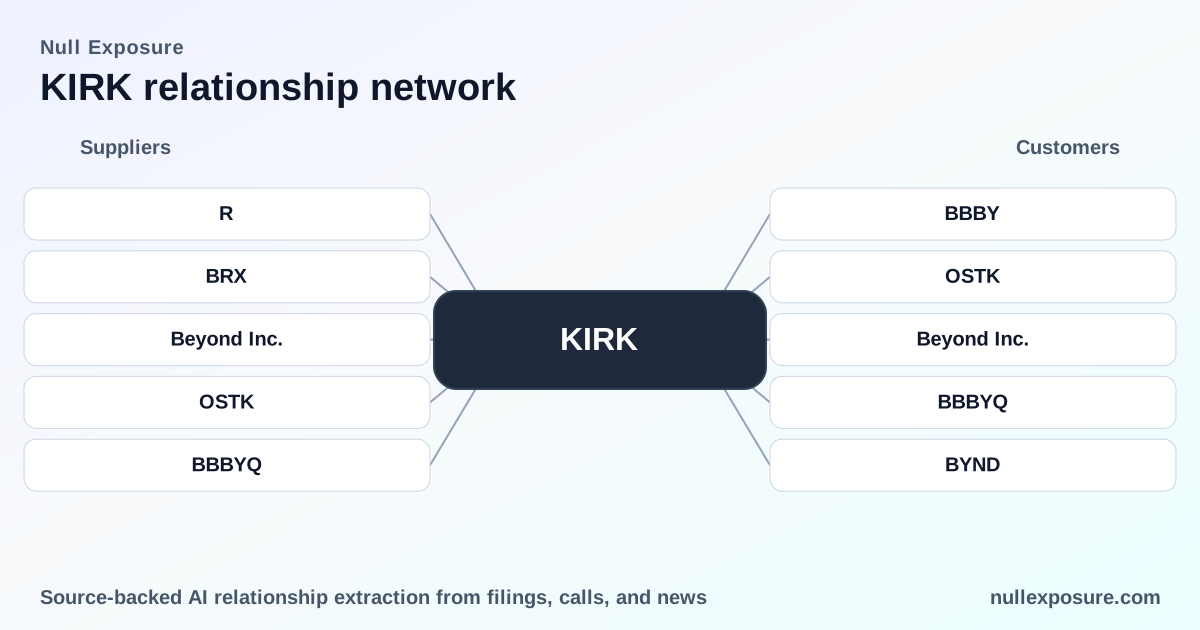
Kirkland’s (KIRK) customer relationships: the new operator-first playbook and what investors should price in
Kirkland’s operates as a specialty home décor retailer that is increasingly monetizing through a hybrid of brick-and-mortar operations, licensing and third‑party merchandising agreements rather than pure brand ownership. Over the last 12 months the company shifted from a standalone brand-owner into a development-and-operator role for other home‑goods banners, while pursuing expanded e‑commerce distribution with marketplace partners to lift average order values and margins. This repositioning drives revenue diversification but also concentrates operational risk into a few strategic partners.
Learn more about how Null Exposure tracks these customer relationships at https://nullexposure.com/.
How the operating model has changed — from brand owner to operator and licensee
Kirkland’s historical retail cash flows came from in‑store sales and owned private‑label assortments. Recent documentary evidence shows a deliberate pivot: the company is now taking on inventory ownership and merchandising responsibilities for partner banners, and has licensed its merchandising expertise to relaunch legacy retail formats. That shift transforms Kirkland’s contracting posture from a merchant‑brand to a service‑and‑supply operator — higher working capital and execution risk, but potentially more scalable revenue via operator fees, wholesale and licensing revenue.
Because the data payload provided no explicit contractual constraints, treat that absence as a company‑level signal: no additional contractual limits or contingent liabilities were disclosed in the feed, so the operational changes above should be evaluated against public press and filings rather than embedded contractual caveats in this set.
Relationship map — every customer and partner identified in the record
Bed Bath & Beyond (BBBY / Bed Bath & Beyond Inc. / BBBYQ)
Kirkland’s has entered a deep and multi‑faceted relationship with Bed Bath & Beyond: Bed Bath & Beyond acquired Kirkland’s intellectual property for $10 million in September 2025, and Kirkland’s will act as the exclusive brick‑and‑mortar operator and licensee for a new, smaller “neighborhood” Bed Bath & Beyond format while owning inventory and developing merchandising for those locations. According to USA Today and multiple regional press reports, the IP sale was used to accelerate store conversions and expand the Kirkland’s Home brand into Bed Bath & Beyond’s assortments (USA Today, Dec 3, 2025; GulfshoreBusiness, mid‑Sept 2025). Additional reporting confirmed plans to use Kirkland’s Home as an exclusive private‑label assortment within Bed Bath & Beyond stores (HFBusiness update, FY2025).
Overstock / Overstock.com (OSTK / Overstock)
Kirkland’s is actively exploring expanded e‑commerce distribution with Overstock to drive average order value and broaden online reach for furniture, patio and rugs through marketplaces. That partnership is presented as a channel expansion that complements Kirkland’s in‑store operator activity and supports higher‑ticket categories via third‑party marketplaces (HFBusiness, FY2025).
Source: HFBusiness coverage of Kirkland’s strategic plan update (FY2025).
Beyond Inc. / Beyond (BYND)
Beyond (the operator associated with the Bed Bath & Beyond banner in several reports) has positioned Kirkland’s as the development engine for its banners — Kirkland’s will operate and develop physical neighborhood store concepts for Beyond’s brands, with Bed Bath & Beyond the first to roll out the format; press indicates Kirkland’s will own inventory and run merchandising for those locations (HomePageNews special report, FY2025; RetailWire commentary, FY2024). The partnership explicitly reassigns store‑level operational responsibilities to Kirkland’s while Beyond focuses on banner strategy and cost management.
Source: HomePageNews special report (FY2025) and RetailWire (FY2024).
Why these relationships are consequential for investors
- Business model transformation: Kirkland’s has moved from brand ownership to an operator‑centric model where revenue depends on merchandising and inventory management contracts and on wholesale/private‑label placement inside partner banners. The September 2025 IP sale to Bed Bath & Beyond is the clearest evidence of that pivot (DigitalCommerce360, May 2025 reported the IP deal; regional outlets documented the September closing).
- Revenue concentration and counterparty importance: Bed Bath & Beyond (and the broader Beyond group) is the dominant counterparty in the feed. That concentration elevates counterparty risk: operational missteps by Kirkland’s in executing store conversions or inventory programs would have outsized revenue and margin impact.
- Working capital and margin profile: Operating and owning inventory for partner banners increases working capital intensity and execution risk. Media reporting explicitly notes Kirkland’s owning inventory for new Bed Bath & Beyond locations — a structural change that impacts cash conversion cycles (HomePageNews, FY2025).
- Channel diversification via marketplaces: The Overstock relationship indicates a deliberate push into marketplace channels for larger categories, which supports higher average order values and provides a hedge to brick‑and‑mortar exposure (HFBusiness, FY2025).
Key risks and what to monitor next
- Execution risk on store rollouts: Kirkland’s is now responsible for opening and stocking new neighborhood formats; watch conversion cadence, inventory turns and per‑store economics reported in upcoming quarters. Several outlets describe up to five initial locations and broader rollout plans (RetailWire/Chain Store Age citations in press).
- Concentration risk: A significant portion of the documented partner activity points to Bed Bath & Beyond/Beyond as the primary commercial engine; investor models should test sensitivity to slower rollout or weaker wholesale placements.
- Brand and IP dynamics: The $10 million IP transfer to Bed Bath & Beyond alters Kirkland’s brand ownership and potential long‑term licensing income; follow filings or press releases for the precise licensing terms and fee structures. Multiple news reports document the $10 million IP acquisition and subsequent merchandising plans (USA Today; DigitalCommerce360; TheCityMenus).
Bottom line and actionable investor read
Kirkland’s has deliberately traded some elements of brand ownership for an operator-and-development revenue model that scales through partner banners and marketplaces. That transition increases operational leverage and working capital needs while concentrating commercial exposure with a small number of large partners, chiefly Bed Bath & Beyond/Beyond. Investors should value KIRK on scenario assumptions that separate legacy retail sales from operator fees and wholesale revenue, and should prioritize metrics tied to conversion velocity, inventory turns and margin performance in partner stores.
For a granular, document‑level view of these relationships and to track new partner disclosures in real time, visit our research hub at https://nullexposure.com/.
Bold takeaway: Kirkland’s is no longer just a home‑decor retailer — it has recast itself as a third‑party operator and merchandising engine, and that strategic pivot is the single most important factor for modeling KIRK’s revenue and risk profile over the next 12–24 months.