Nauticus Robotics (KITT): Customer Map and What It Means for Investors
Nauticus Robotics monetizes through a three-pronged offering: sale and deployment of robotic platforms (hardware), subscription and licensing of its ToolKITT autonomy and command-and-control software, and engineering/service contracts to government and energy clients. Revenue is driven by short-duration contracts and project work tied to field demonstrations and phase-based commercialization, with a concentrated customer base that makes a small number of counterparties highly material to near‑term cash flow. For primary research and transaction diligence, see more at https://nullexposure.com/.
The operating model in plain terms — commercial posture and constraints
Nauticus operates as a vertically integrated ocean robotics supplier: it designs and manufactures vehicles at its Webster, Texas facility, sells software that controls those systems, and executes field service contracts for energy and defense customers. Key operating characteristics for investors:
- Contracting posture is short-term and project-based. Company disclosures describe contracts that “typically have terms of up to 18 months,” which translates into revenue volatility tied to bid wins and milestone deliveries rather than long-term annuity streams.
- Government work is a meaningful counterparty class. Public statements indicate a material portion of revenue comes from U.S. defense agencies, establishing a revenue profile that is partially event-driven by awards and extensions.
- Customer concentration is acute and operationally critical. The company reports that sales to three customers represented 82% of 2024 revenue, making customer retention and contract renewals a primary risk vector.
- Geographic footprint is global but anchored in North America. While operations are concentrated in the U.S., Nauticus already engages international customers, including Brazil, and targets global offshore markets.
- Product mix spans hardware, software, and services. Nauticus sells AUV/ROV hardware, ToolKITT software, and consulting/service work — a diversification that helps margin optionality but does not remove concentration risk while commercial scale is still ramping.
- Commercial stage is ramping. Management positions the service offering as being commercialized at scale but still early; this implies growth upside if field deployments convert to recurring service contracts, and execution risk if they do not.
These operating signals should shape valuation assumptions: model short contract durations, assign high renewal and customer concentration risk, and isolate growth scenarios around government and energy project pipelines. If you want a tailored customer-concentration stress test or deal-level readout, visit https://nullexposure.com/.
Relationship roll-call: the counterparties in public reporting
Below are every customer relationship identified in public reporting available in the results set, with a concise, plain-English summary and the source.
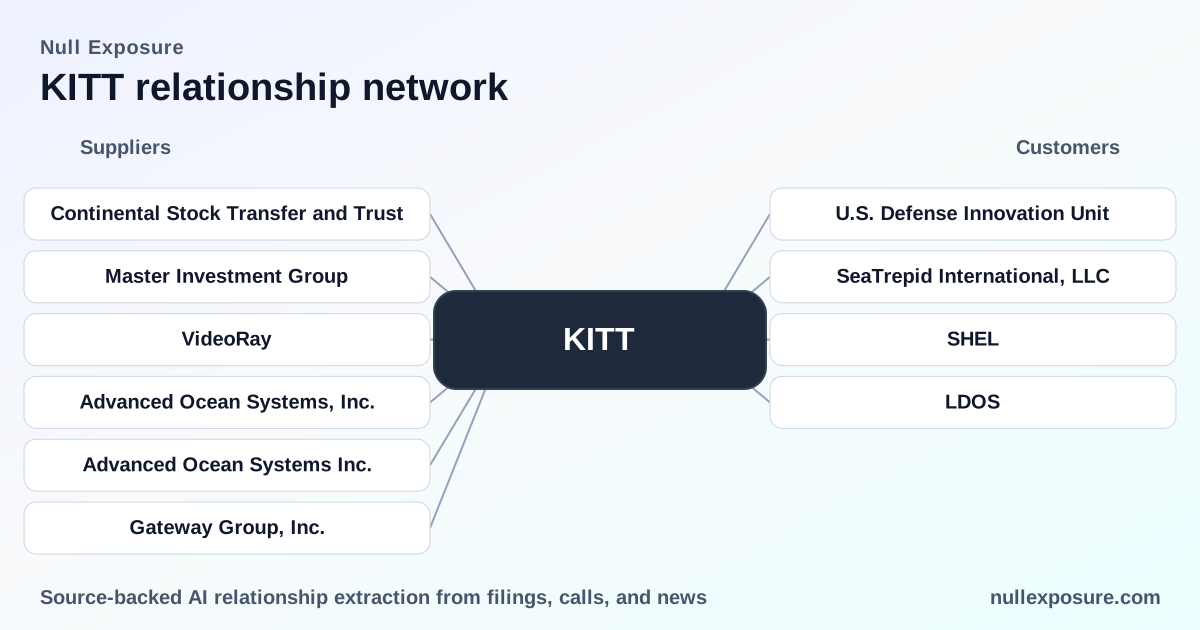
U.S. Defense Innovation Unit — amphibious autonomous system contract
Nauticus was awarded a second multimillion-dollar contract by the Defense Innovation Unit to develop a self-piloted amphibious robot system using ToolKITT for command-and-control, signaling institutional defense interest in the company’s autonomy stack. This was reported by Houston InnovationMap in March 2026.
Source: Houston InnovationMap coverage, first seen March 10, 2026.
SeaTrepid International, LLC — ToolKITT integration into ROV fleet
Nauticus integrated ToolKITT into SeaTrepid’s existing ROV fleet, positioning Nauticus’ autonomy software as a retrofit and augmentation play for legacy remote-operated vehicles and an avenue to scale software revenue across third‑party fleets. This initiative was described in Marine Technology News, referenced in March 2026.
Source: Marine Technology News, first seen March 10, 2026.
SHEL (Shell) — commercial demonstrations and follow‑on scoping
Nauticus completed in-water demonstrations for Shell and is scoping a next phase for supervised autonomy and tool control via acoustic networking, indicating a path from proof-of-concept to phased commercial work with an energy major. This engagement is documented in company press material and industry reporting in 2023 and cited again in 2026 market summaries.
Source: GlobeNewswire press release (March 28, 2023) and subsequent industry coverage referenced in March 2026.
SHEL (via market roundup) — commercial opportunity reference
A market commentary noted Nauticus’ success has unlocked commercial opportunities with energy majors such as Shell, underlining external market recognition of Shell as a reference customer that helps validate Nauticus’ service proposition. This appears in a Finviz industry roundup in March 2026.
Source: Finviz industry coverage, first seen March 10, 2026.
LDOS (Leidos) — contract expansion, additional $2.7 million
Nauticus secured an additional $2.7 million under its existing contract with Leidos, extending a relationship with a major government contractor and reinforcing the defense and government revenue path. The Robot Report covered the award and expansion.
Source: The Robot Report, first seen March 10, 2026.
Leidos Holdings, Inc. — framing with the prime contractor
The same award was described with Leidos named explicitly, showing Nauticus as a subcontractor/partner to Leidos on government programs and underlining the company’s channel into larger federal programs through established primes. The Robot Report story documents this relationship.
Source: The Robot Report, first seen March 10, 2026.
Shell — press disclosure of demonstrations and next phase scoping
Company filings and press releases confirm Nauticus completed Shell demonstrations and is scoping the next phase focused on supervised autonomy and acoustic networking — a follow-up to the earlier Shell engagement that signals moving from demonstration to potential contracted work. This is in a GlobeNewswire release from March 2023 that the company continues to reference.
Source: GlobeNewswire press release (March 28, 2023).
What these relationships collectively tell investors
- Defense and energy are the twin demand pillars. Contracts and demonstrations with DIU, Leidos, and Shell show a deliberate go-to-market into defense procurement channels and energy majors that require validated, field-tested autonomy.
- Software monetization is a scalable lever. Integration of ToolKITT into SeaTrepid’s fleet reveals a licensing/technology‑integration pathway beyond unit hardware sales.
- Commercial traction remains project-driven, not recurring today. The mix of phased demonstrations, expanded awards, and short-term contracts points to revenue spikes tied to program activity rather than predictable subscriptions.
- Concentration is the single largest operational risk. Given three customers represented 82% of 2024 revenue, any loss or non-renewal of a major program materially affects near-term financials.
Investment implications and a short checklist for diligence
- Confirm renewal probability and pipeline for the DIU and Leidos awards; quantify how much of reported revenue is expected to recur beyond current delivery milestones.
- Stress-test cash flow under a scenario where the top three counterparties do not renew in a 12–18 month window.
- Validate the commercial terms of ToolKITT integrations (license vs. one-off engineering) to establish long-term margin potential.
- Monitor international engagements (Brazil/LatAm) for customer diversification and regulatory complexity.
For further analysis, client-grade diligence products and contract-level summaries are available at https://nullexposure.com/.
Conclusion: Nauticus is a high‑upside, execution‑sensitive operator in ocean robotics — its technology has credible enterprise buyers, but revenue concentration and short contract durations demand conservative modeling and active monitoring of renewal and scaling milestones.