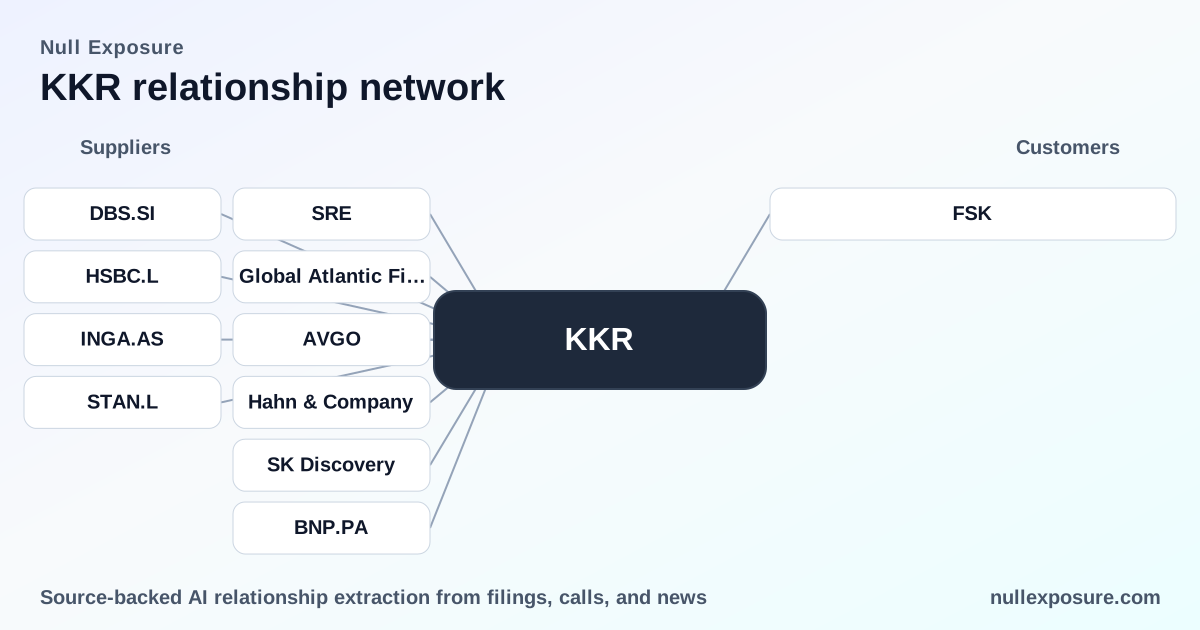
KKR’s customer map: how relationships convert platform scale into recurring revenue
Thesis — KKR monetizes a global alternatives platform by charging for management, performance and capital-markets services to affiliated investment vehicles, preferred-equity and credit issuers, and third‑party counterparties; its economics are driven by durable fee contracts, distribution reach into individual and institutional channels, and transactional income tied to portfolio activity. For investors, the critical question is not whether KKR can source deals — it can — but how counterparty structure, geographic concentration and the mix of long‑term vs. transactional contracts govern revenue volatility and capital intensity.
Discover how KKR’s customer relationships map to revenue drivers and operational constraints at https://nullexposure.com/.
How KKR actually gets paid — a quick, investor‑oriented summary
KKR generates income through three principal channels: management and incentive fees from funds and vehicles; transactional and capital markets fees (underwriting, advisory, syndication); and returns/carry and strategic holdings that convert capital appreciation into earnings. The firm also externally manages REITs, BDCs and credit vehicles, which creates recurring fee revenue while concentrating operational and reputational risk on a small set of sponsored entities.
Operating constraints that shape customer exposure
KKR’s customer model is shaped by several structural signals rather than single counterparty idiosyncrasies:
- Contracting posture — long‑term orientation. KKR reports that roughly 93% of AUM is either perpetual or locked for at least eight years, signaling a revenue base biased toward long-dated fee contracts rather than short-term redemptions. This supports predictable management fees but links performance to multi-year market cycles.
- Counterparty mix — individual and institutional layers. The firm increasingly offers vehicles accessible to retail and accredited individuals while remaining deeply embedded with institutional investors and distributors; distribution breadth increases scale but raises compliance complexity.
- Geographic footprint — global but North America‑heavy. KKR operates globally (Americas, EMEA, APAC). North America contributes the largest share of deployment and revenue, with Europe and Asia‑Pacific material but secondary, implying regional concentration risks despite global reach.
- Materiality and concentration. KKR’s disclosures show single funds and large reinsurance blocks can contribute >10% of segment revenues, highlighting that a few customers or transactions can meaningfully swing reported fees.
- Role diversity — manager, seller and service provider. KKR functions simultaneously as investment adviser, underwriter, sponsor and service provider to vehicles it controls and to third parties, creating aligned economics but increasing operational complexity and regulatory surface.
- Segment focus — services first. Fee revenue arises predominantly from asset management and capital‑markets services rather than product sales, making service delivery, client retention and track record the primary drivers of cash flows.
These constraints imply a business that is mature in contracting and distribution but cyclical in performance fees, concentrated around large funds and strategic transactions, and operationally complex because KKR wears many hats.
Customer relationships that matter — short, source‑backed profiles
Below are the relationships extracted from recent reporting and filings. Each entry is a plain‑English snapshot with source attribution.
BrightSpring (BTSG)
KKR is listed as one of the underwriters in BrightSpring’s IPO filings, indicating a direct capital‑markets role in bringing the home‑health company public and extracting underwriting and advisory fees. This was reported in coverage of BrightSpring’s FY2024 IPO filing (HospiceNews and FierceHealthcare, reported March 2026 referencing the FY2024 filing).
KKR Real Estate Finance Trust — preferred (KREF‑P‑A)
KREF‑P‑A is the preferred stock of KKR Real Estate Finance Trust, which is externally managed and advised by an affiliate of KKR, creating recurring management and admin fees tied to the REIT’s capital structure; this was confirmed in multiple dividend‑declaration notices and press releases (Investing.com; Markets.FinancialContent; Globe and Mail, FY2025–FY2026).
KKR Real Estate Finance Trust (KREF)
KREF, a mortgage REIT sponsored by KKR, leverages KKR’s capital‑markets and financing capabilities, with KKR affiliates providing management, market access and internal capital markets support; commentary and earnings transcripts describe this integration and financing posture (Yahoo Finance, TradingView, and Q4‑2025 earnings call transcripts, FY2025–FY2026).
FS KKR Capital Corp. (FSK / FS KKR Capital Corp.)
FSK is a credit vehicle established via a strategic partnership between FS Investments (later branded Future Standard) and KKR Credit; KKR provides credit underwriting and advisory services and is part of the FS/KKR Advisor structure that advises the BDC, putting KKR in a direct fee and performance role (MarketBeat; Globe and Mail; SimplyWall.St, FY2026).
Huntington Bancshares (HBAN)
KKR monetized non‑core wealth management assets by divesting Janney Montgomery Scott business units to Huntington Bancshares, demonstrating an exit strategy for non‑core holdings and one‑off monetization fees tied to corporate sales (Globe and Mail, FY2026).
Ecolab (ECL)
KKR sold CoolIT Systems to Ecolab in a transaction valued at approximately $4.75 billion, showing KKR’s activity as a sponsor and seller of portfolio companies that generates transaction proceeds and carry on realized exits (Investing.com coverage, reported FY2026).
KKR Income Opportunities Fund (KIO‑R)
KKR Credit Advisors is identified as the fund’s investment adviser, illustrating KKR’s role providing advisory services to closed‑end funds and rights offerings that produce recurring advisory and management fees (Markets.FinancialContent press release, FY2023).
KREST / KKRT (KKRT)
KREST is managed by KKR Registered Advisor LLC and uses KKR’s global real estate resources; the managerial link confirms KKR’s role as external advisor and operator of sponsored real‑estate vehicles (CityBiz report on leadership appointment, FY2023).
Crescent Energy (CRGY)
A management agreement shows KKR Energy Assets Manager LLC is contractually entitled to compensation from Crescent Energy, illustrating KKR’s role as manager for energy‑sector entities and a provider of operational expertise for fees (SEC filing summary reported via StockTitan, FY2026).
Apollo (APO) transaction link
Apollo acquired a 40% stake in Pembina Gas Infrastructure from KKR, an example of KKR monetizing infrastructure stakes via strategic sales to other large alternative managers, crystallizing capital gains and advisory proceeds (Globe and Mail transaction coverage, FY2026).
Hannon Armstrong (HASI)
HASI referenced a co‑investment vehicle with KKR (CCH 1), implying a partnership structure where KKR supplies co‑invest and structuring expertise that boosts profitability per share through access to bond markets and investment‑grade assets (Q4‑2025 earnings call transcript, FY2025).
OneStream (OS)
OneStream used net proceeds from a public offering to purchase units from KKR Dream Holdings in a synthetic secondary, evidencing KKR’s participation as a significant pre‑IPO shareholder and the use of structured secondaries to realize value (PR Newswire release on FY2024 offering).
Chubb (CB)
Chubb’s management referenced partnerships with KKR and jointly formed funds in an earnings‑call context, indicating distribution and co‑investment ties between large insurance underwriters and KKR‑managed funds (InsiderMonkey transcript of Chubb Q1‑2026 call, FY2026).
Investment implications and risk checklist
- Revenue resilience: Long‑dated AUM provides stable management fees but performance fees remain cyclical and sensitive to valuation resets.
- Concentration risk: Large funds and reinsurance blocks historically contributed >10% of segment revenues, so single‑transaction shocks can move reported results.
- Operational complexity: Acting as adviser, underwriter and seller increases fee capture but raises regulatory, compliance and client‑governance obligations.
- Geographic balance: Global reach mitigates localized downturns, but North America dominates deployments and revenue, concentrating political and macro risk exposure.
For a deeper look at KKR’s counterparty map and how these relationships drive fee realization and balance‑sheet exposure, visit https://nullexposure.com/ for analyst‑grade customer intelligence and scenario analysis.