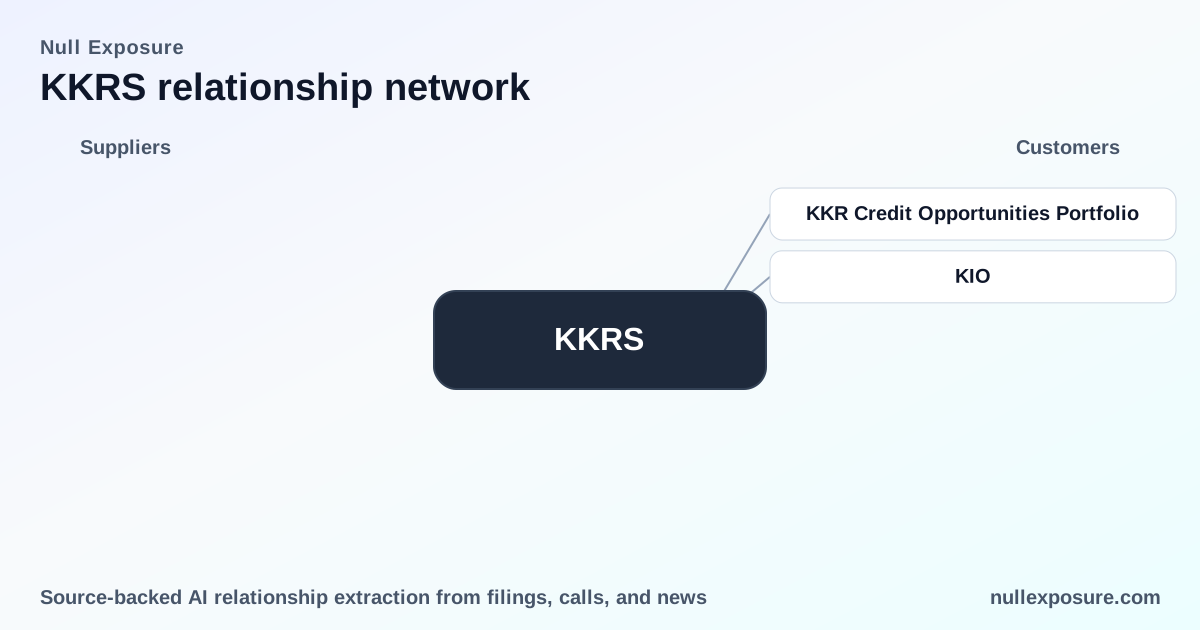
KKRS customer relationships — focused intelligence for investors
KKRS operates and monetizes through a dual pathway: a technology-driven product platform combined with investment advisory and asset-management services that generate recurring management, incentive and transaction fees. Revenue is derived from selling technology-enabled solutions to enterprise customers and from fee income earned as an investment adviser to registered investment companies and related vehicles. For a compact dossier on the customer counterparties disclosed by KKRS, see NullExposure for deeper coverage: https://nullexposure.com/.
Why this matters to investors: advisory contracts underpin recurring, high-margin fee streams; product sales drive volume and channel exposure. Together they determine cash flow stability, counterparty concentration risk, and regional revenue mix.
What the filings actually disclose about customer relationships
KKRS’s FY2024 Form 10‑K (document kkrs-2024-12-31) explicitly identifies the company as an investment adviser to several registered investment companies. The following relationships are reported by name in that filing.
KKR Credit Opportunities Portfolio — an interval fund under management
KKRS serves as the investment adviser to the KKR Credit Opportunities Portfolio, an interval fund structure used to access credit markets for certain investors. This relationship is disclosed in KKRS’s FY2024 10‑K as part of the company’s advisory business. (Source: KKRS FY2024 10‑K, kkrs-2024-12-31.)
KIO (ticker: KIO) — KKR Income Opportunities Fund
KKRS acts as investment adviser to KKR Income Opportunities Fund, which is listed on the NYSE under the symbol KIO. The FY2024 10‑K names KIO explicitly as one of the registered investment companies the firm advises. (Source: KKRS FY2024 10‑K, kkrs-2024-12-31.)
KKR Income Opportunities Fund — same fund, separate mention
The filing also repeats the reference to the KKR Income Opportunities Fund by name, confirming advisory responsibilities to the same NYSE‑listed vehicle. The duplication in the results reflects both the fund’s formal name and its ticker reference in the 10‑K. (Source: KKRS FY2024 10‑K, kkrs-2024-12-31.)
How these relationships fit into KKRS’s operating model
KKRS combines product sales with services-led revenue. The advisory relationships with listed funds are classic services contracts: they generate management and incentive fees and entail ongoing obligations (monitoring, reporting, regulatory compliance). The FY2024 disclosure frames these advisory roles alongside the company’s broader asset management and capital markets activities.
- Contracting posture: The company acts primarily as seller/service provider when it performs advisory and capital markets functions; contracts are fee-for-service and structured under the Investment Company Act. This is a company-level signal drawn from the FY2024 disclosure of advisory arrangements and fee descriptions.
- Concentration and materiality: The 10‑K characterizes certain counterparties and transactions as material; the filing notes instances where a single counterparty or flagship fund contributed more than 10% of consolidated asset-management revenues in the reported period, which signals measurable concentration risk at the portfolio level.
- Criticality: Advisory relationships are mission-critical to recurring fee income and to KKRS’s position in capital markets activities; those service contracts underpin monitoring and transaction fee fees described in the filing.
- Maturity and stage: Disclosures use present-tense advisory language and reference recurring monitoring fees negotiated per portfolio company, indicating active, ongoing relationships rather than one-off engagements.
Geographies, counterparty types and spend signals — reading the constraints
The FY2024 filing and extracted constraint signals show KKRS operates with a broad geographic footprint and a diverse counterparty set:
- Geographic mix: Fee generation and capital markets competition are reported across North America, Europe/Middle East, and Asia‑Pacific, with quantified fees in the Americas, Europe/Middle East, and Asia‑Pacific for the year ended December 31, 2024. This supports a multi-regional revenue base rather than single-market dependency. (Source: FY2024 10‑K excerpts.)
- Counterparty profile: The company interacts with both institutional and individual investors; the filing cites fundraising from accredited investors and retail channels for certain vehicle types, signaling a mixed counterparty strategy.
- Spend/commitment signals: The disclosures include references to large contingent obligations and funding commitments (for example, development-stage renewable energy obligations in the hundreds of millions), which imply material capital and contingent exposure on a company level. (Source: FY2024 10‑K excerpts.)
Key operational implication: advisory contracts provide cash flow stability but coexist with capital commitments and reinsurance/transactional exposures that can produce episodic revenue swings and material counterparty concentration events.
For additional context and a consolidated view of these signals, visit NullExposure: https://nullexposure.com/.
Investment implications — what investors should watch
- Revenue mix risk versus stability: Advisory fees are recurring and high-margin but concentrated; a flagship fund or a single counterparty driving >10% of asset-management revenues creates single-point risks to top-line stability.
- Regulatory and distribution complexity: Serving registered funds and retail channels increases compliance costs and distribution execution complexity across jurisdictions (UK retail rules, US Rule 506 crowdfunding pathways).
- Regional diversification is real: Fees are generated across Americas, EMEA and APAC, providing geographic diversification, but regional regulation and competition remain active constraints.
- Capital commitments and contingent liabilities: Large contingent funding obligations and reinsurance transactions reported in FY2024 elevate balance-sheet and liquidity monitoring as primary due-diligence priorities.
Bottom line for investors and operators
KKRS combines technology product sales with an asset-management advisory franchise that drives fee revenue. The advisory relationships named in the FY2024 10‑K — KKR Credit Opportunities Portfolio and KKR Income Opportunities Fund (KIO) — are live contributors to recurring fee income. Investors should balance the appeal of recurring advisory fees against documented concentration and contingent exposure reported in the same filing.
For systematic monitoring of counterparty and contract-level signals cited here, NullExposure maintains a consolidated tracker of these disclosures: https://nullexposure.com/.