KLA Corporation (KLAC): Customer Relationships, Concentration and Commercial Shape
KLA sells high‑precision process control and yield‑management equipment to semiconductor manufacturers and monetizes through equipment sales plus a recurring services/subscription‑like revenue stream tied to installed systems and maintenance. The company’s economics combine high‑margin capital equipment with a growing services annuity that increases lifetime value and underpins strong operating margins.
For an organized view of KLA’s customer map and related intelligence, see NullExposure’s customer coverage at https://nullexposure.com/.
Investment thesis in one paragraph
KLA operates as a platform supplier to the semiconductor ecosystem: it sells mission‑critical inspection and metrology systems to large foundries and fabs, captures recurring services revenue that smooths cyclicality, and benefits from geographic diversification concentrated in APAC where most fabs are located. The business model delivers high profitability and predictable aftermarket cash flow, but customer concentration and regional exposure create idiosyncratic revenue sensitivity tied to a handful of large manufacturers.
What the press is saying about KLA’s customers right now
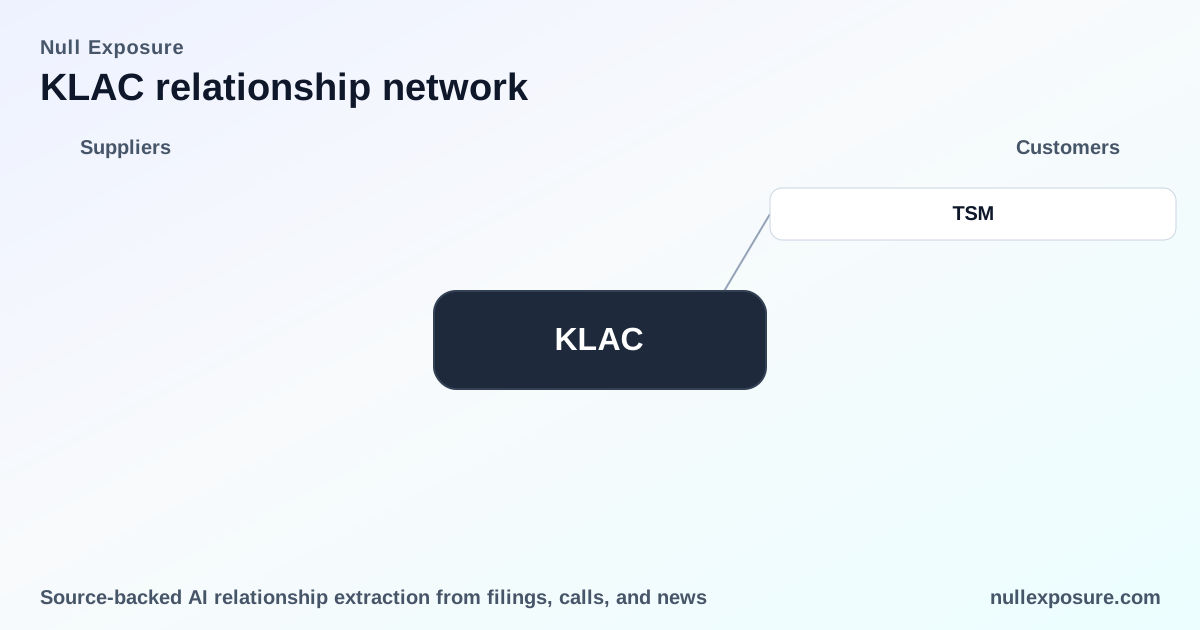
Press coverage from March 10, 2026 highlights Taiwan Semiconductor Manufacturing Company (TSMC) as one of KLA’s largest customers and links TSMC’s strong quarter to positive sentiment for KLA shares. Below are the raw relationship citations pulled from the news stream; each item is represented with a brief, plain‑English summary and source.
Finviz — Taiwan Semiconductor Manufacturing Company (TSMC) (Mar 10, 2026)
KLA’s investor sentiment was lifted by strong fourth‑quarter results at TSMC, which the article identifies as one of KLA’s largest customers. Source: Finviz article, March 10, 2026 (https://finviz.com/news/328649/why-kla-corporation-klac-shares-are-trading-lower-today).
Finviz — TSM (inferred symbol TSM) (Mar 10, 2026)
The same Finviz coverage repeats TSM as a direct input to market sentiment, reinforcing that TSMC’s performance is monitored closely by KLA investors. Source: Finviz (same article), March 10, 2026 (https://finviz.com/news/328649/why-kla-corporation-klac-shares-are-trading-lower-today).
TradingView — Taiwan Semiconductor Manufacturing Company (TSMC) (Mar 10, 2026)
TradingView carried parallel coverage noting that strong TSMC earnings supported positive sentiment toward KLA, underlining TSMC’s importance as a major buyer of process control systems. Source: TradingView news, March 10, 2026 (https://www.tradingview.com/news/stockstory:e1df1a6ea094b:0-why-kla-corporation-klac-shares-are-trading-lower-today/).
TradingView — TSM (inferred symbol TSM) (Mar 10, 2026)
A second TradingView entry reiterates the link between TSMC results and KLA share movement, reflecting multiple feeds syndicating the same market signal. Source: TradingView news, March 10, 2026 (https://www.tradingview.com/news/stockstory:e1df1a6ea094b:0-why-kla-corporation-klac-shares-are-trading-lower-today/).
StockStory — Taiwan Semiconductor Manufacturing Company (Mar 10, 2026)
StockStory’s coverage mirrored other outlets: TSMC’s strong quarterly performance is identified as materially relevant to KLA because TSMC ranks among KLA’s largest customers. Source: StockStory article, March 10, 2026 (https://stockstory.org/us/stocks/nasdaq/klac/news/why-up-down/why-kla-corporation-klac-shares-are-trading-lower-today).
StockStory — TSM (inferred symbol TSM) (Mar 10, 2026)
A duplicated StockStory feed again associates TSMC’s earnings with KLA sentiment, highlighting how a single large customer event propagates across market commentary. Source: StockStory (same article), March 10, 2026 (https://stockstory.org/us/stocks/nasdaq/klac/news/why-up-down/why-kla-corporation-klac-shares-are-trading-lower-today).
Key takeaway: All captured media mentions from March 10, 2026 connect KLA’s market outlook directly to TSMC’s operating performance, illustrating the practical impact a major foundry has on KLA’s near‑term revenue expectations and investor sentiment.
How KLA’s commercial model is structured (constraints as company‑level signals)
The public record and company filings describe several durable characteristics of KLA’s operating model that are essential for any investor or operator evaluating customer risk and revenue quality:
- Subscription‑like services anchor recurring revenue. KLA explicitly describes its services revenue as largely generated from recurring “subscription‑like” contracts, which increases contract value by extending system lifetimes and locking in aftermarket spend.
- Large enterprise counterparties dominate. The company serves the leading semiconductor and electronic device manufacturers worldwide, signaling a large‑enterprise counterparty profile rather than a long tail of small buyers.
- Global sales footprint with APAC concentration. KLA’s revenues are international (about 89% outside the U.S. in recent fiscal years), and APAC — specifically China, Taiwan, Korea and Japan — accounts for a majority of shipments, which concentrates geographic exposure where the largest fabs operate.
- Services are material and growing. Services accounted for approximately 22% of revenue in fiscal 2025 and have shown consistent year‑over‑year growth, supporting margin resilience and cash conversion across cycles.
- Revenue recognition and channel nuance. KLA recognizes sales upon shipment in certain distributor transactions and when installation is perfunctory, indicating a mix of direct OEM sales and independent distributor relationships in parts of the business.
- Customer concentration is meaningful. In fiscal 2025, one customer represented roughly 19% of revenues, which is a company‑level concentration signal that increases earnings sensitivity to the purchasing cadence of a small number of large customers.
These constraints imply a contracting posture that blends long‑term service contracts with discrete capital equipment sales, high counterparty concentration among large foundries, and geographic concentration in APAC that is critical to revenue generation.
For a consolidated view of customer exposures and how they translate to revenue risk, visit NullExposure’s platform at https://nullexposure.com/ — the site aggregates relationship signals and public evidence.
Risk and opportunity lens for investors and operators
- Opportunity: Recurring services cash flow increases predictability and supports valuation premiums relative to pure equipment vendors.
- Risk: Customer concentration and APAC geographic concentration create idiosyncratic exposure; a slowdown at a top customer or in a regional capex cycle will have outsized impact.
- Operational implication: KLA’s model requires excellence in installed‑base management and a sales organization calibrated to both capital equipment cycles and subscription renewal economics.
Bottom line
KLA’s financial profile is shaped by the dual dynamics of high‑value capital equipment and an increasingly important services annuity. Press coverage in March 2026 emphasizes TSMC as a key demand driver and a proximate cause of share‑price sensitivity. Investors should value KLA on the basis of durable service revenue growth and the company’s exposure to a small set of very large, geographically concentrated customers.