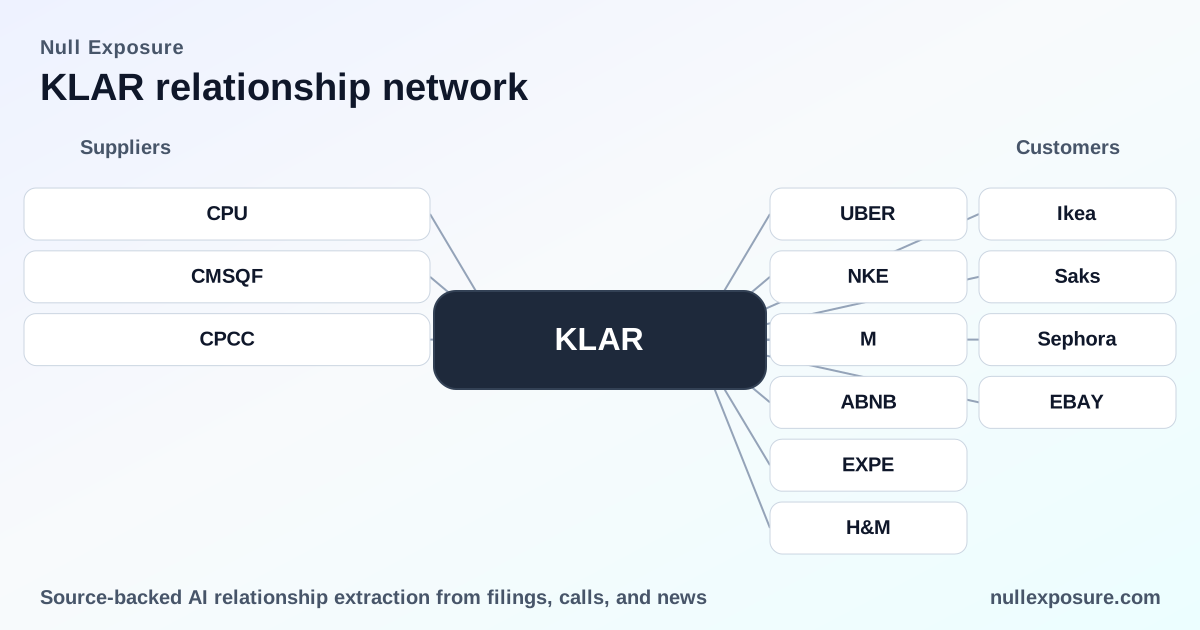
Klarna (KLAR): Merchant relationships that drive scale and optionality
Klarna operates as a technology-first payments platform that monetizes by embedding flexible checkout and financing products into merchant flows, earning fees from merchants and interest or interchange on consumer financing. Its growth strategy is merchant-led: win distribution through large retail partnerships, then increase customer lifetime value via Klarna’s wallet and credit products. For investors, the question is execution — can Klarna convert merchant distribution into durable unit economics and incremental revenue per active shopper?
If you want a centralized view of Klarna’s partner footprint and what it implies for revenue durability, see the full merchant mapping at https://nullexposure.com/.
How Klarna’s merchant engine converts distribution into revenue
Klarna’s revenue model blends merchant fees for conversion uplift and optional consumer financing revenue. The company reports 3.509 billion USD revenue TTM and 1.699 billion USD gross profit TTM, underscoring that commoditized payments can still be profitable when embedded at scale. Klarna’s merchant-first posture gives it negotiating leverage with high-volume retailers while spreading risk across a very large partner base: press reports cite over 966,000 retailers using Klarna’s solutions as of early 2026. That scale reduces merchant concentration risk and supports product expansion into resale and travel verticals.
- Key monetization drivers: merchant fees for checkout integration, interchange and interest from consumer financing, and wallet-led cross-sell (embedded resale and travel integrations).
- Capital and funding channel: Klarna originates BNPL loans and, for some arrangements, sells those receivables to institutional partners — a model that preserves origination economics while shifting capital intensity off the balance sheet.
Explore an interactive partner map and source links at https://nullexposure.com/ to track how merchant wins translate into revenue.
Merchant relationships — what the press coverage shows
Below I cover every merchant relationship captured in recent news items and filings. Each entry is a concise, plain-English take with the cited reporting source.
Quay
Klarna partnered with Quay to offer flexible payments for eyewear purchases, expanding Klarna’s footprint in specialty retail. FinancialContent reported the partnership on May 3, 2026. (FinancialContent, May 3, 2026.)
H&M
Klarna expanded its H&M partnership into Romania and Hungary, bringing pay-in-30-days and interest-free installment options to new markets — a sign of deeper regional rollout with a global apparel leader. (TradingView/Zacks coverage, May 3, 2026; BizWire press distribution, March 2026.)
Aven Hospitality
Klarna agreed to provide flexible payments to the 10,000+ hotels connected to Aven Hospitality’s booking engine, pushing Klarna deeper into travel and accommodation checkout flows. (InsiderMonkey summary of Klarna announcement, April 14/May 2026.)
Uber
Klarna is listed among major retail and services partners that use Klarna’s solutions to drive loyalty and growth, indicating integration with ride-hailing and mobility commerce. (Company press distribution reposted via Business Wire and STT Info, March 2026.)
Macy’s
Macy’s is cited as a Klarna merchant, reinforcing Klarna’s penetration in U.S. department store commerce where financing options influence basket size. (Company press distribution via Business Wire and STT Info, March 2026.)
Airbnb
Airbnb is named among enterprise partners using Klarna’s checkout offerings, which demonstrates Klarna’s expansion in travel marketplaces. (BizWire/STT Info press distribution, March 2026.)
Nike
Nike is referenced as a partner using Klarna’s payment tools — a valuable brand that signals healthy merchant mix in sporting goods and direct-to-consumer flows. (BizWire/STT Info, March 2026.)
Expedia Group
Expedia Group is included in Klarna’s enterprise roster, showing Klarna’s distribution into large online travel agencies and reservation flows. (BizWire/STT Info, March 2026.)
Saks
Saks is listed among luxury and department store partners using Klarna’s solutions, supporting higher-ticket installment use cases. (BizWire/STT Info, March 2026.)
Sephora
Sephora’s inclusion signals Klarna’s prevalence in beauty and cosmetics retail — a vertical where repeat buying and conversions are valuable. (BizWire/STT Info, March 2026.)
Ikea
Ikea is cited as a merchant partner, indicating Klarna’s reach into home goods and big-ticket furnishing purchases where financing increases ticket sizes. (BizWire/STT Info, March 2026.)
Elliott Investment Management
Elliott provides capital support through funds that acquire BNPL receivables originated by Klarna, allowing Klarna to scale US lending while transferring credit exposure. TradingView coverage described the loan-sale structure on May 3, 2026. (TradingView, May 3, 2026.)
Douglas Group
Klarna expanded its partnership with Douglas Group into Italy and Spain, extending beauty retail integrations across Southern Europe. (TheFly reported via InsiderMonkey, April 9 / May 2026.)
eBay
Klarna scaled embedded resale integrations with eBay into six new markets (including Australia and Canada), embedding resale flows into everyday purchasing and broadening transaction volume. Multiple outlets (Finviz, Investing.com, Intellectia) reported iterations of the expansion in March–May 2026. (Finviz/Investing.com/Intellectia, Mar–May 2026.)
Fiserv (FISV)
Fiserv added Klarna to enable payment options on its technology in the U.S., which extends Klarna’s distribution through point-of-sale and merchant acquiring channels. (Digital Transactions coverage, March 9, 2026.)
Amazon
Klarna’s merchant count messaging includes Amazon among platforms where Klarna’s commerce reach is promoted, highlighting attempts to embed in the largest e-commerce ecosystems. (TradingView commentary listing merchant footprint, May 3, 2026.)
Abercrombie & Fitch (ANF)
Abercrombie & Fitch uses Klarna’s BNPL options at checkout, demonstrating Klarna’s penetration with mid-market apparel retailers and omnichannel brands. (PredictStreet coverage referencing BNPL offers, October 2025; first-seen in March 2026 summary.)
What these relationships imply about Klarna’s operating model
Klarna’s merchant roster and the nature of these partnerships reveal specific operating characteristics:
- Contracting posture: Klarna executes enterprise-level integrations (H&M, Ikea, Nike, Expedia) while also signing vertical-specific partnerships (hotels via Aven Hospitality, resale via eBay), showing a hybrid go-to-market that combines large strategic deals with volume-driven merchant onboarding.
- Concentration: Public statements citing >966,000 merchants imply low merchant concentration at the platform level, reducing single-counterparty dependency; however, strategic partnerships with marquee brands deliver disproportionate volume and marketing value.
- Criticality: For large retailers and travel marketplaces, payment flexibility is mission-critical to conversion and average order value, which gives Klarna negotiable commercial leverage with those partners.
- Maturity: Klarna is a public company with positive operating margin metrics but negative EPS and mixed valuation multiples; its product set has matured from pure checkout financing into wallet services, resale, and embedded travel — a sign of product diversification rather than pure commoditization.
Bottom line for investors
Klarna’s merchant relationships are both the growth engine and the moat — they drive distribution at scale and create cross-sell opportunities into financing and wallet revenue. The company’s model of originating loans and selling receivables to institutional backers like Elliott accelerates growth while moderating capital strain. Key risks for investors are credit performance at scale and the ability to sustain per-merchant economics as BNPL competition intensifies.
For a deeper merchant-level intelligence briefing and to monitor new partner announcements in real time, visit https://nullexposure.com/ — the portal aggregates press and filing signals that affect merchant concentration and revenue flow.