Kulicke & Soffa (KLIC): Customer Relationships that Drive Revenue — and Risk
Kulicke & Soffa designs, manufactures and sells capital equipment and consumables for semiconductor assembly and supplements hardware sales with aftermarket service, parts and upgrades. The company monetizes through equipment sales, recurring consumables and higher-margin aftermarket services, with a concentrated customer base heavily weighted to APAC manufacturers. For investors, revenue growth is therefore a function of cyclic capital spending at a handful of large IDMs and OSATs plus the steadier stream from services and consumables. Learn more at https://nullexposure.com/.
What the FY2025 disclosures reveal about KLIC’s customer mix
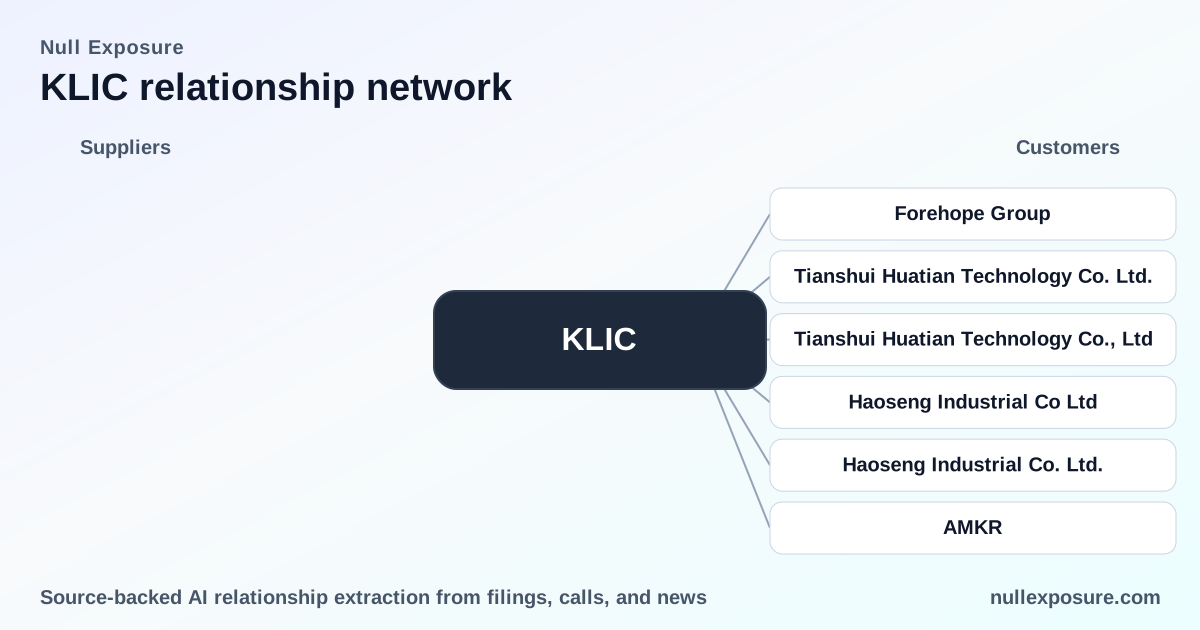
KLIC’s FY2025 Form 10‑K highlights a small group of large customers that together account for a majority of revenue and receivables. The following entries reproduce every named customer relationship in the results set and summarize what the filings and coverage state in plain English.
Tianshui Huatian Technology Co. Ltd. — accounts receivable concentration (10‑K)
KLIC disclosed that Tianshui Huatian represented 30.3% of accounts receivable as of October 4, 2025, up from 17.2% the prior year, signaling large outstanding balances tied to this customer. This detail comes from the company’s FY2025 Form 10‑K (filed October 4, 2025).
Forehope Group — material receivables and revenue relevance (10‑K)
Forehope Group is listed among customers with significant receivable concentrations (15.7% in the receivables table) and is treated as a material customer for receivable exposure in FY2025 disclosures. Investors should note this disclosure is drawn directly from KLIC’s FY2025 Form 10‑K (filed October 4, 2025).
Tianshui Huatian Technology Co., Ltd — revenue share (10‑K)
The FY2025 revenue table shows Tianshui Huatian accounted for 12.0% of net revenue for the fiscal year ended October 4, 2025, making it one of the largest single customers by revenue. This revenue share is reported in KLIC’s FY2025 Form 10‑K (filed October 4, 2025).
Haoseng Industrial Co Ltd — accounts receivable exposure (10‑K)
Haoseng Industrial is reported as representing 13.0% of accounts receivable as of October 4, 2025, placing it among the handful of counterparties that generate outsized balance-sheet exposure. This item is recorded in KLIC’s FY2025 Form 10‑K (filed October 4, 2025).
Haoseng Industrial Co. Ltd. — named customer concentration risk (10‑K)
The filing separately tags Haoseng Industrial as a named customer in the company’s customer concentration risk disclosures, reinforcing its status as a major counterparty in FY2025 narrative risk sections. This appears in the FY2025 Form 10‑K (filed October 4, 2025).
Amkor (AMKR) — market coverage pointing to incremental opportunity (news)
Market commentary has linked Amkor’s guidance and expansion plans—specifically investments in 2.5D packaging—to potential incremental orders for KLIC’s tooling and assembly equipment, suggesting a near-term revenue opportunity if those investments translate into equipment purchases. This analysis was published in a Finviz commentary on March 10, 2026.
What these relationships imply about KLIC’s operating model
KLIC’s customer disclosures and supporting commentary produce a consistent set of operating signals:
- High customer concentration and materiality. Sales to the top ten customers comprised 54.8% of net revenue in FY2025, so KLIC’s revenue performance depends heavily on a small number of large counterparties (FY2025 Form 10‑K).
- Large-enterprise counterparties. Trade receivables arise primarily from sales to a relatively small number of large manufacturers in a concentrated industry, consistent with capital equipment supply dynamics (FY2025 Form 10‑K).
- APAC revenue footprint with global service footprint. Approximately 90.5% of net revenue in FY2025 was shipped outside the U.S., primarily to the Asia/Pacific region, while sales and service resources are deployed globally across major semiconductor hubs (FY2025 Form 10‑K).
- Short-duration contracts and cancellable backlog. KLIC treats most contracts as having durations under one year and notes backlog consists principally of orders scheduled within the next 12 months that are subject to cancellation or deferral with limited penalties, which compresses visibility into medium-term demand (FY2025 Form 10‑K).
- Dual revenue model: hardware sales plus aftermarket services. The company functions both as a seller of capital equipment and as a service provider that sells consumables, maintenance and upgrades, positioning aftermarket revenue to smooth cycles inherent in capital equipment demand (FY2025 Form 10‑K).
- Portfolio rationalization underway. Management approved a strategic plan to wind down the Electronics Assembly (EA) equipment business, with wind‑down activities expected to be substantially complete by fiscal 2026; remaining obligations will be serviced through ongoing support (FY2025 Form 10‑K).
These characteristics create a business profile where top-line movement tracks large-customer CAPEX cycles and APAC capital allocation, while services provide defensive revenue.
Investment implications — risks and upside
- Concentration risk is primary. A single named customer (Tianshui Huatian) accounted for double-digit net revenue and more than 30% of receivables at a point in time, while the top ten customers represented over half of revenue — a structural risk for valuation and cash-flow stability (FY2025 Form 10‑K).
- Receivable clustering increases credit exposure. Material percentages of accounts receivable tied to a few counterparties create a balance-sheet vulnerability during semiconductor downcycles (FY2025 Form 10‑K).
- Geographic concentration amplifies cyclicality tied to APAC demand. With roughly 90% of revenue shipped outside the U.S., regional CAPEX trends in Asia drive KLIC’s near-term revenue trajectory (FY2025 Form 10‑K).
- Aftermarket services provide margin and durability. The APS segment historically shows lower volatility and is tied to unit consumption rather than capacity expansions, which supports margins during capex troughs (FY2025 Form 10‑K).
- Near-term upside from wafer-level and 2.5D packaging investments. Market commentary around AMKR’s 2.5D plans signals potential incremental equipment orders; conversion of such discussions into purchase orders would drive near-term revenue acceleration (Finviz, March 10, 2026).
Bottom line for investors and operators
Kulicke & Soffa is a capital-equipment supplier with a bifurcated revenue model: cyclical equipment sales concentrated among a handful of large APAC customers and steadier aftermarket services. That structure creates higher return potential in upcycles and meaningful downside in concentrated receivable scenarios. Investors should monitor customer-specific receivable trends (notably Tianshui Huatian and Haoseng), order cancellation exposure in backlog, and any conversion of industry-level packaging investments (e.g., Amkor’s 2.5D activity) into confirmed orders.
For a deeper comparator view and to track how these customer dynamics affect balance‑sheet risk across the tech equipment complex, visit https://nullexposure.com/.