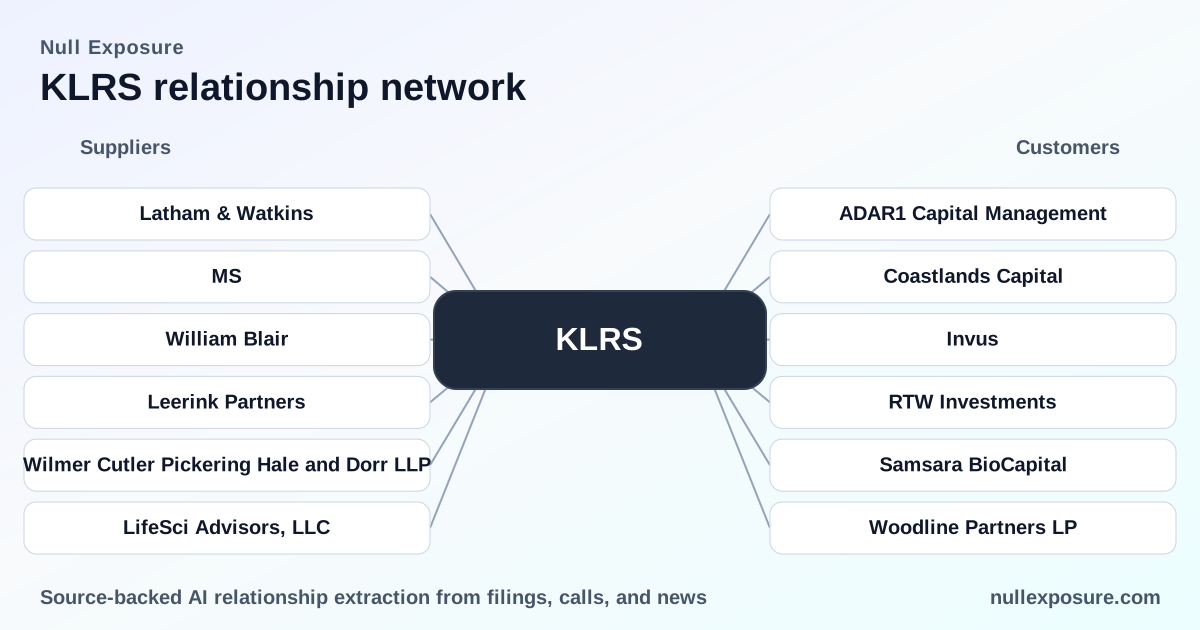
KLRS: Who’s financing Kalaris Therapeutics and what investors should infer
Kalaris Therapeutics is a clinical-stage ophthalmology company developing treatments for neovascular retinal diseases; it currently generates no product revenue and monetizes through clinical development, equity financing, and future licensing or commercialization events. The company’s near-term valuation and operating runway are driven by capital raises and institutional backers rather than product sales, so investor interest centers on the quality and depth of its financing partners as indicators of both credibility and capacity to fund trials. For a practical signal feed and relationship tracking on this issuer, visit https://nullexposure.com/.
Company snapshot — capital-driven, R&D-first
Kalaris is headquartered in Palo Alto and trades on NASDAQ under KLRS. Key balance-sheet and market signals: market capitalization roughly $127M, negative EBITDA and no reported revenue for the trailing twelve months, high institutional ownership (~78.6%), and modest insider holdings (~10.2%). The company is pre-revenue and development-stage, which makes external financing the primary mechanism for continuing operations and advancing clinical milestones.
The recent $50M private placement and the investor list
Kalaris announced an oversubscribed $50.0 million private placement in March 2026, and the participants tell a concise story about who is underwriting the clinical path forward. According to an Investing News report (March 10, 2026), the round included a mix of new and existing institutional investors. Each participating investor below is described with a short, plain-English takeaway.
ADAR1 Capital Management
ADAR1 Capital Management participated in the oversubscribed $50.0 million private placement that funded Kalaris’ near-term development plan, signaling institutional appetite for the company’s pipeline. (Investing News, March 2026.)
Coastlands Capital
Coastlands Capital joined the financing alongside other life-sciences-focused investors, providing additional institutional validation of Kalaris’ capital plan. (Investing News, March 2026.)
Invus
Invus committed capital to the private placement, underscoring participation from multi-strategy health-care investors in the company’s latest equity raise. (Investing News, March 2026.)
RTW Investments
RTW Investments was among the institutional participants in the $50.0 million transaction, aligning a long-biased life-sciences investor with Kalaris’ clinical trajectory. (Investing News, March 2026.)
Samsara BioCapital
Samsara BioCapital participated as part of the oversubscribed placement, reflecting interest from venture and life-science specialist investors in Kalaris’ retinal disease program. (Investing News, March 2026.)
Woodline Partners LP
Woodline Partners LP joined the round, contributing to the oversubscription and broad institutional investor base that funded the company’s near-term operations. (Investing News, March 2026.)
What the investor mix reveals about Kalaris’ operating model
- Contracting posture: Kalaris operates with a financing-first posture typical of clinical-stage biotechs — external equity issuances are the principal lever to fund R&D rather than operating cash flows. The March 2026 private placement is a clear example of that posture.
- Concentration and investor quality: Institutional ownership is high (approximately 78.6%), and the private-placement syndicate includes specialized biotech investors and multi-strategy funds. High institutional concentration both reduces retail-driven volatility and raises the bar for clinical deliverables.
- Criticality and runway: With no reported revenue and negative EBITDA, Kalaris is critically dependent on capital raises to sustain trials and operations; the $50M raise materially extends runway and de-risks near-term dilution events.
- Maturity and commercialization path: The firm remains in clinical development; commercialization is a multi-year outcome tied to trial readouts and potential partnerships or licensing. Value realization is milestone-dependent rather than revenue-driven today.
- Governance signal: Insider ownership of ~10% and a syndicate of reputable institutional backers provide governance depth that supports disciplined clinical and spend execution.
Investment implications — upside drivers and risk profile
Bold takeaways for allocators and operators:
- Upside is binary and milestone-driven. Positive clinical outcomes, successful partnering, or acquisition would rapidly re-rate equity given current lack of revenue and modest float.
- Downside is financing execution and trial risk. The company’s valuation and operational continuity depend on executing clinical programs and maintaining access to institutional capital.
- Institutional backing reduces information asymmetry. Participation by specialized life-sciences investors and established funds signals professional due diligence and lowers the probability of opportunistic financing at distressed terms in the immediate term.
- Liquidity and float constraints influence trade dynamics. With a relatively small shares float, directional moves will be amplified on news flow.
Key operational considerations for management and operators:
- Prioritize efficient capital deployment toward the highest-probability clinical readouts.
- Leverage institutional relationships from the March 2026 placement for potential strategic partnerships or structured financing that preserves upside for existing shareholders.
- Maintain transparent, milestone-linked investor communications to align expectations with the development timeline.
Final read for portfolio managers and industry analysts
Kalaris’ investor list from the March 2026 private placement is a practical signal: the company is funded for the near term and underwritten by institutional investors with life-sciences interest, which elevates confidence in the clinical pathway while leaving ultimate valuation contingent on trial outcomes. For allocators tracking sponsor networks and evolving investor exposures, these relationships are a positive structural signal of market support.
For a consolidated view of relationship maps and real-time signals on Kalaris and comparable issuers, visit https://nullexposure.com/.
Bottom line: KLRS is a capital-dependent clinical biotech whose recent oversubscribed financing brought credible institutional partners to the cap table — that reduces immediate financing risk but keeps the stock’s fate squarely tied to upcoming clinical milestones and partnership outcomes.