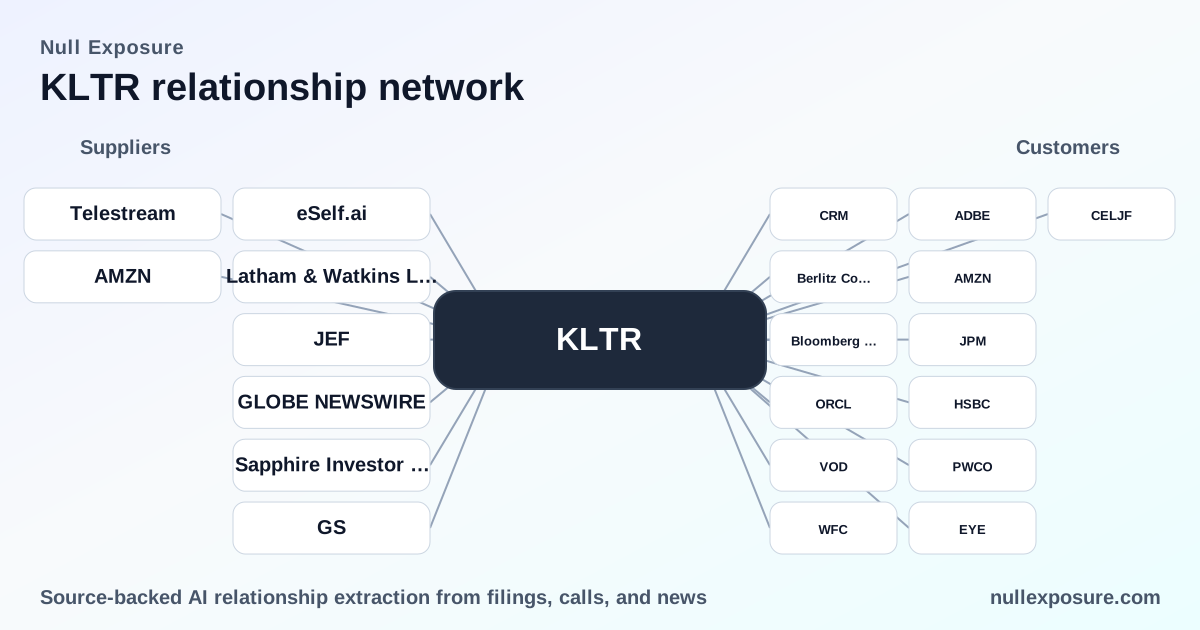
Kaltura (KLTR) customer map: enterprise-grade relationships that drive recurring revenue
Kaltura monetizes a cloud-native Video Experience Cloud through a mix of SaaS subscriptions, platform usage licenses, professional services, and segment-specific usage billing (notably telecom per‑subscriber billing). The business sells primarily into large and very large enterprises and institutions, with contracts ranging from short (12–24 months) to multi‑year (2–5 years) terms; this mix produces predictable recurring revenue while leaving exposure to a handful of material customers. For investors evaluating customer risk and go‑to‑market effectiveness, the roster of marquee clients—spanning tech, finance, media, telco and pharma—supports the company’s enterprise positioning but also concentrates commercial exposure in a limited number of large buyers. Learn more about how this intelligence is assembled at https://nullexposure.com/.
Big names, strategic pattern: what the customer list tells you
Kaltura’s public mentions and filings show a clear go‑to‑market pattern: enterprise and strategic accounts, cross‑industry coverage, and a significant telecom/operator footprint that drives usage‑based revenue. The company emphasizes integrated solutions for video portals, virtual events, learning and TV streaming—products sold via a mix of subscription, licensing, and professional services. This is a business that scales by landing large logos and expanding seat/platform usage within them.
- Concentration signal: Vodafone accounted for ~10.7% of revenue in FY2024, making the relationship a material commercial dependency (Kaltura 10‑K, FY2024).
- Contracting posture: Kaltura uses multi‑year and annual contracts alongside usage billing for telco offerings, giving revenue visibility but exposing the company to renewal cycles from large customers.
- Geography and scale: Revenue is global (roughly half Americas, ~38% EMEA, ~9% APAC in 2024), and Kaltura serves a mix of very large enterprises and mid‑market customers.
If you want the raw relationship roll‑up for diligence, Kaltura’s public PRs and its 2024 10‑K supply a consistent list of enterprise references; see the detailed relationship list below. For a deeper platform view, visit https://nullexposure.com/.
Operating constraints and business model characteristics
Kaltura’s disclosures articulate operating constraints that shape risk/return:
- Contracts range from short (12–24 months) to multi‑year (2–5 years) arrangements; telecom customers often generate usage‑based revenue recognized per end subscriber. This mix yields predictable recurring revenue with episodic usage variability tied to telco customers.
- The company defines enterprise customers as those generating meaningful ARR (> $60k) and focuses its GTM on direct sales for large accounts and inside sales/channel for smaller buyers—sales effort and account management intensity are concentrated on large clients.
- Customers are global and diversified across sectors, but materiality remains because a small number of large accounts supply a disproportionate share of subscription revenue.
- Kaltura acts both as service provider (professional services, integrations) and as a software supplier (SaaS/license), increasing cross‑sell opportunities but also forcing delivery resources for implementations.
Detailed customer relationships (public mentions and filings)
Below are the distinct customers cited across Kaltura press releases, news coverage and its FY2024 10‑K; each entry includes a concise plain‑English summary and the public source.
- Adobe — Adobe is described as a long‑time Kaltura customer that uses the platform for internal events, all‑hands and “Inside Adobe TV,” underlining Kaltura’s value inside large digital content organizations. Source: GlobeNewswire and Markets/BusinessInsider press coverage (April–May 2026).
- Amazon / AWS — Kaltura publicly lists Amazon/AWS among its large clients, positioning the platform for major cloud and enterprise use cases. Source: Calcalistech coverage and GlobeNewswire (March & April 2026).
- AstraZeneca — Named among industry leaders using the combined Kaltura/PathFactory offerings for content intelligence and video marketing efforts. Source: GlobeNewswire press release (April 17, 2026).
- Bank of America — Cited as a customer leveraging Kaltura’s video and event solutions for content activation in enterprise marketing and internal communications. Source: GlobeNewswire and SahmCapital news pieces (April 2026).
- Berlitz Corp. — Listed in regional reporting as a referenced customer among enterprise and media clients, reflecting Kaltura’s breadth across corporate training and events. Source: Calcalistech reporting (March 2026).
- Bloomberg L.P. — Appears in reporting as a named customer, illustrating Kaltura’s penetration into media/financial information companies. Source: Calcalistech (March 2026).
- Cisco / Cisco Webex — Cisco Webex is the subject of a customer case study showing how it rebuilt its martech stack around unified content and engagement data with Kaltura; Cisco/Cisco Webex are cited repeatedly. Source: GlobeNewswire Forrester B2B Summit release (April 24, 2026).
- Cornerstone OnDemand — Kaltura joined Cornerstone’s partner program to deliver integrated AI‑powered video learning experiences, signaling a channel/technology partnership in corporate learning. Source: GlobeNewswire partnership announcement (March 23, 2026).
- EY — Listed among consulting firms that use Kaltura for corporate video portals, demonstrating adoption across professional services. Source: Calcalistech (March 2026).
- HSBC — Named as a bank customer where Kaltura manages video portals for major banks. Source: Calcalistech (March 2026).
- IBM — Cited as a customer benefiting from Kaltura’s content intelligence and video/event capabilities. Source: GlobeNewswire and Markets/BusinessInsider (April–May 2026).
- JP Morgan / JPM — Kaltura manages video portals for major banks, including JP Morgan, showing penetration into global financial institutions. Source: Calcalistech (March 2026).
- LG — Listed among industry leaders supported by the combined entity for video, event and conversational marketing, indicating enterprise electronics and consumer brands as customers. Source: GlobeNewswire press release and related coverage (April–May 2026).
- Oracle — Appears in multiple reports as a customer and as a named enterprise reference for video portals and internal communications. Source: Calcalistech (March 2026).
- Palo Alto Networks — Included among industry leaders using Kaltura for content intelligence and marketing activation. Source: GlobeNewswire and Markets/BusinessInsider (April–May 2026).
- PwC — Listed alongside EY as a consulting firm customer for video portal services, reinforcing usage among professional services firms. Source: Calcalistech (March 2026).
- Salesforce — Named repeatedly as a major customer and a marquee logo acquired, supporting both internal and external video use cases. Source: GlobeNewswire, Investing.com and Markets/BusinessInsider (April–May 2026).
- Vanguard — Listed among institutional clients supported by Kaltura’s offerings for content and engagement. Source: Investing.com and GlobeNewswire press mentions (May 2026).
- Vodafone — A material customer: Vodafone accounted for approximately 10.7% of Kaltura revenue in FY2024, reflecting a concentrated telco/operator contract that materially impacts results. Source: Kaltura 2024 10‑K (filed for FY2024).
- Wells Fargo — Named in reporting as a banking customer using Kaltura’s video portals. Source: Calcalistech (March 2026).
- Wells / Bank list crossover — Multiple banking names (Bank of America, Wells Fargo, JP Morgan, HSBC) indicate financial services is a vertical focus for Kaltura. Source: Calcalistech and GlobeNewswire (March–April 2026).
- Bloomberg / media cluster — Bloomberg L.P. and other media references show traction in media customers for portal and distribution use cases. Source: Calcalistech (March 2026).
- Cellcom / CELJF — Cited as a telecom operator customer representative of Kaltura’s profitable but lower‑growth telecom access management business unit that generates about a quarter of revenue historically. Source: Calcalistech analysis (March 2026).
- Cornerstone / Learning partners — Cornerstone partnership shows strategic alignment for AI‑infused video learning inside enterprise LMS ecosystems. Source: GlobeNewswire (March 2026).
- Additional symbol‑only entries (ORCL, AMZN, VOD, CSCO, PANW, NVDA, CRM, WFC, BAC, AZN, CSOD, CELJF, EYE, etc.) — These are the same corporate clients referenced under ticker or symbol variations across press pieces and filings; they reinforce the presence of large enterprise customers across sectors. Source: various press releases and coverage (March–May 2026).
Investment takeaways
- Strength: Kaltura sells into global, very large enterprise logos that validate product‑market fit across internal comms, marketing, learning and telco streaming—supporting durable recurring revenue streams.
- Risk: Revenue concentration (notably Vodafone at ~10.7% in FY2024) and contract renewal cycles with large customers create outsized sensitivity to a handful of accounts.
- Operational: The mixed contract types (multi‑year subscriptions, annual contracts, and usage‑based telco billing) deliver both predictability and episodic variability; investors should watch renewal cadence and telco usage trends.
For a structured view of these relationships and to track changes over time, visit https://nullexposure.com/.
In sum, Kaltura’s customer footprint is an investor‑grade mix of marquee logos and vertical depth, balanced by classic concentration and contract renewal risks that should be explicitly modeled in any valuation or operational diligence.