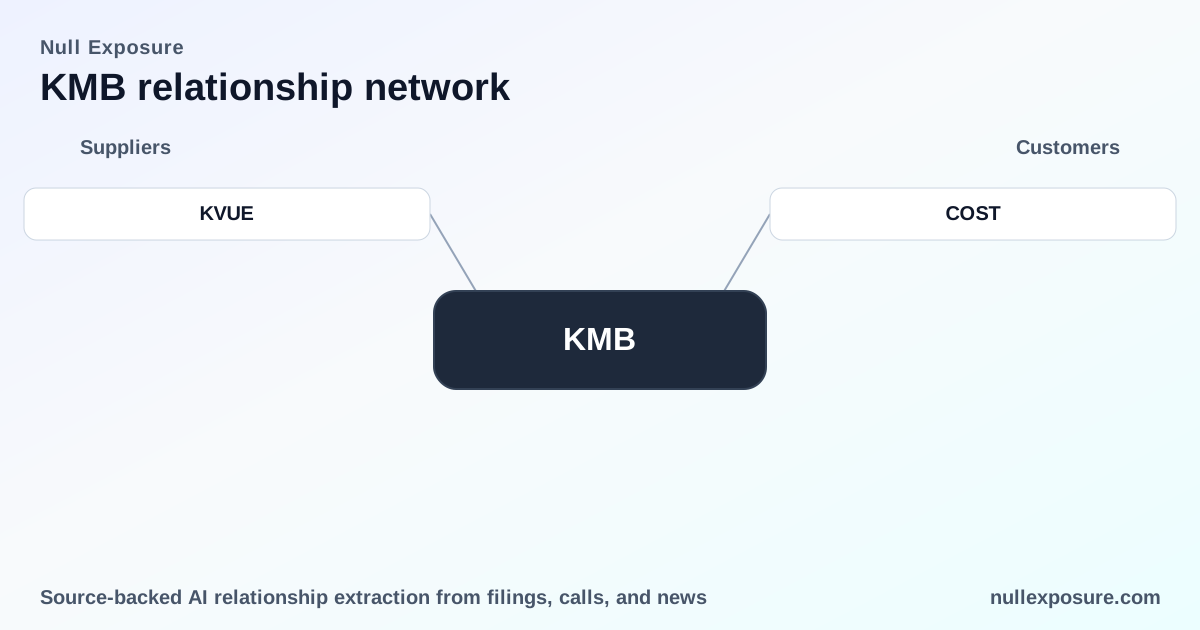
Kimberly‑Clark (KMB): Customer relationships that move margins and strategy
Kimberly‑Clark manufactures and sells branded and private‑label personal‑care and tissue products to retailers, distributors and institutional buyers, monetizing through consumer goods volume, branded premium pricing and ongoing supply contracts with large retail partners. Revenue is driven by global scale in household essentials, stable pricing power, and recurring purchase patterns that support a high dividend and predictable cash generation. Learn more about how we map these counterparty relationships at https://nullexposure.com/.
What investors need to know up front
Kimberly‑Clark is a mature consumer staples company with a large, global retail footprint and concentrated exposure to major distributors and warehouse clubs. The business model is operationally simple but contractually complex: manufacturing scale and brand equity generate stable margins, while dependence on major retail partners and portfolio divestitures affect near‑term revenue composition and execution risk. Kimberly‑Clark’s FY‑TTM metrics show ~$16.6bn revenue and an EBITDA of $3.35bn, a dividend yield above 5% and a low beta (0.31), underscoring defensive cash flow characteristics.
Operating model signals and business constraints
Kimberly‑Clark’s public disclosures and press references surface several company‑level constraints that shape commercial dynamics:
- Counterparty posture — large enterprise counterparties: Kimberly‑Clark sells directly to supermarkets, mass merchandisers, drugstores, warehouse clubs and e‑commerce platforms, signaling negotiated, high‑volume relationships rather than transactional retail outlets. This is a company‑level signal drawn from corporate selling channels.
- Global reach and distribution: The company states its brands operate in more than 175 countries and territories, which implies global supply chains, regulatory complexity, and currency exposure that influence contract terms and margin management.
- Distributor and professional channels: Professional products are sold through distributors and directly to institutional buyers, meaning Kimberly‑Clark operates both business‑to‑retailer and business‑to‑institution models with differing margin profiles and contractual terms.
These signals translate into actionable operating characteristics: contract terms are typically long enough to secure scale economics but subject to renegotiation with large buyers; revenue concentration to a few major retail partners increases commercial leverage; product criticality for consumers makes relationships strategically important even where private‑label competition exists; and legacy product lines deliver cash flow stability but limit rapid margin expansion.
KMB’s notable customer relationships (what the market is citing)
Below I cover every customer relationship referenced in the recent results set and summarize the commercial facts investors need to price into KMB.
Costco / COST — advertising collaboration and manufacturing change
Costco referenced a marketing collaboration with Kimberly‑Clark in its Q4 2025 earnings call, noting targeted MVM amplification campaigns run with Kimberly‑Clark on third‑party websites to drive member value and supplier ROI, indicating a promotional partnership beyond pure product supply (Costco earnings call, Q4 2025; reported March 7, 2026).
Separately, multiple March 10, 2026 news reports noted that Kimberly‑Clark has stopped manufacturing Costco’s private‑label diapers, which signals a shift in a manufacturing/supply relationship that could affect volume flows and margin mix for KMB in private‑label channels (Bitget and Finviz, March 10, 2026).
Source context: Costco Q4 2025 earnings call (reported March 7, 2026); news coverage reporting supply cessation (Bitget and Finviz, March 10, 2026).
Suzano S.A. / SUZ — major asset sale counterparty in motion
Numerous press reports in early May 2026 indicate Kimberly‑Clark is nearing a $3.5 billion sale of its global tissue business to Suzano, a transaction that would materially reconfigure KMB’s exposure to the low‑margin tissue segment and concentrate future revenue around personal care and higher‑margin categories (Simply Wall St, May 3–4, 2026).
Source context: Simply Wall St reporting on the potential sale (May 3–4, 2026).
Strategic implications for investors
- Revenue and margin composition: The reported Suzano transaction would remove a low‑margin, capital‑intensive business unit and free cash for share repurchases, M&A (such as Kenvue pursuits), or higher‑return brand investment; investors should revalue KMB’s pro forma margins and capital allocation after a tissue divestiture.
- Retail partner concentration risk: The reported cessation of manufacturing for Costco private‑label diapers and ongoing promotional ties with Costco highlight the dual nature of large retail relationships — they offer distribution scale but also give buyers negotiating leverage on manufacturing and pricing.
- Commercial sophistication: Advertising collaborations with Costco indicate Kimberly‑Clark leverages marketing and data partnerships with anchor retailers to defend branded share, a positive for maintaining pricing power against private labels.
Risks and catalysts to watch
- Execution of the Suzano sale and the precise divestiture terms (timing, retained IP, transitional service agreements).
- Volume migration and margin impact from the Costco manufacturing change and whether private‑label production shifts to other suppliers or to Costco’s internal capacities.
- Any renegotiation of promotional or co‑marketing arrangements with large retailers that could increase trade spend.
Quick takeaways for portfolio positioning
- Defensive cash flow with headline risk from strategic portfolio moves: Kimberly‑Clark’s dividend and stable EBITDA support income strategies, while asset sales and retailer dynamics drive event‑driven volatility.
- Concentration matters: Large enterprise retail partners provide scale but compress contractual flexibility and create potential single‑counterparty shocks.
- Repositioning opportunity: A successful tissue sale to Suzano would sharpen Kimberly‑Clark’s focus on higher‑margin categories and improve capital deployment optionality.
For a deeper counterparty map and ongoing alerts about these relationships visit https://nullexposure.com/ — our platform tracks the signals that matter to investors evaluating KMB’s commercial and strategic exposures.
Bold takeaway: Kimberly‑Clark’s core strength is predictable, defensive cash generation; its near‑term valuation and operational trajectory will be driven by the outcome of the Suzano transaction and evolving terms with large retail partners such as Costco.