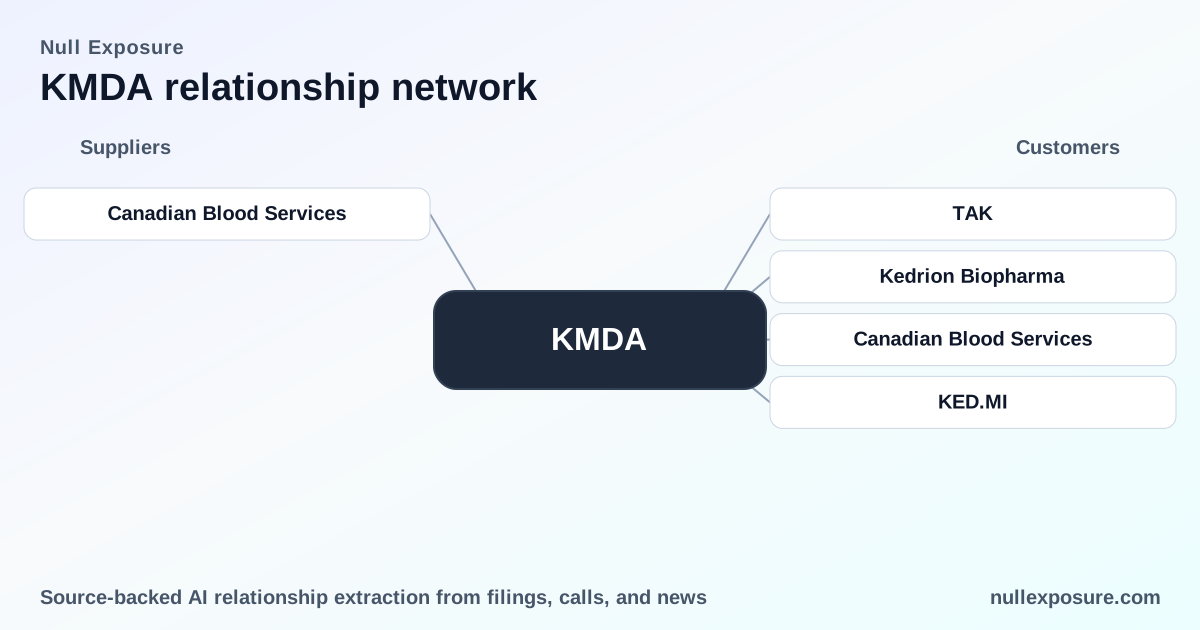
Kamada (KMDA): Customer map and commercial durability
Kamada monetizes by developing and manufacturing plasma‑derived specialty therapies and selling them through a mix of direct tenders, distribution partners and royalty arrangements. Revenue today is driven by a small number of high-value commercial relationships — long‑dated supply agreements, contract minimums and royalty streams — that convert Kamada’s manufacturing capacity into predictable cash flow. For investors, the question is whether those contracts provide sustainable top‑line growth while limiting concentration and royalty exposure. Learn more at https://nullexposure.com/.
How to read Kamada’s customer picture
Kamada is a supplier‑centric commercial model: it manufactures plasma proteins and licenses distribution or receives royalties where large pharma or national buyers handle commercialization. That posture creates several structural characteristics you should treat as company‑level signals rather than partner‑specific facts: multi‑year contracts with minimum commitments, material customer concentration, a mix of direct tender revenue and royalties, and moderate contract maturity. These characteristics explain why Kamada reports steady margins and relatively stable guidance despite fluctuations in individual product royalties.
Counterparty map — what every listed relationship contributes
Kedrion Biopharma (also referenced as Kedrion / KED.MI)
Kedrion is Kamada’s U.S. commercialization partner for KEDRAB (anti‑rabies immunoglobulin); sales to Kedrion totaled approximately $54 million in 2025, well above contract minimums, and Kedrion has committed to $90 million of minimum orders for 2026–2027 under a supply agreement that extends through 2031. Source: Kamada earnings call, Investing.com transcript (May 3, 2026) and related company disclosures.
Takeda Pharmaceutical Company (TAK)
Takeda is the licensee and commercial partner for GLASSIA (alpha‑1 antitrypsin), generating both ex‑US product sales and U.S./Canada royalty income for Kamada; GLASSIA contributed about $35 million in total revenue, and a reduced royalty rate effective August 2025 will have its first full‑year impact in 2026. Source: Kamada earnings commentary on Investing.com (May 3, 2026) and Globenewswire guidance release (Jan 7, 2026).
Canadian Blood Services
Canadian Blood Services awarded Kamada a two‑year extension for the supply of four specialty plasma‑derived products (WINRHO, HEPAGAM, CYTOGAM, VARIZIG) valued at approximately $10–$14 million. This tender extension reinforces Kamada’s established position in the Canadian specialty plasma market. Source: Globenewswire press release (Dec 18, 2025) and Globe and Mail summary (May 2026).
Baxter International (BAX)
Kamada has a distribution agreement with Baxter for GLASSIA, and public reporting indicates the arrangement can be expanded to include an AAT protein developed for diabetes indications, reflecting optionality within existing distribution channels. Source: Globes (Israel) coverage (May 2026).
Chiesi Pharmaceuticals SpA
Chiesi is cited as a European distributor for certain Kamada products, representing international channel reach that supports incremental launches and geographic diversification. Source: Globes (Israel) reporting (May 2026).
Historical/contractual notes (Kedrion Biopharma / Takeda references in earlier filings)
Kamada’s historical press materials and PR filings document that Kamada held manufacturing and licensing arrangements dating back several years — for example, a prior agreement with Takeda where Kamada produced GLASSIA until Takeda initiated its own production and began paying royalties. These legacy contractual terms create a long royalty runway (through many past agreements) that still influences revenue mix today. Source: PR Newswire (press release describing prior Takeda arrangement) and company filings (FY2021 disclosures).
Commercial profile and operating constraints (company‑level signals)
- Contracting posture: Kamada operates with multi‑year supply agreements and minimum order commitments that convert manufacturing capacity into committed revenue streams and reduce short‑term volatility in demand.
- Concentration: A handful of partners account for a meaningful share of revenue; this structure improves predictability but increases counterparty concentration risk at the company level.
- Revenue mix and criticality: The business mixes direct tender payments, multinational distribution deals and royalty income; royalties (notably from GLASSIA) are material but subject to scheduled rate changes, creating predictable but steppable income.
- Maturity and optionality: Contracts extend into the late 2020s and early 2030s, giving Kamada a mid‑term visibility window while also leaving runway for distribution expansions (for example, potential product additions via Baxter or Chiesi) that can uplift growth.
Investment implications: growth drivers and risk checklist
Kamada’s commercial model delivers a blend of defensive cash flow and selective growth optionality:
- Growth drivers: Large, committed orders from distributors and national tenders; expanding distribution agreements offer upside if Kamada and partners extend scope to adjacent proteins or geographies.
- Key risks: Customer concentration, downward movement in royalty rates (already in effect for GLASSIA from Aug 2025), and tender renewals that can compress pricing or shift volumes. Investors should track minimum‑order compliance, the timing of royalty rate changes, and competitive dynamics around national tenders.
What to watch next (operational milestones)
- Confirmation of Kedrion minimum order fulfillment and whether Kedrion exercises the full committed volumes for 2026–2027.
- Quarterly disclosure of GLASSIA royalty receipts to quantify the full‑year impact of the reduced rate that began in August 2025.
- Any public expansion of Baxter or Chiesi distribution scopes into new indications or geographies that would materially increase recurring sales.
Bottom line
Kamada’s commercial strength is grounded in long‑dated supply commitments and a compact set of high‑value relationships that generate predictable revenue today while leaving room for distribution‑led growth. The balance of committed manufacturing revenue against concentration and royalty sensitivity is the core tradeoff for investors assessing KMDA’s risk/reward profile. For a deeper counterparty intelligence view and ongoing coverage, visit https://nullexposure.com/.