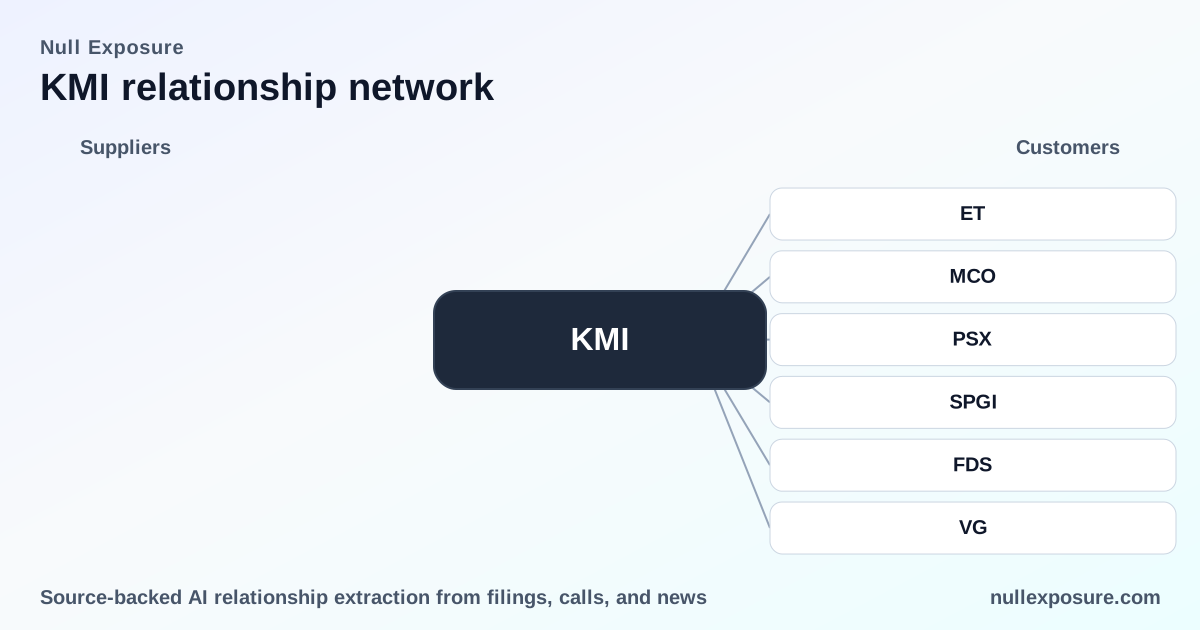
Kinder Morgan (KMI): Customer Relationships and Strategic Counterparties
Kinder Morgan builds, owns and operates North American energy infrastructure—pipelines, terminals, storage and related midstream services—and monetizes those assets through a mix of long‑term fixed reservation contracts, fee‑based transportation and terminaling services, and commodity sales tied to spot volumes. This business model produces high cash flow visibility from take‑or‑pay style agreements while retaining exposure to throughput and commodity cycles where spot contracts are used.
For an at‑a‑glance tracking tool and deeper counterparty intelligence, see https://nullexposure.com/.
How KMI’s commercial model shapes customer risk and revenue visibility
Kinder Morgan’s commercial framework is contract‑driven and service‑oriented. Company filings and disclosures indicate a clear operating posture:
- Long‑term contracts dominate revenue recognition, providing predictable reservation and service fees that support stable distributable cash flow. Company disclosures discuss fixed reservation charges and long‑term transportation and terminaling contracts as primary revenue drivers.
- Spot and commodity sales are a secondary but meaningful component, recognized at the point of delivery for commodity volumes and introducing variable monthly revenue.
- North America is the primary geography, concentrating counterparty and regulatory risk across U.S. and, to a much smaller degree, Mexico operations.
- KMI functions simultaneously as seller, service provider and occasional buyer of commodity, depending on the business line—gathering, processing, transportation, storage and LNG services.
- Customer relationships are active and operationally critical; several recent announcements involve pipeline tie‑ins, open seasons and fuel‑supply agreements that affect throughput and utilization.
These characteristics result in high revenue certainty from contracted services paired with throughput sensitivity from spot exposure—an attractive risk profile for income‑oriented investors when paired with conservative balance‑sheet management.
Counterparty and partner roundup: what to watch
Below are the counterparties and partners referenced in public disclosures and reporting. Each entry is summarized in plain English and linked to the underlying public mention.
-
Phillips 66 (PSX) — KMI and Phillips 66 launched a second open season for the proposed Western Gateway Pipeline system, extending the window for prospective shippers to evaluate and secure capacity. According to KMI’s 2025 Q4 earnings call and subsequent press reports, the open season was active in early 2026 and later extended to April 15, 2026 (earnings call, March 2026; investing.com, May 2026).
-
S&P Global (SPGI) — S&P upgraded Kinder Morgan to BBB+, a recognition noted on KMI’s 2025 Q4 earnings call as evidence of an improved balance sheet and credit profile (KMI 2025 Q4 earnings call, March 2026).
-
Fitch (FDS) — Fitch upgraded Kinder Morgan to BBB+ during the summer of 2025, an upgrade KMI highlighted alongside other rating agency actions as supportive of financing flexibility (KMI 2025 Q4 earnings call, March 2026).
-
Moody’s (MCO) — Moody’s placed Kinder Morgan on a positive outlook, which KMI referenced during its 2025 Q4 earnings call when discussing credit trends and funding options (KMI 2025 Q4 earnings call, March 2026).
-
Energy Transfer (ET) — Energy Transfer is referenced as the operator in a project context noted on KMI’s earnings call; the remark clarifies operator roles in joint infrastructure efforts (KMI 2025 Q4 earnings call, March 2026).
-
Western Midstream Partners (WES) — Western Midstream reported increased natural gas throughput tied to the tie‑in of Kinder Morgan’s Altamont pipeline into Western’s Chipeta processing plant, a completed operational tie‑in that drove incremental volumes in late 2025 (WES Q3/Q4 2025 earnings commentary, March 2026).
-
TVA / Tennessee Gas Pipeline (TVE) — Reporting on the Tennessee Valley Authority’s fuel plans described a new 32‑mile gas pipeline built by Tennessee Gas Pipeline (part of Kinder Morgan) to supply the Cumberland replacement plant, underlining KMI’s role as a project developer for utility fuel supply (Knox News, December 2022; referenced in KMI customer coverage).
-
Targa Resources (TRGP) — Targa joined DCP Midstream and Kinder Morgan in developing a Gulf Coast Express‑style project and was announced as a major customer on the proposed system, signaling anchor shipper commitments for a Gulf Coast midstream expansion (Daily Energy Insider, May 2026).
-
Pioneer Natural Resources (PXD) — Pioneer was named alongside Targa as a major customer on the same proposed system, indicating material shipper interest from large E&P counterparts (Daily Energy Insider, May 2026).
-
Entergy Texas (ETI‑P) — Entergy Texas entered a fuel supply agreement with Kinder Morgan and Golden Pass LNG tied to the Trident Intrastate Pipeline project, designed to secure natural gas supply, lower costs, and improve reliability for Southeast Texas power customers (Offshore‑Energy.biz and Entergy press release, 2025–2026).
-
Venture Global (VG) — KMI’s 2025 Form 10‑K references TGP and Evangeline Pass projects serving Venture Global’s Plaquemines LNG facility, demonstrating KMI’s role as a midstream transporter for export‑scale LNG customers (KMI 2025 10‑K, December 31, 2025).
What this network means for investors
- Revenue stability is high because a material portion of KMI’s cash flows come from long‑term, fixed reservation-style contracts; long‑term contracts reduce volume volatility risk for base cash flows.
- Throughput upside is real where pipeline tie‑ins and open seasons (Phillips 66, Pioneer, Targa, Western Midstream) convert into incremental fee revenue and utilization gains.
- Counterparty quality and anchor shippers matter; relationships with blue‑chip refiners, majors and large utilities improve contract enforceability and bankability of projects.
- Regulatory and tariff disputes remain a vector of operational risk, as noted in company disclosures about shipper complaints and rate protests—these are company‑level dynamics, not specific to a single counterparty.
- Credit momentum supports growth optionality: upgrades from rating agencies (S&P, Fitch, positive outlook from Moody’s) lower funding costs and increase optionality for capital projects and M&A.
Key takeaway: Kinder Morgan’s customer map combines contractual visibility with selective growth optionality from new pipeline open seasons and tie‑ins—this is a cash‑flow‑centric model enhanced by high‑quality counterparties and improving credit metrics.
How to monitor developments going forward
- Track open seasons and shipper commitments (Phillips 66 Western Gateway, Gulf Coast projects) and pipeline interconnect completions (Altamont/Chipeta).
- Watch earnings‑call citations and 10‑K/10‑Q disclosures for shifts between long‑term reservation revenue and spot volumes.
- Observe rating agency commentary (S&P, Fitch, Moody’s) for changes to funding cost assumptions that affect project economics.
For a practical feed of these relationship signals and to set alerts on developments like open seasons, rating actions and contract tie‑ins, visit https://nullexposure.com/.
Bold thesis recap: Kinder Morgan delivers durable, fee‑based cash flow from long‑term contracts while selectively growing throughput via open seasons and strategic tie‑ins with high‑quality shippers—credit upgrades accentuate the company’s capital flexibility.