CarMax (KMX): customer relationships that shape retail reach and distribution
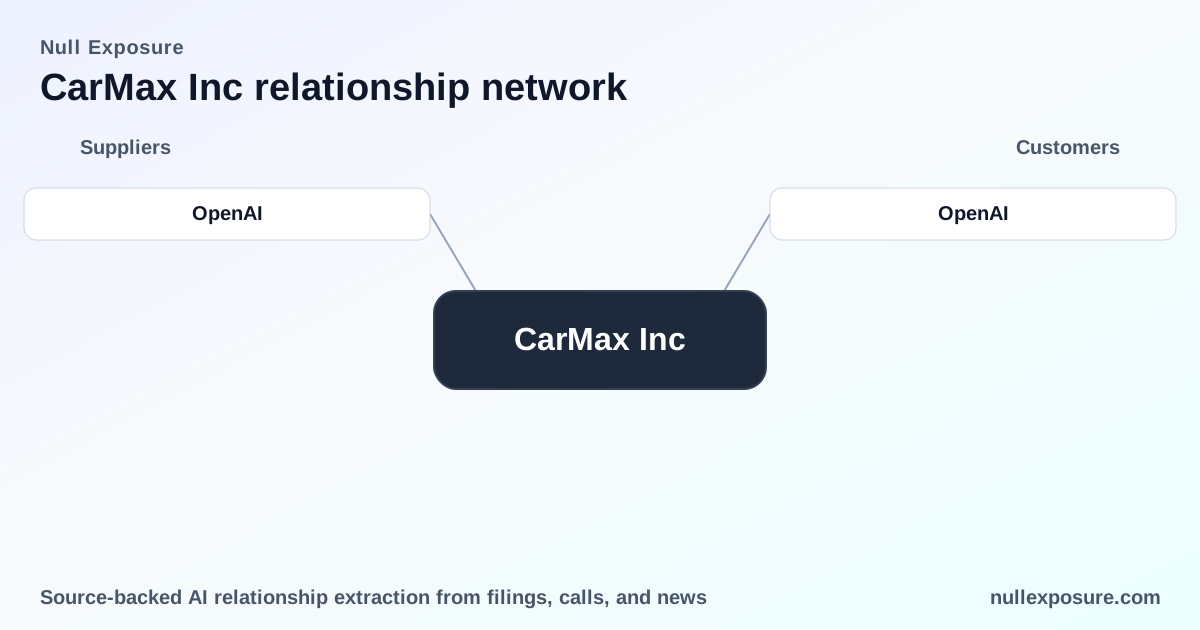
CarMax operates the largest used-vehicle retail platform in the U.S., monetizing through vehicle sales and a captive finance arm (CarMax Auto Finance) while layering recurring revenue from extended protection plans, service, and advertising. The business is both a retailer and a lender: sales margins drive scale and the finance segment captures interest and fee income on retail sales. For investors evaluating counterparty exposure and channel dynamics, recent third‑party integrations with OPENLANE and OpenAI illustrate two distinct distribution and technology partnerships that extend CarMax’s inventory reach and retail convenience. Learn more at https://nullexposure.com/.
How CarMax makes money and why customer relationships matter
CarMax’s operating model is a hybrid retail-finance enterprise. The Sales Operations segment sources, reconditions, and retails used vehicles through a national footprint (250 stores across 109 U.S. markets as of FY2025), while the CarMax Auto Finance (CAF) segment underwrites and services retail loans sourced from those sales. Revenue flows from transaction margins on vehicle sales, plus interest and ancillary product sales (ESPs, GAP, service). The CAF function creates tighter customer economics and raises customer lifetime value, but it also concentrates credit exposure on long-term installment contracts.
This commercial posture—high physical retail concentration, captive financing, and platform exposure to third-party distribution channels—defines the company’s counterparty risk profile and the strategic value of the relationships described below.
Third-party relationships in focus
The public signals in our coverage list two recent partnerships or integrations that expand CarMax’s distribution and consumer engagement channels. Each is summarized below with source context.
OPENLANE / AUTONIQ: wholesale channel integration (May 3, 2026)
CarMax has integrated its auction inventory with AUTONIQ, the marketplace platform operated by OPENLANE, enabling wholesale buyers on AUTONIQ to access CarMax Auction inventory nationwide. According to a corporate press release from OPENLANE dated May 3, 2026, the integration brings CarMax inventory feeds to AUTONIQ’s platform, broadening wholesale liquidity and secondary-market reach.
Source: OPENLANE corporate release (May 3, 2026).
OpenAI (ChatGPT): retail convenience through conversational commerce (March 10, 2026)
CarMax launched a CarMax App in ChatGPT that surfaces nationwide inventory and online offer capabilities directly within OpenAI’s ChatGPT interface, effectively creating a conversational retail touchpoint for vehicle shopping and offers. A Yahoo Finance report (March 10, 2026) covered the launch, noting that the integration lets consumers access inventory and receive online offers through ChatGPT.
Source: Yahoo Finance (March 10, 2026).
Constraints and what they reveal about CarMax’s operating profile
The textual constraints we extracted from CarMax public filings and disclosures provide company-level signals about contract structure, customer type, geography, and segment roles. Translate these into investor-relevant operating characteristics:
- Contracting posture — long-term installment contracts. CarMax’s managed receivables are composed of fixed-rate installment loans, indicating durable credit relationships and predictable interest revenue over the life of loans (company filings as of Feb 28, 2025). This supports earnings visibility from CAF but concentrates duration and credit risk on long-lived paper.
- Counterparty type — retail individuals dominate. CarMax’s business is primarily retail: the company sold 789,050 used vehicles at retail in FY2025, which underlines a high-volume, low-ticket counterpart base dominated by individual consumers rather than large corporate buyers.
- Geographic footprint — national US exposure. Operating 250 stores across 109 U.S. TV markets establishes national scale but also ties the revenue and credit performance to U.S. macro and regional demand cycles.
- Relationship roles — both buyer and seller behavior embedded. CarMax functions as a seller of vehicles and related services while its finance arm acts as a buyer of credit exposure (i.e., originating loans). This vertical integration increases cross-segment dependency but also creates internal capture of margin.
- Relationship stage — active portfolio with measurable receivables. Public figures for managed receivables and past-due balances indicate an active lending portfolio that is central to the company’s economics.
- Business segments — core retail product and services. The firm’s core product is vehicle retailing; services (financing, ESPs, GAP, repair) are complementary and important for non-vehicle margin expansion.
Collectively these constraints point to a mature, merchant-lender model: high physical and credit scale, recurring finance cash flows, and exposure to retail demand cycles. The model is capital‑intensive and operationally complex, with critical dependencies on inventory sourcing, reconditioning throughput, consumer credit performance, and distribution channels (including the two third‑party integrations above).
What the relationships mean for risk and opportunity
- OPENLANE/AUTONIQ integration increases wholesale liquidity and remarketing efficiency. For investors, the OPENLANE integration reduces inventory holding risk by broadening access to wholesale buyers, improving turn rates and potential realized yields on auctioned units. Source: OPENLANE corporate release (May 3, 2026).
- OpenAI ChatGPT app extends consumer touchpoints and reduces friction. The ChatGPT app creates a low-friction conduit for inventory discovery and lead generation, which can improve conversion rates and online offer penetration. This speaks to digital distribution complementing physical stores. Source: Yahoo Finance (March 10, 2026).
Strategic implications for valuation and operations
- Revenue mix stability versus credit sensitivity. The sales segment provides volume and gross profit; CAF supplies interest income but introduces credit cycle sensitivity. Investors should price CarMax as a hybrid retailer with leveraged credit exposure.
- Distribution diversification is value-accretive. Partnerships like OPENLANE and OpenAI reduce single-channel dependence: wholesale integrations improve secondary-market economics, while conversational retail expands front-end acquisition efficiency.
- Operational execution remains critical. Margin realization depends on inventory sourcing, reconditioning costs, online-offline conversion, and credit loss management. Given the national footprint and fixed-rate loan book, CarMax is exposed to both used-vehicle market swings and interest-rate/credit cycles.
Bottom line and recommended next steps
CarMax combines broad retail scale and captive finance to capture both transaction and interest income. The OPENLANE and OpenAI relationships represent complementary moves to optimize remarketing and expand retail distribution, respectively, and are consistent with a strategy to reduce inventory friction while enhancing consumer access. Investors should monitor wholesale turn rates, CAF delinquencies, and the adoption metrics for new digital touchpoints to assess how these partnerships translate into margin improvement.
For a deeper read on customer relationships and channel risk across retail platforms, visit https://nullexposure.com/.
If you are modeling CarMax, prioritize scenario analysis around used-vehicle gross margins, managed receivable performance, and traffic/conversion uplift from digital integrations. For bespoke briefings and concentrated relationship analytics, see https://nullexposure.com/.