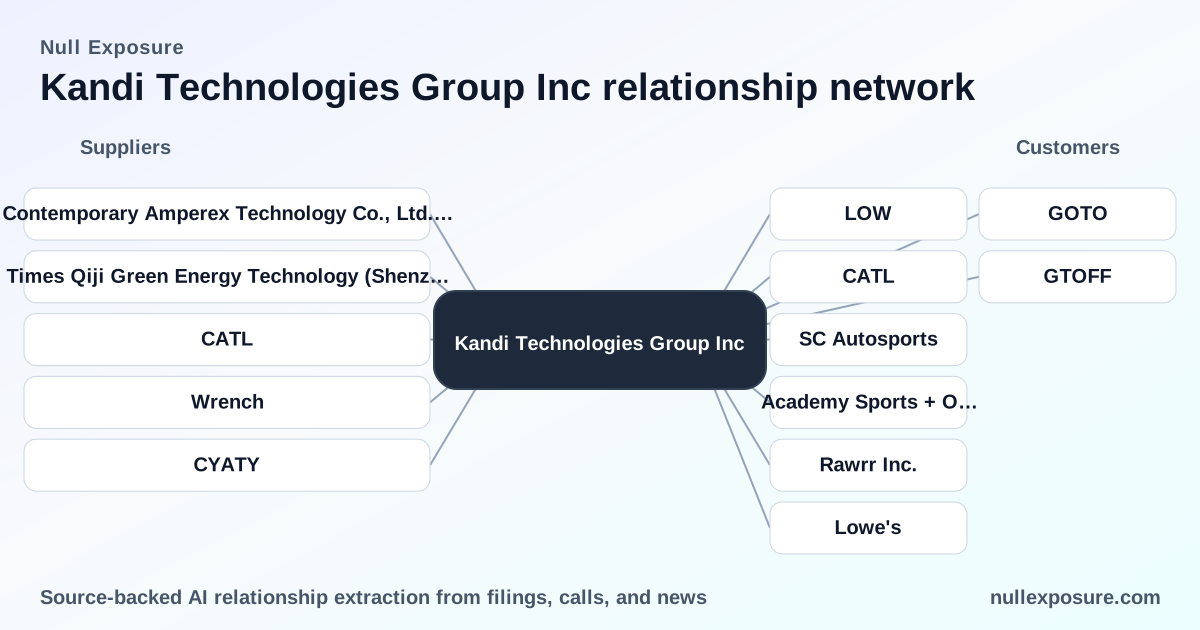
Kandi Technologies (KNDI): Customer relationships that drive distribution, batteries and robotics optionality
Kandi Technologies manufactures and distributes low-speed electric vehicles, off-road motorcycles and related charging and battery-swap infrastructure, monetizing through product sales, licensed retail distribution and growing B2B equipment contracts for battery-swap stations and robotics. Revenue today is retail- and channel-driven (big-box and specialty retailers, local dealers and a U.S. subsidiary) while new strategic supply and robotics contracts create higher‑margin service and equipment revenue potential. For a concise map of Kandi’s customer map and what it implies for investors, read on — or visit https://nullexposure.com/ for deeper coverage.
How to read Kandi’s commercial posture
Kandi is a small-cap Chinese manufacturing business with clear signs of distribution concentration and product diversification into adjacent hardware and services.
- Contracting posture: Kandi sells through exclusive distributors and large retail partners, indicating a channel-first go-to-market that trades margin for volume and reach. This structure supports rapid North American rollout but ties Kandi to retailer terms and execution.
- Concentration and criticality: Key retail partners and a dedicated U.S. distributor create dependency on a handful of outlets for consumer sales, while the battery-swap and robotics contracts open a separate, more capital‑intensive revenue stream that can be strategically critical if scaled.
- Maturity and financial signal: Public filings show negative earnings and modest scale (Revenue TTM ~$104m, negative EPS), implying execution risk despite visible commercial wins; insider ownership is material (~17%) while institutional ownership is low (~1.3%), signaling founder/insider control and limited sell‑side coverage.
Customer and channel relationships — what each connection means
Below are every customer or channel relationship noted in the public record, with plain-English summaries and source references.
SC Autosports / Kandi America
Kandi acquired SC Autosports in 2018 and operates Kandi America through that acquisition as its exclusive U.S. distributor, using the entity to route vehicles into the Texas-based dealer and specialty market. According to MotorTrend reportage (FY2021), SC Autosports became Kandi America to serve as the company’s stateside distribution arm.
Lowe’s (LOW)
Kandi has an active retail partnership with Lowe’s in the U.S., including exclusive product launches such as officially licensed NFL-branded golf carts sold through Lowe’s stores — a channel-oriented strategy to scale consumer awareness and unit sales. This relationship is cited repeatedly in Kandi’s earnings remarks (2024 Q3 and 2025 Q2), where management highlights Lowe’s as a key retail partner.
Academy Sports + Outdoors
Kandi expanded U.S. retail distribution into Academy Sports + Outdoors to broaden its big-box footprint and reach value-oriented consumers across regional markets, as announced in the company press release chain (reported FY2026 via market notices).
Rawrr Inc.
Kandi announced the acquisition of Rawrr Inc. to accelerate entry into North American electric off-road motorcycles, with Rawrr expected to leverage Kandi’s existing retail channels to improve market penetration and lower customer acquisition costs. Quiver Quant coverage (FY2025) reported this strategic acquisition and the planned distribution integration.
CATL / China Battery Exchange (via strategic equipment deals)
Kandi secured orders tied to CATL-related battery-swap equipment, marking a movement from vehicle-only sales toward infrastructure for battery swapping; a GlobeNewswire/market release (August 18, 2025) noted Kandi’s first CATL order for heavy-truck battery-swap station equipment under its “Ten Thousand Station Plan.” Additionally, press coverage (FY2026) described China Battery Exchange acting as a strategic supplier in related deals supporting Qiji Energy’s swap-station rollouts.
Times Qiji Green Energy Technology (Qiji Energy) / China Battery Exchange (supplier role)
Kandi’s public commentary and third-party reports link it into the broader battery-exchange and swap-station ecosystem supporting Qiji Energy, with China Battery Exchange specified as a strategic equipment supplier shaping station layout and manufacturing. Investing.com coverage (FY2026) detailed the supplier role and Kandi’s participation in the swap-station solution chain.
GoTo Group (GoTo / GOTO / GTOFF)
Kandi established a new subsidiary and won its first order to deliver robotic equipment to Indonesia’s GoTo Group, expanding Kandi’s addressable market into logistics and robotics deliverables for large digital ecosystems. MarketScreener and Finviz write-ups (FY2026, with the initial GlobeNewswire release dated September 2025) report Kandi’s new subsidiary and the GoTo order as part of its robotics push.
KH Robotics (and HawkRobo collaboration)
Kandi is positioning itself to lead scalable production and deployment for KH Robotics’ robotic platform while other partners (HawkRobo) supply the AI/controls, effectively combining Kandi’s manufacturing capacity with third-party robotics software and hardware to commercialize autonomous systems. A business press piece on KH Robotics (FY2026) described Kandi’s role as production lead and integrator.
What these relationships collectively tell investors
- Retail distribution is the primary near-term revenue engine. Partnerships with Lowe’s, Academy Sports and the U.S. distributor established via SC Autosports provide immediate retail channels and consumer reach.
- M&A and acquisitions are tactical tools to accelerate market access. The Rawrr purchase demonstrates a playbook of buying brands and folding them into Kandi’s retail network to conserve marketing and distribution costs.
- Infrastructure and equipment contracts change margin dynamics. Contracts tied to CATL and battery-swap station orders shift parts of the business from low-margin unit sales to higher-capital equipment and services, improving revenue mix if execution scales.
- Robotics orders are strategic optionality, not core consumer revenue yet. The GoTo and KH Robotics engagements move Kandi toward industrial hardware and systems integration, creating diversification but demanding new capabilities and capex discipline.
Risks, concentration and operational implications
- Channel dependency: Heavy reliance on a few big retailers and a sole U.S. distributor concentrates execution risk — a retail pullback or distribution disruption would materially affect unit sales.
- Execution and working-capital stress: Current financials show negative profitability and margin pressure, implying Kandi must convert channel wins into profitable volume while managing capex for swap stations and robotics.
- Low institutional ownership and small market cap: With limited institutional oversight and a small market capitalization, Kandi’s equity is more sensitive to newsflow and execution milestones.
Bottom line — what investors should monitor next
Kandi’s commercial strategy is clear: scale consumer EV and off-road sales through established retail channels while building higher‑value revenue lines in battery-swap infrastructure and robotics. Key near-term catalysts: order book growth for CATL/swap‑station equipment, retail rollouts and the commercial ramp of Rawrr in North America, and execution against the GoTo robotics order. Monitor quarterly disclosures for revenue mix shifts from product sales to equipment/services and watch retailer inventory levels and U.S. distribution metrics closely.
For a structured investor brief and ongoing updates on Kandi’s customer relationships and contract flow, visit https://nullexposure.com/.
Bold takeaway: Kandi is a distribution-led EV manufacturer that is actively converting channel reach into higher-margin infrastructure and robotics contracts — execution against those contracts will determine whether the company transitions from a retail play to a diversified industrial hardware vendor.