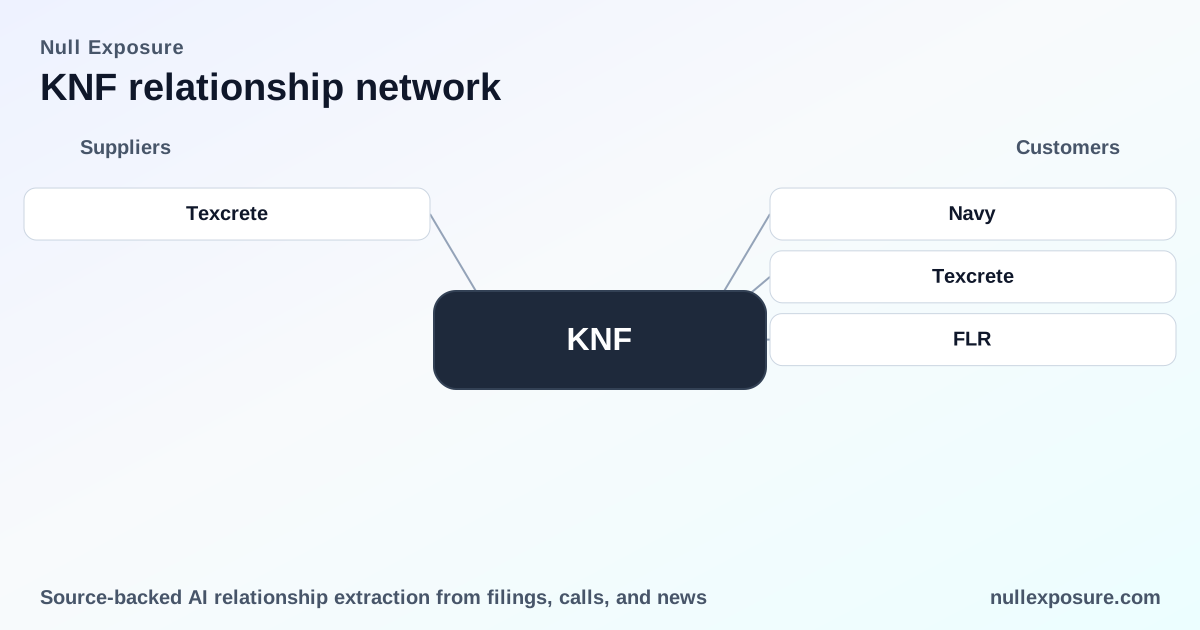
Knife River Corporation (KNF) — Customer Relationships That Drive Construction Materials Demand
Knife River monetizes a distributed network of aggregates, ready‑mix concrete and asphalt operations and contracts its own crews for public‑infrastructure projects. The company generates revenue through material sales (aggregates, ready‑mix, liquid asphalt) and short‑term contracting services, with a heavy tilt toward public‑sector projects and state DOT work, which creates predictable volume corridors but exposes margins to public‑spend cycles. For investors and operators, the key question is how high‑quality, geographically diversified customer wins — from large federal projects to local subcontracting relationships — translate into steadier utilization and backlog conversion. Learn more at https://nullexposure.com/.
Quick investment thesis
Knife River is a vertically integrated aggregates and contracting platform that captures upstream material margin and downstream contracting margin by selling stone, sand & gravel, ready‑mix and asphalt while bidding for and executing publicly funded construction projects. Revenue stability comes from broad geographic coverage and a public‑sector revenue mix; margin variability stems from short‑term contract structures and project timing.
How Knife River’s customer profile frames risk and opportunity
- Contracting posture: Knife River’s contracting services are primarily short‑term by design; the company notes most contracts have original durations less than one year, which supports flexibility but requires continuous bidding and limits long‑duration revenue visibility.
- Counterparty concentration: Public‑sector customers are dominant: Knife River reports roughly 83% of contracting revenues from public customers and an even larger share of backlog tied to public funding, making the business sensitive to state and federal infrastructure cycles and appropriation timing.
- Geographic diversification: Knife River operates across 14 U.S. states with a large operating footprint of aggregate sites, ready‑mix and asphalt plants, which reduces single‑regional exposure but ties performance to multi‑state road and infrastructure programs.
- Customer concentration: No single customer generated more than 10% of 2024 revenue, signaling low single‑counterparty dependency even while overall public‑sector exposure is high.
- Role duality: The company functions both as a seller of materials (internal Energy Services supplies liquid asphalt) and as a service provider (contracting for highways, bridges, local roads), capturing multiple margins along the construction value chain.
These characteristics create a clear operating model: frequent short‑term contracts, high public‑sector revenue share, multi‑state scale, low single‑customer concentration, and integrated materials supply. For investors, that profile implies predictable topline corridors when public projects are funded and executed, balanced against execution and working‑capital risk inherent to short‑duration contracts.
Customer relationships: who’s buying Knife River’s work and materials?
Below are every customer relationship mentioned in public sources collected for KNF, with a short, plain‑English summary and the original source noted.
Navy — large federal infrastructure spend in Hawaii
Knife River began supplying cement and ready‑mix for the Navy’s P209 dry dock infrastructure improvements in Hawaii, a program valued at roughly $3.0 billion where Knife River supplied materials starting in Q4 2025 and expects strong volumes in 2026. According to the company’s Q4 2025 earnings call, the P209 dry dock project is driving material demand into 2026 (KNF Q4 2025 earnings call, March 2026).
Texcrete — regional ready‑mix partnership in Texas
A commercial deal with Texas‑based Texcrete enables Knife River to pull through aggregates from its existing Texas operations into Texcrete’s ready‑mix plants, extending Knife River’s local supply footprint and creating internal demand for aggregates from partner ready‑mix volumes (Pit & Quarry, March 2026).
FLR (Fluor Corp., lead contractor) — subcontracting on a major TxDOT program
Knife River is the asphalt and paving subcontractor to Fluor Corp. on a $671 million Texas Department of Transportation project, where Knife River secured roughly $112 million in aggregate, asphalt and paving services; the contract is positioned as a multi‑year engagement tied to a five‑year program commonly described as the “Big 6.” Coverage in trade press identifies Knife River as a key subcontractor to Fluor on this TxDOT work (Pit & Quarry and ConcreteProducts, FY2025–FY2026 reporting).
Fluor Corp. — lead contractor context for Knife River’s $112M award
Separate mentions in trade coverage reiterate that the $112 million award for aggregate, asphalt and paving services dovetails with Fluor Corp. acting as lead contractor on the five‑year, $671 million program, confirming Knife River’s role as a strategic subcontractor on a major state DOT delivery (ConcreteProducts, January 2026).
What these relationships imply for revenue cadence and backlog conversion
- High‑value public projects (Navy, TxDOT via Fluor) bring lumpier but material volume spikes that can drive utilization across Knife River’s aggregate, ready‑mix and asphalt assets. The Navy P209 win contributes federal demand visible into 2026, while the TxDOT engagement with Fluor provides multi‑year subcontract work in Texas.
- Regional commercial partnerships (Texcrete) create recurring pull‑through demand for aggregates and ready‑mix supply, increasing local utilization without the need to win new DOT contracts.
- Together, these relationships illustrate Knife River’s blended go‑to‑market: winning discrete public infrastructure awards while monetizing incremental materials demand through relationships with regional producers.
Operational constraints that investors must price in
- Short contract durations require an active bidding pipeline and raise working‑capital and utilization timing risk; Knife River discloses most contracting services start as sub‑one‑year engagements.
- Public‑sector concentration (approximately 83% of contracting revenues) delivers demand predictability when appropriations are strong but creates cyclicality tied to government budgets and project timing; Knife River’s backlog disclosures showed most backlog relates to publicly funded projects, with a large portion expected to be completed within the next fiscal year.
- Geographic scale across 14 states mitigates localized downturns but keeps the company exposed to multi‑state DOT cycles and regional construction activity swings.
- No single customer exceeds 10% of revenue, which reduces counterparty concentration risk but does not eliminate systemic exposure to government funding dynamics.
Bottom line for investors and operators
Knife River’s commercial relationships combine federal infrastructure work and regional supply agreements to create a diversified demand base for its materials and contracting capabilities. The Navy and TxDOT‑related Fluor awards provide headline wins that should lift volumes in 2026, while arrangements like Texcrete’s extend Knife River’s local pull‑through for aggregates. Investors should value Knife River for its integrated margin capture and geographic scale, but underwrite short‑term contract turnover and public‑spend cyclicality into forecasts.
For further analysis and ongoing tracking of KNF’s customer relationships and contract flow, visit our homepage: https://nullexposure.com/.