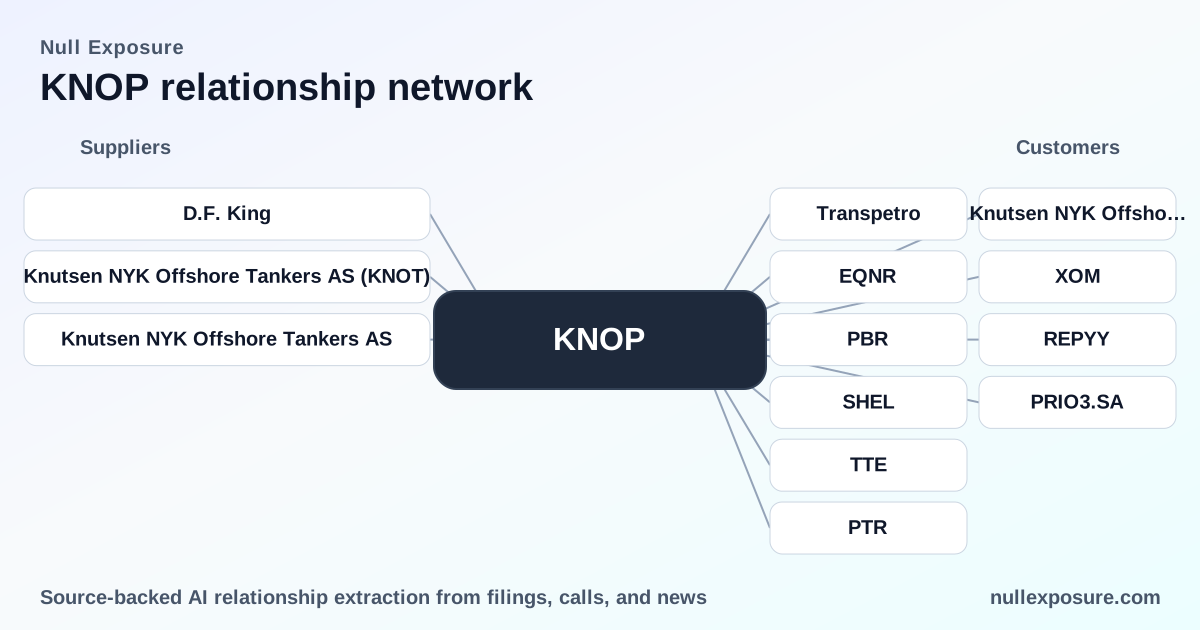
KNOP: Customer relationships that underpin cash yield and charter stability
KNOT Offshore Partners LP (KNOP) owns and operates shuttle and tanker vessels that it monetizes primarily through long‑term time charters with large integrated and national oil companies in the North Sea and Brazil, supplemented by targeted vessel swaps and asset sales that crystallize value and adjust fleet composition. For investors, the commercial profile is straightforward: durable charter cashflows with embedded extension options and periodic asset transactions that support distributions and deleveraging. For a closer look at the commercial data and filings, visit https://nullexposure.com/.
Why the customer map matters for valuation and risk
KNOP’s economics are rooted in charter duration and counterparty quality rather than spot exposure. The company’s stated model—operating vessels under long-term charters in the North Sea and Brazil—creates a contracting posture dominated by fixed or fixed‑plus‑options agreements with major oil companies, producing predictable revenue streams. Financials show material cash generation (Revenue TTM ~$364m; EBITDA ~$201m) that supports modest distributions (Dividend yield ~1.76%) and provides flexibility for asset swaps and selective acquisitions.
Key business signals for analysts and operators:
- Contracting posture: long fixed periods with multiple extension options increase revenue visibility and lower short‑term cyclicality.
- Concentration: geographic concentration in Brazil and the North Sea focuses exposure where shuttle tanker demand and long‑term oil logistics remain critical.
- Counterparty quality and criticality: counterparties are large national and international oil companies, whose need for shuttle transport gives contracts strategic importance.
- Maturity and optionality: multi‑year contractual terms and option windows (extensions) act as built‑in tailwinds for utilization and cashflow stability.
For deeper coverage of KNOP’s counterparties and transcripts, see https://nullexposure.com/.
Counterparties and contracts — the ledger investors should watch
Below is a concise, plain‑English ledger of every counterparty referenced in KNOP public materials and press coverage. Each entry is short, focused, and tied to the underlying source.
Shell (SHEL)
KNOP reported obtaining an extension with Shell for the Hilda Knutsen of up to one year, reinforcing continuity of cashflow on that vessel (KNOP Q3 2025 earnings call, March 2026; MarketBeat coverage, FY2025).
Equinor (EQNR)
KNOP secured an extension with Equinor for the Bodil Knutsen, contracted through March 2029 with two additional one‑year options—an example of long‑dated, optionality‑rich chartering (KNOP Q3 2025 earnings call, September extension; MarketBeat and InsiderMonkey summaries, FY2025).
Petrobras (PBR)
KNOP management included commentary referencing Petrobras’s five‑year planning and relevant highlights for 2026–2030, indicating Petrobras’s strategic plans informed KNOP’s operating context in Brazil (KNOP Q3 2025 earnings call; referenced in Q3 2025 materials).
TotalEnergies (TTE / TotalEnergies)
A recent vessel swap transaction involved the Tuva Knutsen, which operates in Brazil under a charter to TotalEnergies with a fixed period expiring February 2026 and the charterer holding options for up to 10 additional years, preserving long‑range optionality for KNOP’s Brazil fleet (ShippingTelegraph and Chemanalyst reporting on the swap, FY2024/FY2025).
PetroChina (PTR)
KNOP disclosed that the Daqing Knutsen is on time charter with PetroChina in Brazil through July 2027, with charterer options that extend the economic term, anchoring a portion of the Brazil revenue base (KNOP Q2 2025 earnings call; ShippingTelegraph coverage, FY2025).
Knutsen NYK Offshore Tankers AS (KNOT)
KNOP’s subsidiary executed a simultaneous purchase/sale with KNOT involving Tuva Knutsen and Dan Cisne, a transaction structured via sale of the owning entities and producing a modest net cash transfer between the parties—an operational example of fleet optimization through related‑party swaps (Chemanalyst and ShippingTelegraph reports, FY2024).
Repsol Sinopec (REPYY)
Repsol Sinopec exercised an option to extend the Raquel Knutsen through June 2028, demonstrating the prevalence of exercisable renewal clauses that push revenue visibility into later years (KNOP Q2 2025 earnings call, FY2025).
Petrorio (PRIO3.SA)
KNOP management noted they extended redelivery timing from Petrorio to minimize downtime between charters, a commercial adjustment that preserves utilization and reduces idle days (KNOP Q2 2025 earnings call, FY2025).
ExxonMobil (XOM)
The Windsor Knutsen commenced operations with ExxonMobil on June 4 following scheduled drydocking, signaling activation of a charter following maintenance downtime and the resumption of contract revenue (KNOP Q2 2025 earnings call, FY2025).
Transpetro
KNOP addressed Transpetro in Q&A, asking for an appreciation of the potential rate change versus the current time charter when a vessel moves over to KNOP, indicating active commercial negotiation and rate resetting as charters transition between owners/operators (KNOP Q3 2025 earnings call and related MarketBeat/InsiderMonkey coverage, FY2025).
What this customer map implies for investors
- Predictable cashflow: The prevalence of fixed terms with large, creditworthy counterparties produces a high degree of revenue visibility. Extensions and options—explicit in several contracts—translate into embedded upside without incremental capital commitment.
- Idiosyncratic but manageable concentration: Brazil and the North Sea dominate routes; this concentrates risk but also positions KNOP where shuttle tankers are commercially essential, strengthening bargaining leverage with charterers.
- Active balance‑sheet management: The Tuva/Dan swap demonstrates that KNOP leverages asset transactions to optimize fleet composition and cash, which supports distributions and strategic flexibility.
- Operational cadence matters: Drydock scheduling, redelivery timing, and option exercises materially affect utilization quarter‑to‑quarter; investors should track earnings call disclosures for near‑term vessel availability.
Final takeaway
KNOP’s customer relationships are the core asset: long‑dated charters with major oil companies and routine asset optimisation translate into stable charter cashflows and predictable distribution capacity. The commercial playbook is execution‑driven—monitor earnings calls and the press coverage listed above for contract extensions, drydock timing, and swaps that directly alter cashflow timing and credit profile.
For continuous tracking of KNOP counterparties, transcripts, and press updates, visit https://nullexposure.com/.